



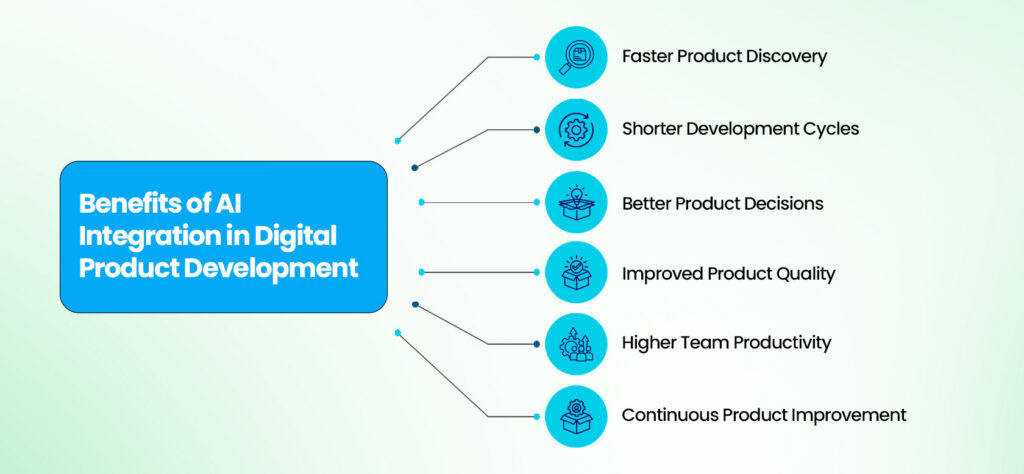
- AI speeds up digital product development by reducing repetitive work across discovery, development, and post-launch improvement.
- Product discovery becomes faster when AI helps identify patterns in customer feedback and research.
- AI can help developers code and test, but experienced teams must review the results.
- Product teams can detect early signs of user churn and identify features that need improvement.
- Not every product needs AI at its core. Adding it to existing workflows may deliver better value.
- AI implementation costs depend on the complexity of the features and how they connect with existing systems.
- Start with one high-impact use case instead of automating every workflow at once.
- Measure AI success through faster releases and better product outcomes, not the amount of work automated.
- Human judgment remains essential for product strategy and decisions that affect long-term growth.
Businesses investing in digital product development face constant pressure to deliver faster without sacrificing quality.
Adding more developers or extending working hours rarely fixes delayed launches, shifting requirements, or slow decision-making. Artificial intelligence offers a different approach.
Instead of replacing product teams, AI helps them process information, automate repetitive work, and move from idea to execution with more confidence.
The biggest advantage comes from improving decisions across the product lifecycle, not from generating code alone.
This guide covers three practical ways AI accelerates digital product development, where it creates measurable value, and how to balance automation with human expertise.
Why AI Has Changed Digital Product Development
The digital product development lifecycle no longer ends at launch. Teams continuously research customer needs, ship features, monitor performance, and refine the experience based on real-world feedback.
As products grow, so does the volume of information teams manage: customer interviews, analytics dashboards, support tickets, reviews, and engineering documentation all compete for attention.
AI automation services help teams process this information faster so product managers, designers, and developers can focus on solving customer problems instead of organizing data.
Where Traditional Development Slows Down
Delays between development stages are among the common reasons digital products fail, often creating more problems than coding itself.
| Product Stage | Common Bottleneck | How AI Helps |
| Discovery | Reviewing research | Summarizes and groups insights |
| Planning | Feature prioritization | Highlights recurring opportunities |
| UX Design | Repetitive iterations | Generates initial concepts |
| Development | Boilerplate coding | Assists with repetitive code |
| Testing | Regression testing | Generates test cases |
| Post-Launch | Reviewing feedback | Detects trends automatically |
Most bottlenecks involve analyzing information rather than building software, which is exactly where AI performs best.
What AI Improves and What It Doesn’t
AI handles repetitive, data-intensive tasks efficiently, while people continue making strategic decisions.
AI works well for: organizing customer feedback, summarizing research, drafting documentation, generating repetitive code, creating test cases, identifying product trends, and classifying support tickets.
Human expertise remains essential for: product strategy, customer validation, business priorities, system architecture, security decisions, and final product approvals.
The strongest teams combine both. AI accelerates execution while experienced professionals determine direction.
Validate Your Product Strategy Before You Add AI
Many organizations ask, which AI tool should we use? A better question is, which product challenge are we trying to solve? AI delivers the greatest return when it addresses a clearly defined bottleneck. This makes product strategy consulting important before committing to another technology investment.
Start With Your Biggest Bottleneck
Not every workflow benefits equally. Some activities require creativity and business judgment, while others follow predictable patterns that AI can support.
| Workflow | Business Value | AI Potential | Priority |
| Customer feedback analysis | High | High | High |
| Product documentation | Medium | High | High |
| Regression testing | High | High | High |
| Sprint planning | Medium | Moderate | Medium |
| Product strategy | Very High | Low | Human-led |
| System architecture | Very High | Low | Human-led |
Repetitive work sits at the top of this list. Strategic decisions stay people-driven because they require business context and long-term thinking.
Focus on Outcomes
Instead of adopting AI because competitors do, define the business outcome you want to improve first.
| Business Goal | Where AI Can Help |
| Reduce discovery time | Analyze research and feedback faster |
| Increase release frequency | Support development and testing workflows |
| Improve product quality | Detect issues earlier during QA |
| Reduce support workload | Classify and summarize customer requests |
| Improve roadmap decisions | Identify recurring customer problems |
Before investing, assess whether your business is ready for AI by examining repetitive tasks, available data, manual delays, and opportunities to improve outcomes through automation.
If most answers are yes, AI likely delivers value. If the work depends primarily on relationships or judgment, keep it human-led.
3 Ways to Accelerate Digital Product Development with AI
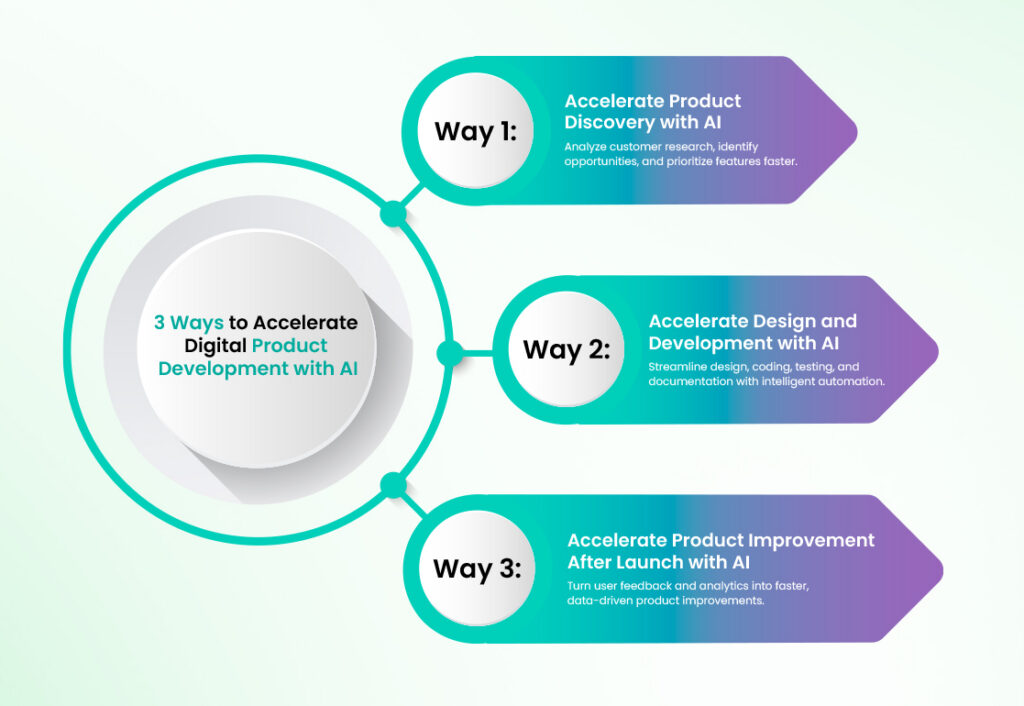
Way 1: Accelerate Product Discovery with AI
Product discovery determines whether your team builds something customers actually need. A structured discovery sprint helps prevent unnecessary features and delayed releases.
Discovery draws on several sources at once:
- Customer interviews
- Survey responses
- Product analytics
- Support tickets
- Sales feedback
- Competitor research
- Market trends
| Discovery Activity | Traditional Process | AI-Assisted Process |
| Customer interviews | Manual note review | Automatic summaries and themes |
| Survey analysis | Spreadsheet sorting | Pattern detection |
| Support tickets | Manual tagging | Intent classification |
| Product reviews | Individual reading | Sentiment and topic clustering |
| Competitor research | Manual comparison | Opportunity extraction |
Where AI Creates the Most Value in Discovery
AI creates the most value when research generates more information than a team can reasonably analyze in a short timeframe. It can:
- Group similar customer pain points
- Identify recurring feature requests
- Summarize interview transcripts
- Compare competitor capabilities
- Draft personas and journey maps
- Highlight emerging trends
Best practice: Treat AI-generated insights as hypotheses. The same principle applies when validating your mobile app idea through customer conversations and business analysis.
How AI Fits Into the Discovery Workflow
| Step | Activity | AI Contribution |
| 1 | Collect research | Consolidate multiple data sources |
| 2 | Analyze feedback | Group recurring themes |
| 3 | Identify opportunities | Highlight customer problems |
| 4 | Validate findings | Human-led interviews and workshops |
| 5 | Prioritize features | Support opportunity scoring |
| 6 | Define MVP | Provide documentation and summaries |
When This Approach Delivers the Greatest Value
AI-assisted discovery pays off most when your team:
- Reviews hundreds of customer responses monthly
- Manages multiple products at once
- Handles large support ticket volumes
- Plans several releases a year
- Builds for SaaS, enterprise, marketplace, healthcare, or fintech products with continuous feedback
Where Human Expertise Still Leads
AI recognizes patterns in existing information, but it cannot weigh business priorities or competitive positioning. Even during AI MVP development planning, experienced product leaders must make those decisions.
| Decision | AI Role | Human Role |
| Product vision | Research support | Define direction |
| Customer validation | Organize insights | Conduct interviews |
| Feature prioritization | Suggest patterns | Make final decisions |
| Business strategy | Provide analysis | Evaluate commercial value |
| MVP scope | Estimate opportunities | Balance value and effort |
Measuring Success
| KPI | Why It Matters |
| Research synthesis time | Shows how fast raw feedback becomes usable insight |
| Time to roadmap decision | Measures how quickly insights turn into prioritized features |
| Feedback volume processed | Reflects how much research the team can realistically cover |
| Stakeholder alignment cycles | Indicates how much rework validation requires |
Key takeaway: AI helps teams identify what customers need faster and can inform MVP development, but experienced leaders still decide whether those insights fit business goals.
Stop Losing Development Time on the Wrong Features
Turn scattered customer feedback into clear product priorities. Our experts help validate your ideas before expensive development work begins.
Validate My Product Idea!Way 2: Accelerate Design and Development with AI
Once discovery defines the right problem, execution takes over. Interactive prototyping helps teams validate design decisions before committing more time to engineering and QA. AI reduces repetitive work across:
- UX wireframing and iteration
- Interface copywriting
- Boilerplate coding
- Technical documentation
- Code review cycles
- Unit and regression testing
| Development Activity | Typical Challenge | How AI Helps |
| UX wireframing | Creating initial layouts | Generates early design concepts |
| UI content | Writing repetitive copy | Drafts interface content |
| Coding | Repetitive implementation | Generates boilerplate code |
| Documentation | Maintaining technical docs | Creates and updates documentation |
| Code reviews | Identifying common issues | Suggests improvements pre-review |
| Testing | Building repetitive test cases | Generates unit and regression tests |
Where AI Creates the Most Value in Design and Development
AI shortens repetitive work across the entire build cycle, from UI/UX design to engineering and testing, rather than improving just one discipline.
It can:
- Draft wireframes and screen variations
- Suggest UX writing and accessibility fixes
- Generate boilerplate code
- Refactor repetitive functions
- Write API documentation and SQL queries
- Generate unit and regression tests
Best practice: Review every AI-generated component against engineering standards and check for common UI UX design mistakes before approving it for release.
How AI Fits Into the Development Workflow
| Step | Activity | AI Contribution |
| 1 | Define requirements | Clarify scope from discovery inputs |
| 2 | Draft initial version | Generate wireframes, copy, or boilerplate code |
| 3 | Review against standards | Flag inconsistencies and common issues |
| 4 | Add business logic | Human-led refinement and judgment |
| 5 | Test | Generate unit and regression tests |
| 6 | Ship | Deploy through the existing review and CI/CD pipeline |
When This Approach Delivers the Greatest Value
AI-assisted development pays off most for:
- Enterprise platforms and SaaS products
- Marketplaces and multi-platform applications
- Healthcare and financial software
- Products with frequent releases
Smaller MVPs with limited functionality see smaller gains, since developers spend less time on repetitive work in the first place.
Where Human Expertise Still Leads
Technical decisions with long-term business impact still require experienced professionals. Human oversight helps prevent common mobile app development mistakes that AI-generated recommendations may overlook.
| Decision | AI Role | Human Role |
| System architecture | Suggest patterns | Design the system |
| Security | Flag common issues | Own risk decisions |
| Infrastructure | Support documentation | Plan capacity and scaling |
| Compliance | Assist with checklists | Ensure regulatory accuracy |
| Production approval | Provide test results | Sign off on release |
Measuring Success
| KPI | Why It Matters |
| Development cycle time | Measures delivery speed |
| Sprint completion rate | Tracks planning accuracy |
| Code review time | Evaluates engineering efficiency |
| Test coverage | Indicates software quality |
| Bug resolution time | Measures maintenance efficiency |
Key takeaway: AI can shorten the app development timeline by removing repetitive work without reducing engineering oversight.
Designers still shape experiences, and technical leaders make architectural calls.
Build Your Digital Product Faster Without Compromising Quality
Our development team combines AI-assisted workflows with experienced engineering to reduce delivery delays and bring your product to market faster.
Discuss My Development Project!Way 3: Accelerate Product Improvement After Launch with AI
Launch marks the start of continuous improvement, not the end of development. Structured post-launch analytics iteration helps teams act on feedback accumulating across multiple channels:
- Product analytics
- Customer support tickets
- Feature requests
- App store reviews
- Customer surveys
- Session recordings
- Sales feedback and churn reports
| Post-Launch Activity | Traditional Process | AI-Assisted Process |
| Customer feedback | Manual review | Theme clustering |
| Product analytics | Dashboard analysis | Trend detection |
| Support tickets | Manual categorization | Intent classification |
| Feature requests | Spreadsheet tracking | Opportunity grouping |
| Churn analysis | Individual investigation | Behavior pattern recognition |
| Roadmap planning | Quarterly reviews | Continuous insight generation |
Where AI Creates the Most Value in Post-Launch Improvement
AI connects user actions to meaningful patterns that dashboards alone rarely explain, helping teams identify opportunities for mobile app performance optimization.
It can:
- Flag features with low adoption
- Detect unexpected drop-off points
- Surface early churn signals
- Categorize and prioritize support tickets
- Draft suggested responses
- Highlight high-retention segments worth doubling down on
Best practice: Validate AI-surfaced trends against real usage data before committing engineering time to fixes or product rescue scaling initiatives.
How AI Fits Into the Post-Launch Workflow
| Step | Activity | AI Contribution |
| 1 | Collect feedback and analytics | Consolidate data across sources |
| 2 | Identify patterns | Detect recurring problems and usage trends |
| 3 | Validate findings | Human-led review with product and CS teams |
| 4 | Prioritize improvements | Support scoring by value and effort |
| 5 | Ship updates | Support release documentation |
| 6 | Measure results | Track outcomes before the next cycle |
When This Approach Delivers the Greatest Value
This approach delivers the strongest returns for:
- Subscription platforms and enterprise software
- SaaS products and marketplaces
- Fintech and healthcare applications
- Products with frequent releases
Smaller products with limited activity can often stick with manual reviews until data volume grows. This also helps control mobile app maintenance costs during early adoption.
Where Human Expertise Still Leads
AI recognizes patterns in historical data, but it cannot fully account for shifting market conditions or customer relationships the way product leaders can.
| Decision | AI Role | Human Role |
| Product vision | Surface behavior data | Define direction |
| Market positioning | Analyze competitor signals | Set strategy |
| Pricing strategy | Analyze usage patterns | Set pricing decisions |
| Investment decisions | Provide data support | Allocate resources |
| Customer relationships | Summarize interactions | Manage the relationship |
Measuring Success
| KPI | Why It Matters |
| Feature adoption rate | Measures product value |
| Customer retention | Indicates long-term engagement |
| Support response time | Evaluates operational efficiency |
| Time to prioritize features | Measures decision speed |
| CSAT / NPS | Reflects user experience and loyalty |
Key takeaway: AI helps teams spot what’s working and what isn’t faster, but product leaders still decide which signals are worth acting on and how they fit the broader strategy.
AI-Enabled vs. AI-Native Products
Not every product needs AI at its core. For most organizations, adding AI to selected workflows creates more value than rebuilding the product around it. However, AI app development services become relevant when AI must support the core product experience.
| AI-Enabled Product | AI-Native Product |
| AI enhances existing features | AI powers the core experience |
| Traditional software architecture | Architecture built around AI models |
| Lower complexity and cost | Higher technical complexity and cost |
| Faster to implement | Longer development timeline |
| Fits existing products | Often built as new products |
DPS Airem is an example of an AI-enabled digital product. Instead of building the entire platform around AI, it integrates AI into selected workflows to improve efficiency, organize information, and support faster decision-making.
This approach allows organizations to introduce AI where it delivers measurable value. The decision between an AI MVP and full product then depends on whether more complex AI-native capabilities are justified.
What Does It Cost to Add AI to a Digital Product?
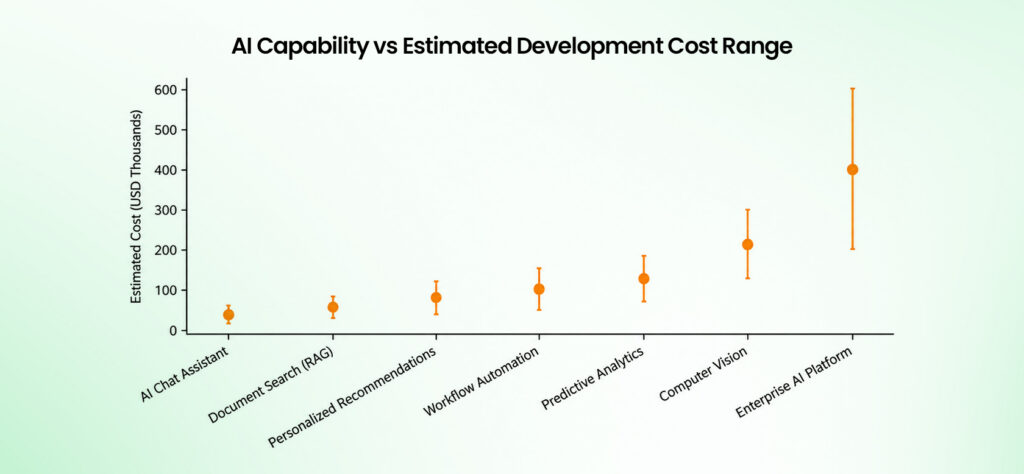
Implementation cost depends on the capability, data requirements, and integration complexity, particularly when custom software development is needed to support specialized AI workflows.
The ranges below reflect typical 2027 development budgets for custom digital products. More complex requirements can significantly increase AI-native digital product development costs.
| AI Capability | Typical Timeline | Estimated Cost (USD) |
| AI Chat Assistant | 4–8 weeks | $20,000–$60,000 |
| Document Search (RAG) | 6–10 weeks | $30,000–$80,000 |
| Personalized Recommendations | 8–14 weeks | $40,000–$120,000 |
| Workflow Automation | 8–16 weeks | $50,000–$150,000 |
| Predictive Analytics | 10–18 weeks | $70,000–$180,000 |
| Computer Vision | 3–6 months | $120,000–$300,000+ |
| Enterprise AI Platform | 6–12 months | $200,000–$600,000+ |
These estimates typically cover discovery, UX design, engineering, testing, and deployment. However, the overall digital product development cost also depends on product complexity and the resources needed for implementation.
Ongoing costs such as cloud infrastructure, model usage, monitoring, and maintenance should factor into long-term planning.
6 Mistakes That Slow AI Product Development
Organizations rarely struggle because AI lacks capability. Instead, common mistakes when building AI apps create unnecessary delays, increase costs, and reduce the impact of AI investments.
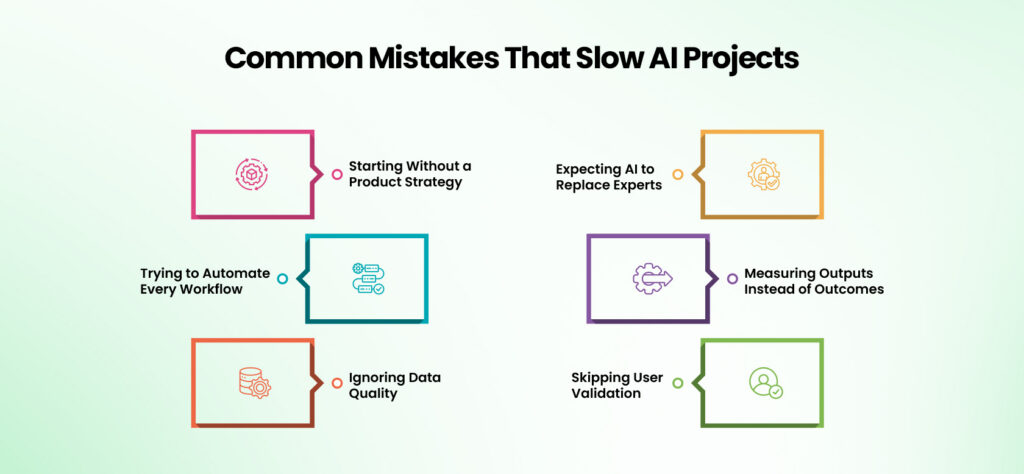
Recognizing these challenges early helps teams introduce AI more effectively and achieve measurable business outcomes.
1. Starting Without a Product Strategy
Many organizations adopt AI because competitors are doing the same. Instead, define the business objective first and identify the specific problem AI should solve.
A clear strategy keeps implementation focused on measurable outcomes rather than technology alone.
2. Trying to Automate Every Workflow
Introducing AI across every department at once increases complexity and slows adoption. Even AI agent development should begin with a defined workflow before expanding into more complex tasks.
Start with one high-impact use case, measure the results, and expand gradually once the team establishes a successful implementation process.
3. Ignoring Data Quality
AI depends on reliable data to produce useful results.
Before implementation, clean, organize, and validate your data to reduce inaccuracies and improve the quality of AI-generated insights.
4. Expecting AI to Replace Experts
AI can analyze information and automate repetitive work, but it cannot replace business judgment, customer understanding, or technical leadership.
Keep strategic decisions, product direction, and architectural planning under the guidance of experienced teams.
5. Measuring Outputs Instead of Outcomes
Generating reports or automating tasks does not guarantee business value.
Measure success using business KPIs such as development cycle time, customer satisfaction, feature adoption, or operational efficiency to understand whether AI delivers meaningful improvements.
6. Skipping User Validation
AI-generated recommendations should always be tested with real users before wider adoption.
User validation helps confirm that new features solve actual customer problems and support long-term product success.
Introducing AI gradually creates a stronger foundation than attempting a large-scale transformation in a single release.
A phased approach reduces implementation risk and helps teams avoid hidden custom software development costs before expanding AI across the product lifecycle.
How to Introduce AI Into an Existing Product
Most organizations don’t need to rebuild their product to benefit from AI. Existing products, including those built through mobile app development, can introduce AI into selected features without replacing the entire system.
A structured rollout reduces risk and lets teams measure value before expanding investment.
- Identify the bottleneck. Find where teams lose time, or customers hit friction.
- Select one high-impact use case, such as support, discovery, or testing.
- Validate your data. Review quality, governance, and accessibility before integration.
- Build a pilot through focused AI MVP development. Launch with a limited user group and monitor KPIs before expanding.
- Measure business impact on efficiency, satisfaction, cost, or delivery speed.
- Scale gradually, expanding only after the pilot shows measurable value.
Accelerate Every Stage of the Product Lifecycle with AI
AI offers a practical way to accelerate digital product development, but the greatest value comes from applying it with purpose.
Organizations that focus on discovery, development workflows, and post-launch improvement tend to deliver faster without compromising quality or strategic direction.
Rather than adopting AI across every workflow, identify where your team loses the most time, define measurable outcomes, and introduce AI incrementally.
Paired with experienced product leadership and strong engineering practices, AI becomes a capability that strengthens every stage of the product lifecycle instead of just adding another layer of technology.
Turn AI Into a Competitive Product Advantage
Partner with our digital product experts to identify high-impact AI opportunities, validate your product strategy, and build AI-powered solutions that accelerate development while delivering measurable business value.
Accelerate My Product Development!Frequently Asked Questions
AI reduces time spent on repetitive, data-intensive tasks such as research analysis, coding, test generation, and trend detection, freeing teams to focus on strategy and customer validation.
No. AI improves efficiency but cannot replace strategic thinking, customer empathy, or business decision-making. People still define the roadmap, design the experience, and ensure software quality.
It depends on the team’s biggest bottleneck. Teams with lengthy research cycles gain the most during discovery, teams with large codebases benefit most during development and testing, and mature products with large user bases see the strongest results from post-launch analytics.
Not always. Early-stage startups should validate product-market fit first. AI can still help by speeding up research, documentation, and development without significantly raising costs.
Costs range from roughly $20,000 for a simple AI chat assistant to $600,000 or more for an enterprise AI platform, depending on complexity and integration scope. Ongoing cloud, model usage, and maintenance costs should also be budgeted.
Focus on business outcomes rather than the number of AI features shipped. Useful metrics include discovery time, release frequency, development cycle time, retention, feature adoption, support response time, CSAT, and NPS.
















“The biggest misconception about AI is that it makes products successful on its own. In reality, AI only accelerates the decisions your team is already making. If your product strategy is clear and your customer problem is well-defined, AI can significantly reduce the time between an idea and a valuable release. Without that foundation, it simply helps you move in the wrong direction faster.”
— Hannan Shahnoor, CEO, Inceptives Digital