

- More than 80% of AI projects fail by some estimates, often because teams start without a clearly defined problem.
- AI should offer a meaningful improvement over existing software or business processes.
- User trust matters as much as technical performance, especially when AI influences important decisions.
- Success should be measured through actual business results rather than model performance alone.
- Incomplete or outdated data can undermine an otherwise promising AI project.
- Buying or integrating existing AI tools may be more practical than building a custom solution.
- An AI MVP should test one complete workflow with a measurable outcome.
- A working AI demo does not prove that users will adopt the finished product.
- AI projects need safeguards for incorrect results and a realistic budget for growing usage.
- Someone must own the product after launch to keep its performance reliable.
A successful AI project rarely starts with choosing a model or comparing tools. It starts by asking whether AI is the right solution in the first place.
That question is often overlooked. According to a RAND research report, by some estimates, more than 80% of AI projects fail, often because teams misunderstand the problem they’re trying to solve, lack the right data, or prioritize technology over business value. In other words, many AI initiatives are set up to fail before development even begins.
Whether you’re building an AI-powered product, automating internal workflows, or evaluating your first AI investment, asking the right questions upfront can save months of development time, unnecessary costs, and expensive course corrections. The goal isn’t simply to launch an AI solution. It’s to build one that delivers measurable value.
In this guide, we’ll walk through the key questions every founder, product manager, and business leader should answer before starting an AI project. If you’re evaluating ideas with an AI development company or planning an in-house initiative, these questions will help you determine whether your project is ready to move from concept to execution.
1. What Problem Are You Actually Trying to Solve?
Building AI just because it is becoming a priority across industries is a common mistake. The strongest AI products do not begin with a technology decision. They begin with a problem worth solving, often clarified through product strategy consulting.
Before evaluating models, tools, or development approaches, define what outcome you want AI to improve. Is it reducing repetitive work? Helping users make better decisions? Improving an inefficient workflow? Creating a capability that was previously difficult to achieve?
Start by answering:
- What specific problem are we solving?
- Who experiences this problem most often?
- What is the cost of not solving it?
- How is the problem handled today?
- What measurable improvement should AI create?
If these questions are difficult to answer, the challenge may not be AI development. It may be a problem definition.
For example, a company might decide it needs an AI customer support assistant. After examining the workflow, it was discovered that customers are primarily frustrated by slow response times due to poor knowledge management. Improving documentation or automating FAQs may solve the issue without building a complex AI solution.
As our guide to common reasons digital products fail explains, the strongest AI products don’t begin with a model. They begin with a clearly defined problem that AI can solve better than existing approaches.
2. Does This Problem Actually Require AI?
Not every problem needs an AI solution. Businesses should first understand the difference between custom software and digital product development before deciding which approach fits their needs.
One of the biggest mistakes teams make is using AI as the starting point instead of evaluating whether it is the best tool for the job. Some challenges can be solved more effectively with custom software development, workflow improvements, or simple automation.
The right question is not:
“How can we add AI?”
It is:
“Would AI create a meaningful improvement over the way this works today?”
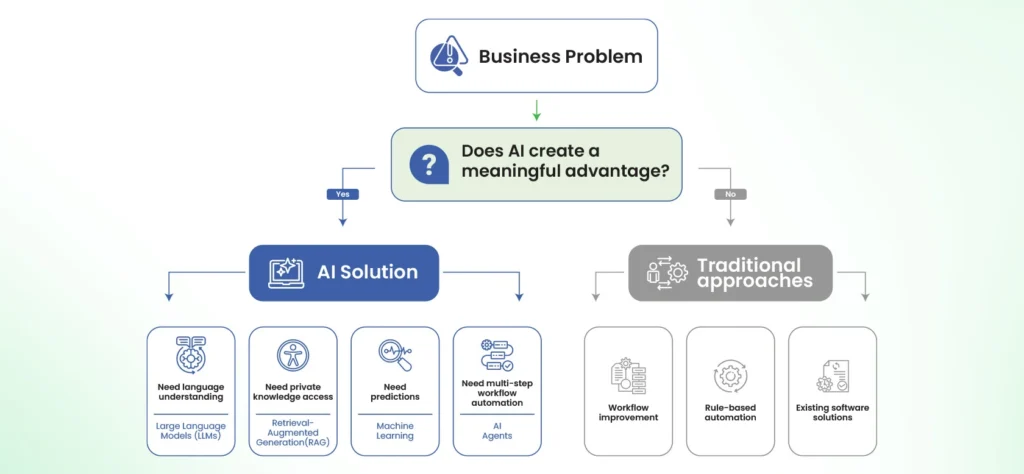
Consider AI when the problem involves areas where traditional systems struggle, such as:
| Problem Type | Suitable Approach |
| Understanding language, documents, or conversations | Generative AI / NLP |
| Finding patterns in large datasets | Machine Learning |
| Automating decisions across multiple steps through AI agent development | AI Agents |
| Answering questions using private business information | RAG systems |
| Repetitive rule-based tasks | Traditional automation or RPA |
For example, an FAQ page may solve simple customer questions, but an AI assistant can help when users need personalized answers across complex information.
Before investing in AI development, make sure the technology is solving a real limitation rather than being added simply because it is available. The best AI projects use artificial intelligence where it creates a clear advantage.
CTO Insight:
“AI does not create value just because it is inside the product. It creates value when it improves a specific user workflow. Before we think about models, we look at the user, the data, the decision being supported, and what needs to be proven first.”
— Atif Zaidy, CTO, Inceptives Digital
Validate the Opportunity Before You Build the Solution
Once the problem is clear, the next step is validating whether AI is the right investment. A strong AI idea needs more than technical feasibility. It needs real users, clear value, and a measurable outcome, as outlined in our guide to validating your mobile app idea.
3. Who Will Use the AI Product, and Will They Trust It?
A technically capable AI system can still fail if users do not trust it or see enough value in using it.
Before development begins, understand who the users are, what role AI will play in their workflow, including considerations for UI/UX design, and how much confidence they need in its outputs.
Consider:
- Who is the primary user?
- What tasks will they rely on AI for?
- How much human oversight is required?
- What happens when AI produces an incorrect output?
Trust depends on more than accuracy. Users need to understand when AI can help, a concern also explored in common UI UX design mistakes, when human judgment is required, and how the system handles uncertainty.
For example, an AI tool that drafts sales emails may only need quick user approval. However, an AI system supporting medical decisions requires stronger validation and human oversight before recommendations are acted on.
The best AI products are not designed to replace users. They are designed to help users complete important tasks with more speed, accuracy, or confidence.
4. What Does Success Look Like?
An AI project needs a clear definition of success before development starts. Without measurable goals, teams often focus on whether the model works instead of whether the product creates real value.
Define what improvement AI should deliver:
| Goal | Possible Success Metric |
| Reduce manual effort | Hours saved |
| Lower operational costs | Cost reduction |
| Improve decision-making | Faster or more accurate decisions |
| Increase adoption | User engagement or retention |
| Reduce errors | Lower error rates |
For example, an AI customer support assistant should not only be evaluated by response quality. The bigger question is whether it reduces support workload while maintaining customer satisfaction. Our AI application profitability guide explores the broader commercial question.
Clear success metrics, supported by discovery sprint planning, help teams build AI solutions that solve business problems instead of simply demonstrating technical capability.
Evaluate Whether Your Business Is Ready
Even with a validated idea, an AI project can face challenges if the underlying foundation is not ready. Before investing in development, evaluate whether you have the data, resources, and approach needed to support the solution.
5. Do You Have the Data AI Needs?
Data is one of the biggest factors that determines whether an AI project succeeds or struggles.
Many teams focus on selecting models and building features, only to discover later that their data is incomplete, outdated, or difficult to use. The quality of your data directly affects the reliability of your AI system, particularly for machine learning development.
Before development, ask:
- Do we have enough relevant data?
- Who owns and manages this data?
- Is it structured, unstructured, or a combination of both?
- Are there privacy or compliance requirements?
Different AI solutions require different types of data. A knowledge assistant may rely on documents, support tickets, and internal resources, while a predictive model may need historical business data.
Data readiness is not just about having information available. It is a critical part of determining whether your business is ready for AI and can support reliable AI outcomes. It is about having the right information in a form that AI can use effectively.
6. Can Existing AI Tools Solve the Problem?
Not every AI project requires building a custom solution from scratch. Businesses planning mobile app development should first evaluate whether existing AI tools can support their product requirements.
Before investing in AI development, evaluate whether existing tools can already solve the problem. In many cases, system integration and API automation services may make adopting an existing AI platform faster, more cost-effective, and easier to maintain.
Consider three approaches:
| Approach | Best For |
| Build | Creating a unique AI product or capability that existing tools cannot provide |
| Buy | Using ready-made AI solutions for common business needs |
| Integrate | Adding AI capabilities through existing models and APIs |
For example, businesses may use tools like ChatGPT, Microsoft Copilot, Claude, Gemini, or industry-specific AI platforms for existing workflows. However, a custom AI app development services may make more sense when you need proprietary data, specialized workflows, deeper integrations, or a unique user experience.
The right decision is not always to build more. Businesses should evaluate AI app builders versus human developers to determine which approach creates the most value with the least unnecessary complexity. It is choosing the approach that creates the most value with the least unnecessary complexity.
Think Beyond the First AI Demo
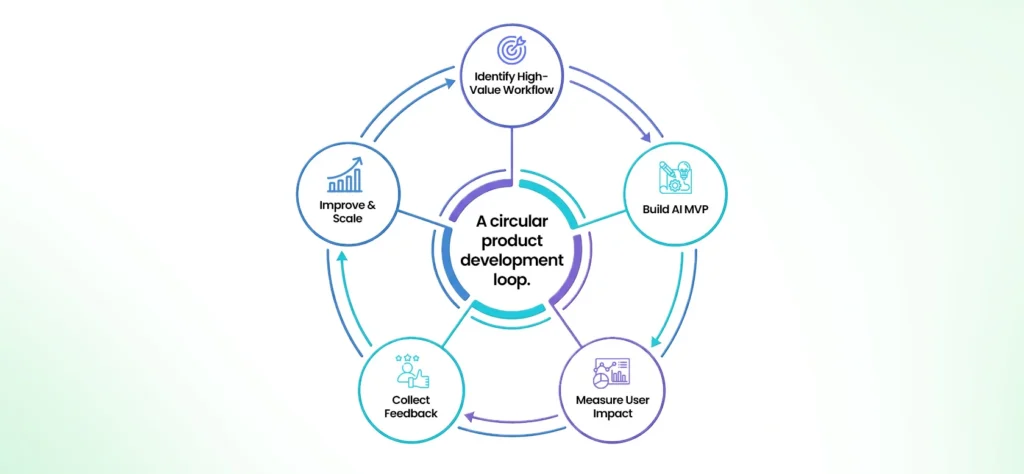
Many AI projects look promising during a demo but struggle when they are introduced into real workflows.
A successful AI product needs more than a working prototype. It needs to prove that users will adopt it, that the workflow improves, and that the value justifies further investment.
7. What Is the Smallest Workflow You Can Validate First?
One of the biggest mistakes teams make is trying to build the complete AI vision from the beginning.
A better approach is to identify the smallest workflow that can prove whether the idea has potential. This is where AI MVP development becomes valuable.
Instead of building multiple features at once, focus on:
- One specific user problem
- One complete workflow
- One measurable success metric
For example, an AI recruiting platform does not need to automate the entire hiring process initially. It may start by validating one workflow, such as resume screening, and measuring whether it reduces the time recruiters spend reviewing candidates.
A focused AI MVP helps teams learn what works before investing in complex infrastructure, additional features, and full-scale product development. Following a structured AI MVP development process helps validate the core workflow before expanding the scope.
How We Built an AI Writing Platform Around a Real User Problem
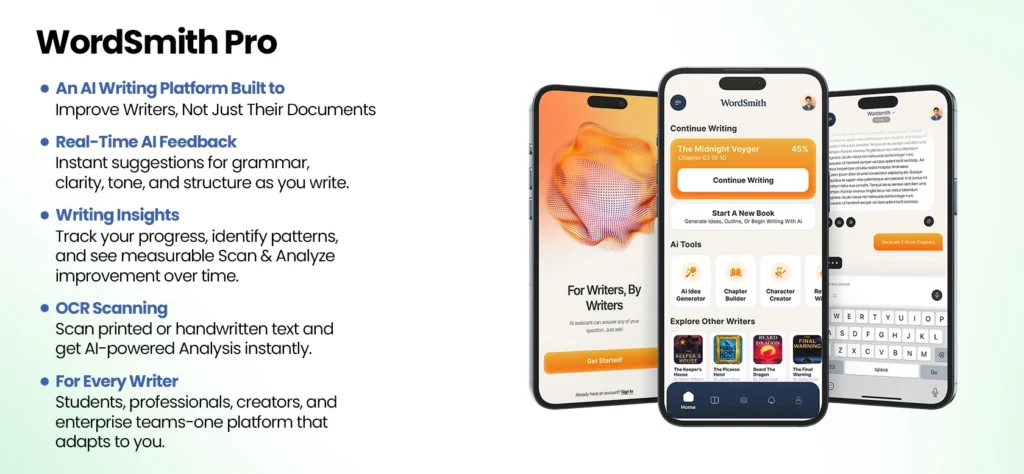
One example of this approach is WordSmith Pro, an AI-powered writing platform we built to help users improve their writing beyond basic grammar correction.
The product started with a simple observation: existing writing tools could identify mistakes, but they did not help users understand how to write more clearly or improve over time.
| Challenge | Product Decision |
| Users needed more than grammar correction | Built AI feedback for tone, clarity, and structure |
| Feedback is needed during writing | Added real-time AI analysis |
| Users wanted a measurable improvement | Added writing insights and progress tracking |
| Different users had different goals | Supported students, professionals, creators, and teams |
Technology Approach: We combined OpenAI models for contextual writing improvements, LanguageTool for grammar validation, OCR for document analysis, and React Native app development for the mobile experience.
Outcome: WordSmith Pro became a production-ready AI writing platform with real-time feedback, personalized insights, and support for both consumer and enterprise use cases.
The takeaway: The AI MVP versus full product decision create value when technology is built around a specific user workflow. The goal is not to add AI features, but to use AI where it meaningfully improves the way people work.
8. What Risks Could Stop Adoption?
AI projects face risks beyond technical challenges. A system can work as expected and still fail if users do not trust it, costs become difficult to control, or the solution creates operational concerns. For mobile AI products, understanding mobile app development costs early can help businesses plan realistic budgets.
Before launching, consider:
- Hallucinations: Can the AI generate incorrect or misleading information?
- Bias: Could the system produce unfair or inaccurate outcomes?
- Compliance: Does the AI handle sensitive information or regulated workflows?
- Cost: Will usage costs remain sustainable as adoption grows? See AI native product development costs for further context.
- User resistance: Will people trust and incorporate the AI into their daily work?
Identifying these risks early helps teams avoid common mistakes when building AI apps and develop safeguards around potential challenges. The goal is not to eliminate every possible issue before launch, but to understand the challenges and build safeguards around them.
Make Smarter Technical Decisions
Choosing the right technology matters, but it should come after understanding the problem, users, and expected outcome. Many AI projects become unnecessarily complex because teams select advanced approaches before defining what the product actually needs.
The right technical decisions should support the product, not drive it.
9. Are You Choosing the Right AI Approach?
Different AI challenges require different approaches. A common mistake is assuming every AI project needs the same technology stack or the latest model.
Start by matching the AI approach to the problem you are solving:
| Requirement | Best Fit |
| Generating and understanding text through generative AI development | Large Language Models (LLMs) |
| Working with a private company’s knowledge | Retrieval-Augmented Generation (RAG) |
| Finding patterns and making predictions | Machine Learning |
| Handling multi-step workflows with AI automation services | AI Agents |
| Automating rule-based processes | RPA |
For example, a company building an internal knowledge assistant may need RAG to connect AI with its documents through NLP development, while a forecasting platform may require machine learning models, as discussed in AI-powered business operations examples trained on historical data.
The best AI architecture is not the most advanced one. It is the one that solves the specific problem efficiently.
10. Who Will Own the Product After Launch?
Launching an AI product is not the end of the process. Unlike traditional software features, AI systems often require continuous monitoring, improvement, and iteration through post-launch analytics iteration.
Before starting development, define who will be responsible for:
- Monitoring AI performance and reliability
- Evaluating output quality over time
- Updating models, data, or workflows
- Collecting user feedback
- Improving the product based on real usage
AI systems can change as users interact with them, data evolves, and business needs shift. Without ownership and a clear improvement process, even a successful launch can decline over time. Ongoing maintenance and monitoring can also introduce hidden software development costs that teams should account for before launch.
The strongest AI products are treated as evolving products, not one-time development projects. Continuous evaluation and iteration are what help AI solutions remain useful after launch.
AI Project Readiness Checklist
Before moving into development, review these questions to make sure your AI project has a strong foundation. A clear problem, a validated use case, and a realistic execution plan can prevent costly changes later. Related lessons appear in common mobile app development mistakes
Use this AI project readiness checklist to evaluate where your project stands:
| Question | Yes | No |
| Is there a clearly defined business problem? | ☐ | ☐ |
| Is AI the right solution for this problem? | ☐ | ☐ |
| Are the target users and their needs identified? | ☐ | ☐ |
| Are success metrics clearly defined? | ☐ | ☐ |
| Is the required data available and usable? | ☐ | ☐ |
| Have existing AI tools and alternatives been evaluated? | ☐ | ☐ |
| Is there a focused workflow that can be validated first? | ☐ | ☐ |
| Have potential risks been identified? | ☐ | ☐ |
| Has the right AI approach been selected? | ☐ | ☐ |
| Is there clear ownership for ongoing improvement after launch? | ☐ | ☐ |
If several answers are still unclear, it may be worth refining the idea before committing significant resources to development. The strongest AI projects start with clarity before they move into execution.
Conclusion: The Best AI Projects Start With Better Questions
The strongest AI projects do not begin with choosing a model, building a feature, or following a trend. They begin with understanding the problem, validating the opportunity, and defining the value AI should create. Asking the right questions early helps teams avoid unnecessary development, reduce risk, and invest in solutions that solve real problems.
If you are exploring an AI project, taking time to evaluate the idea, users, data, and technical approach can make the path forward much clearer. Whether you are still validating an opportunity or preparing for development, a thoughtful product discussion around backend API development with an AI development services expert can help you identify the right next step.
Make the First Build Smaller, Smarter, and More Useful
Start with one high-value workflow, validate the product logic, and build only what proves the AI idea.
Scope My AI MVP!Frequently Asked Questions
Before starting an AI project, define the problem you want to solve, identify the users, evaluate your data readiness, determine success metrics, and decide whether AI is the right approach. A clear foundation helps avoid investing in a solution that does not create meaningful value.
A business is ready for AI when it has a clear use case, accessible and reliable data, defined goals, and the ability to support ongoing improvement after launch. Technical readiness alone is not enough. The workflow and business value must also be clear.
No. Many problems can be solved through traditional software, automation, or process improvements. AI makes the most sense when it provides a clear advantage, such as handling complex information, identifying patterns, or improving decision-making.
The decision depends on your requirements. Existing AI tools may be enough for common use cases, while custom AI solutions make more sense when you need specialized workflows, proprietary data, deeper integrations, or a unique user experience.
The required data depends on the AI use case. Some applications need business documents and knowledge bases, while others require historical operational data. In every case, the data should be relevant, accurate, accessible, and handled according to privacy requirements.
Start with a focused AI MVP that tests one important workflow, one target user group, and one measurable outcome. This helps determine whether the AI solution creates enough value before investing in full product development.
Common risks include inaccurate AI outputs, lack of user trust, data privacy issues, unexpected costs, and poor adoption. Identifying these risks early allows teams to design better workflows and safeguards.
An AI MVP focuses on validating whether an idea works with minimal scope and investment. A full AI product is built for scalability, reliability, integrations, and long-term user adoption, with digital product development cost considerations influencing its roadmap after the concept has been proven.
Data quality is critical because AI systems depend on the information they process. Incomplete, outdated, or unreliable data can reduce accuracy and limit the usefulness of the final product.
AI products require ongoing ownership for monitoring performance, evaluating outputs, improving workflows, updating models, and incorporating user feedback. AI development does not end at launch; continuous iteration is part of maintaining product quality.