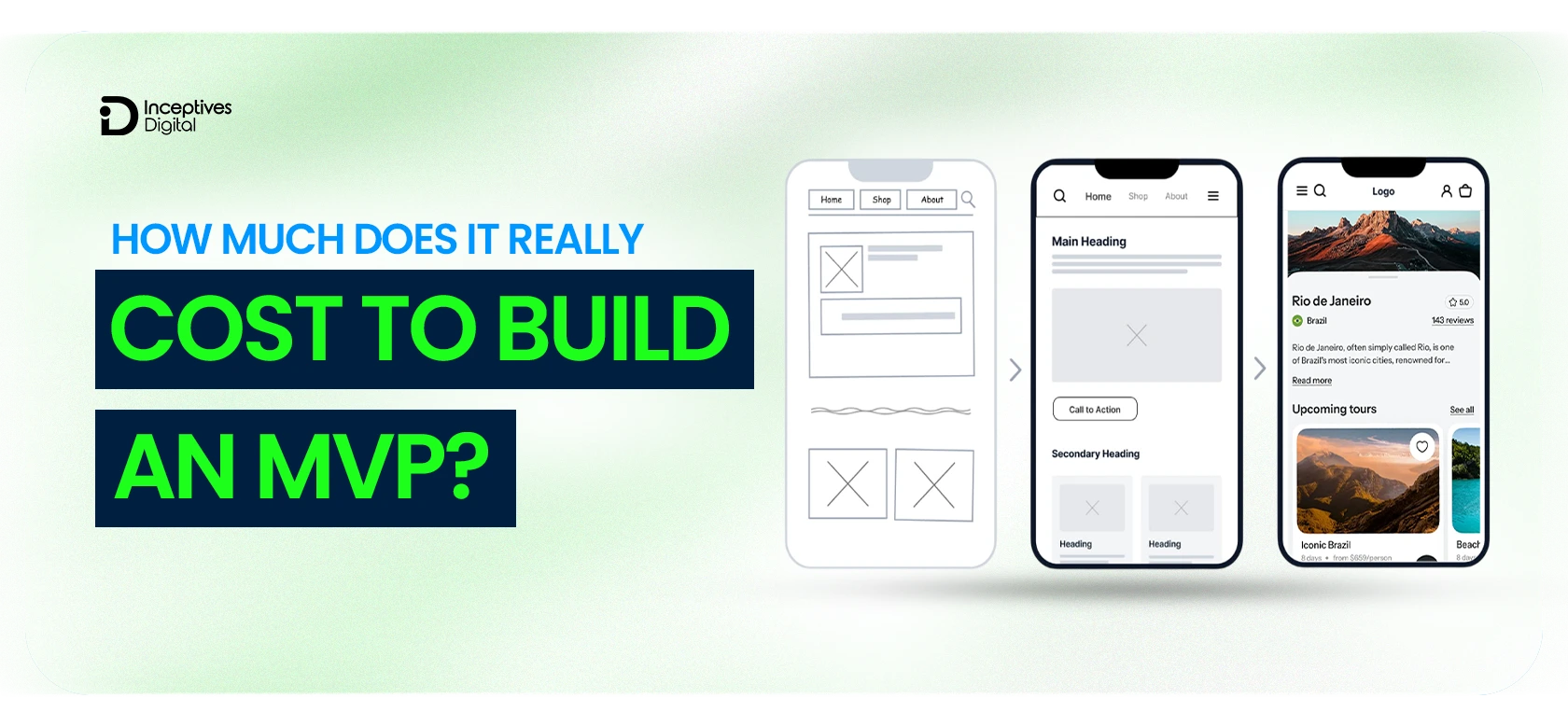
- MVP development can cost under $15,000 for narrowly scoped products, while complex applications may exceed $150,000.
- A well-defined MVP focuses on essential features that help validate a business idea.
- Web, native mobile, and cross-platform applications have different development costs.
- UI/UX design, backend complexity, and third-party integrations affect the overall budget.
- A focused MVP can take approximately 6–12 weeks to develop, while applications with multiple integrations, complex backend systems, or regulated workflows may require 3–6 months or longer.
- Open-source tools and cross-platform frameworks can help reduce development expenses.
- User feedback after launch helps businesses prioritize improvements and avoid unnecessary spending.
MVP development costs can range from under $15,000 for tightly scoped products to $150,000 or more for complex applications. The final budget depends on features, platform requirements, backend architecture, and development team expertise.
An October 2026 study by Rocketech examined published pricing from 95 software agencies and found a median starting price of $13,234 among agencies that disclosed prices. Broader MVP development cost guides showed a median range midpoint of $77,500.
These figures offer useful benchmarks for businesses planning MVP development in 2027, but actual costs depend on the product’s technical scope.
MVP development offers startups a practical way to validate their app ideas before committing to a larger investment. By prioritizing essential functionality, businesses can test demand while keeping initial development costs manageable.
However, to make your MVP successful, it is essential to understand the true MVP development cost and work with the right mobile app development company to make decisions that balance quality, speed, and budget.
This guide will provide you with a comprehensive analysis of MVP cost breakdowns, key pricing factors, post-launch expenses, and real-world examples.
Key Factors That Affect MVP Development Cost
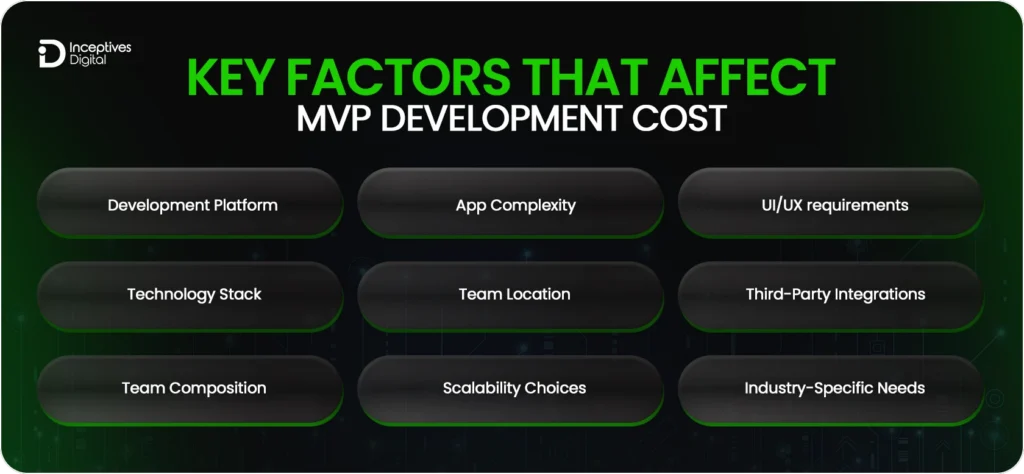
The cost of your MVP development is not fixed and varies depending on the size of the product, choice of technology, and the execution plan. Taking the factors into account helps set your budget, prevent any risks, and manage development time.
Below are the key elements that directly influence the cost of building an MVP.
Feature Scope and Product Complexity
The number and complexity of features directly increase the MVP development cost. Adding core features to your MVP is essential to validate your business idea, but including unnecessary features can take more development time, require more testing, and complicate your architecture.
Prioritize essential features during MVP development to control costs and avoid unnecessary technical complexity.
Platform Selection
Choosing the right platform for MVP mobile app development, such as web MVP, iOS/Android MVP, and cross-platform MVP, affects both cost and time to market.
A web MVP from a web app development company is generally cheaper and faster to build.
In contrast, separate iOS app development and Android app development mean two different codebases, which roughly doubles development and maintenance costs. Cross-platform app development with frameworks like Flutter or React Native uses a single codebase for multiple platforms, often cutting costs by 20-30% compared to separate native apps.
UI/UX Design Requirements
UI/UX Design quality directly affects the cost and effort, with basic wireframes and simple prototypes being inexpensive in terms of functionality. This includes visual refinement and user interaction expectations for the MVP, affecting overall cost.
However, polished UI designs with animations and micro-interactions require more design and development work that increases cost.
Choosing a lean yet usable design helps balance cost with user experience needs.
Technology Stack
Your choice of technology (programming language, frameworks, database) influences the initial development cost as well as scalability. Choosing a proven mobile app tech stack can reduce technical complexity and help teams manage MVP development costs.
However, enabling advanced technologies such as AI development, real-time features, or complex backend systems demands specialized skills and extra testing, which raises the budget.
AI development tools can accelerate certain MVP development tasks, but they also introduce costs for API usage, testing, and ongoing maintenance. Teams should evaluate these expenses against the product’s actual requirements before adding AI functionality.
Development Team Model
The development team influences MVP costs and delivery timelines. Freelancers may suit smaller projects, while in-house teams offer direct control over ongoing product development.
An outsourced development partner can provide access to designers, engineers, and QA specialists without requiring permanent hires.
Conducting a comprehensive project requirements analysis will help you choose the right mobile app development company that fits your budget and project goals.
Why Is Budget Planning Important for a Successful MVP Development?
Budgeting is the initial step of MVP development, guiding financial monitoring, scope, and focus around the key functionalities. It also helps prevent additional features that could increase costs without improving product validation.
Cloud infrastructure, third-party services, licensing fees, and quality assurance activities are other high-expenditure areas that should be considered early in the cost-planning phase. MVP projects with unclear cost budgeting suffer from issues of scope of features, project overruns, and unexpected costs, which adversely affect the quality and stability of the product.
To simplify the MVP development process, structured budget planning helps manage risk and support future growth. Estimating the MVP development cost and operations in advance enables informed decisions regarding the architecture, technology selection, and iteration planning, and product strategy consulting can guide those choices.
After the cost planning is done, the next step is understanding the MVP cost breakdown according to each development stage.
MVP Development Cost Breakdown Step-by-Step

The MVP development lifecycle involves an organized, step-by-step digital product development process that turns an idea into a market-ready product. Each development stage requires different resources and technical effort. Understanding these requirements helps businesses estimate costs from initial planning through launch.
Understanding this cost breakdown of MVP creation will help start-ups know where they can spend more money and how to balance costs without impacting quality.
The following breakdown illustrates a custom-developed MVP with dedicated design, engineering, testing, and deployment work. Smaller validation products may cost less than these estimates, particularly when teams use no-code tools or limit functionality to a single workflow.
| Development Stage | Estimated Timeline | Key Activities | Estimated Cost Range (USD) |
| Discovery & Planning | 1–3 weeks | Research, validation, planning | $3,000 – $10,000 |
| UX/UI Design | 2–4 weeks | Wireframes, prototypes, UI system | $5,000 – $15,000 |
| Development | 6–12 weeks | Frontend, backend, integrations | $18,000 – $80,000 |
| Testing & Quality Assurance | 2–3 weeks | Testing, bug fixing, QA | $6,000 – $33,000 |
| Deployment & Launch | 1–2 weeks | Server setup, release | $3,000 – $12,000 |
The figures above represent illustrative planning estimates for a custom-developed MVP, not verified industry averages. Actual costs depend on product requirements, development complexity, and team pricing.
Development phases do not always run sequentially. Teams may begin engineering while finalizing designs and conduct testing throughout development. As a result, the total project timeline can be shorter than the combined duration of individual stages.
Discovery & Planning Phase
Before the development process begins, the initial cost arises from a discovery sprint and technical planning of your MVP. This phase accounts for a smaller portion of the budget, but it is essential for cost optimization. The cost is usually distributed among requirement analysis, market validation, competitor research, and defining the core MVP features.
Moreover, creating user activities, selecting the technology stack, and estimating timelines help contribute to minimizing uncertainty and costly revisions.
UX/UI Design Phase
Once the planning is complete, the focus should be shifted to user flow and UI/UX design, which plays a critical role in successful MVP development. This phase’s cost is based on your low-fidelity wireframes or full-fledged UI elements in the MVP.
The design stage typically includes wireframes, interactive prototyping, and lean systems. The appropriate investment at this level improves functionality and keeps the cost within budget.
Development Phase
The development phase accounts for the largest portion of the MVP development cost, covering frontend, backend, and the core functionality.
The cost will depend upon the features, platform selection, integrations, and code architecture. Moreover, the technical complexity, like backend API development, authentication, and database design, increases the cost because it demands more effort when compared to visual elements.
Testing & Quality Assurance
Quality assurance runs throughout MVP development rather than starting only after engineering finishes.
Mobile app testing covers core functionality, usability, performance, and essential security requirements. Addressing issues during development helps reduce expensive post-launch fixes.
Deployment & Launch
As development approaches release, teams prepare production infrastructure, configure cloud services, and complete app store submissions where necessary. This stage also includes final release checks and basic monitoring setup.
Deployment costs are generally lower than the development costs, but ensuring a smooth and reliable product launch strategy is critical.
Real-world MVP examples show how established companies approached early product validation. Their strategies offer useful lessons, although they do not establish specific development costs or guarantee similar results.
Ready to get a clear, data-driven breakdown of your MVP development cost?
See how expenses are distributed across each development stage to plan your budget effectively.
Start Planning TodayReal-World MVP Examples and Their Product Validation Strategies
Several successful technology companies began with limited product functionality before expanding their platforms. Their early approaches offer useful lessons in prioritizing features and validating customer demand.
These examples illustrate product development strategies rather than verified historical development costs.
| Product | Early validation approach | Lesson for MVP budgeting |
| Dropbox | Product demonstration and beta waiting list | Validate demand before broad investment |
| Airbnb | Limited accommodation marketplace and manual operations | Begin with a narrow market |
| Focused photo-sharing experience | Prioritize the primary user interaction | |
| Basic short-message posting and timelines | Test engagement with limited functionality | |
| Uber | Initial location-based ride-request service | Validate the core transaction before expanding |
These examples show how companies tested essential product assumptions before expanding. They demonstrate different validation approaches rather than verified development cost savings.
Post-Launch MVP Costs You Must Plan For

The cost of MVP development doesn’t end with the launch. Startups must plan for continuous operation and maintenance costs that sustain the product after launch.
Maintenance and Bug Fixes
Once users start using the MVP, maintenance is an ongoing cost factor that includes bug fixes, optimization of the functionalities, and compatibility with the OS or browser.
Regular maintenance helps businesses address bugs, maintain compatibility, and improve application reliability. These ongoing expenses should form part of the MVP’s post-launch operating budget.
Infrastructure and Hosting Costs
As user activity grows, infrastructure costs rise, driven by server load, data storage, and bandwidth needs.
Additionally, cloud hosting services, database management, and backup systems are variable costs that increase with user activity. Plan a flexible cloud setup to manage these costs and enable future scalability.
Feature Enhancements and Iterations
Post-launch feedback guides feature improvements and minor enhancements, which require adding new features, more development, and repeated testing cycles. Make updates based on real user data from post-launch analytics and iteration to help evolve the MVP into a market-ready product efficiently.
Security and Compliance Updates
Security requirements should shape MVP development from the beginning, especially when applications handle sensitive information. After launch, teams must continue reviewing vulnerabilities, updating dependencies, and addressing applicable compliance requirements based on mobile app security best practices.
These investments in security restrict the risk of breaches and adhere to regulations in data-oriented or user-based applications.
Marketing and User Acquisition Support
App marketing strategies, alongside technical advancements, drive the success of the MVP. This includes analytics tools, onboarding improvements, and integrations to facilitate user acquisition strategies. The alignment of your MVP with marketing and product upgrades maximizes the investments after the launch.
With ongoing expenses identified, businesses can prepare a more complete MVP development cost estimate.
How to Estimate Your MVP Development Cost (Step-by-Step)
Estimating MVP development costs starts with understanding what the product needs to accomplish. Defining the core features and technical requirements helps businesses calculate a preliminary budget before requesting a detailed development quote.
Define MVP goals: The MVP must be well-defined, with a purpose, desired users, and measurements of success so that irrelevant extra features are avoided.
List core features: Include only core features essential for product validation to control expense and functionality scope.
Choose platform & tech stack: Choose technologies and platforms that balance scalability, budget constraints, and performance requirements.
Select team model: Decide whether you need freelancers, outsourcing, or in-house teams according to your product cost efficiency and delivery requirements.
Estimate hours & rates: Break down your MVP process tasks and estimate development hours and team rates to calculate baseline costs.
Add a contingency buffer: It is important to save an additional budget for any scope and other unforeseen technical changes.
With a clear understanding of what your MVP will be and the costs, you can now look at viable options that will lower the cost of your MVP without affecting the quality.
How to Reduce MVP Development Cost Without Compromising Quality
After understanding the MVP prices, the next step is to apply cost-optimization techniques to reduce app development cost without compromising the functionality, scalability, and product quality.
Focus Strictly on MVP Core Features
To control MVP costs, restrict development to only core features to validate the product’s main value proposition.
Additionally, eliminate the non-essential features to reduce the development cycle, simplify and speed up testing, and reduce architectural complexity for faster and cheaper delivery.
Use Open-Source Tools
A number of open-source frameworks and libraries lower the licensing fee and provide strong community-based alternatives.
Well-maintained open-source tools can reduce licensing expenses and development effort. However, teams must still account for integration, security, and ongoing maintenance.
Choose Cross-Platform Development
Cross-platform development frameworks allow developers to develop applications that can work on various platforms with a single codebase.
Cross-platform development can reduce duplicate engineering work, but both iOS and Android still require platform-specific testing and compatibility checks.
Outsource to Cost-Effective Regions
Team location significantly influences the development cost. Outsource to regions with lower labor costs to access skilled developers at more affordable rates.
Properly managed outsourcing keeps the standard quality of products and services while benefiting from lower operational and staffing costs.
Use No-Code or Low-Code Solutions Where Possible
Use no-code technologies to speed up the development process and minimize the cost of particular MVP elements. These solutions work well for admin interfaces and visualizations, which allow teams to test their ideas with a small or no tech investment.
With cost savings in place, there are some common errors that can elevate the MVP costs if they are not identified and avoided early.
Common Mistakes That Elevate MVP Costs
Even well-crafted MVPs can exceed the budget due to errors in planning and execution, making it essential to understand common development mistakes that can increase both timeline and costs.
Overbuilding features: Adding unnecessary MVP functionalities will increase development time, complexity in testing, and maintenance needs without improving early-stage validation.
Poor budget planning: Inadequate budget planning leads to more costs related to infrastructure, integrations, and increased development cycles.
Choosing the wrong team: Selecting the wrong technical team leads to factors such as rework, inefficiency, and delays in delivery.
Ignoring post-launch expenses: Startups that do not consider costs associated with maintenance, hosting, and updates will definitely incur more costs after product launch.
No feedback-driven iteration plan: Lack of a structured user feedback plan will make the company more reactive to changes and will result in higher long-term development costs.
Identifying these common mistakes helps startups develop more realistic preliminary budgets and reduce avoidable development expenses.
Final Thoughts
Building an MVP allows startups to test their product assumptions with a limited investment. Early user feedback helps teams decide whether to improve the product, change direction, or invest in further development. By focusing on core functionality and leveraging reliable mobile app development services, startups can quickly test market demand and gain valuable insights for future development.
Careful budget planning and post-launch iteration help startups control development spending and make informed decisions about further product investment. A focused MVP gives businesses an opportunity to validate demand before committing to a larger product roadmap.
Make Your Startup Idea a Reality with an MVP
Discover exactly what it takes to build your MVP, costs, timelines, and expert guidance, all in one place.
Calculate Your MVP CostMVP Development Cost FAQs
MVP development in 2027 may cost under $15,000 for a narrowly scoped product or exceed $150,000 for a complex application. Published 2026 agency benchmarks show substantial pricing differences, so businesses should estimate costs based on features, integrations, platform requirements, and development scope.
Absolutely, but it typically involves a highly constrained feature set, the application of open-source or no-code tools, and a team of developers that work at a low cost. The development of extremely lean MVPs is about validating a single key idea and scaling.
Among the features that increase cost are real-time functionality, AI integration, complex backend logic, multi-platform support, and highly sophisticated UI/UX with animations. The cost control can be supported by the prioritization of the basic features.
A focused MVP can take 6–12 weeks to develop, while more complex products may require 3–6 months or longer. Development timelines depend on feature complexity, platform selection, integrations, testing requirements, and team capacity.
The cost of an MVP can be reduced by limiting features to core functionality, using open-source or cross-platform tools, outsourcing to cost-effective regions, and leveraging no-code/low-code solutions.