
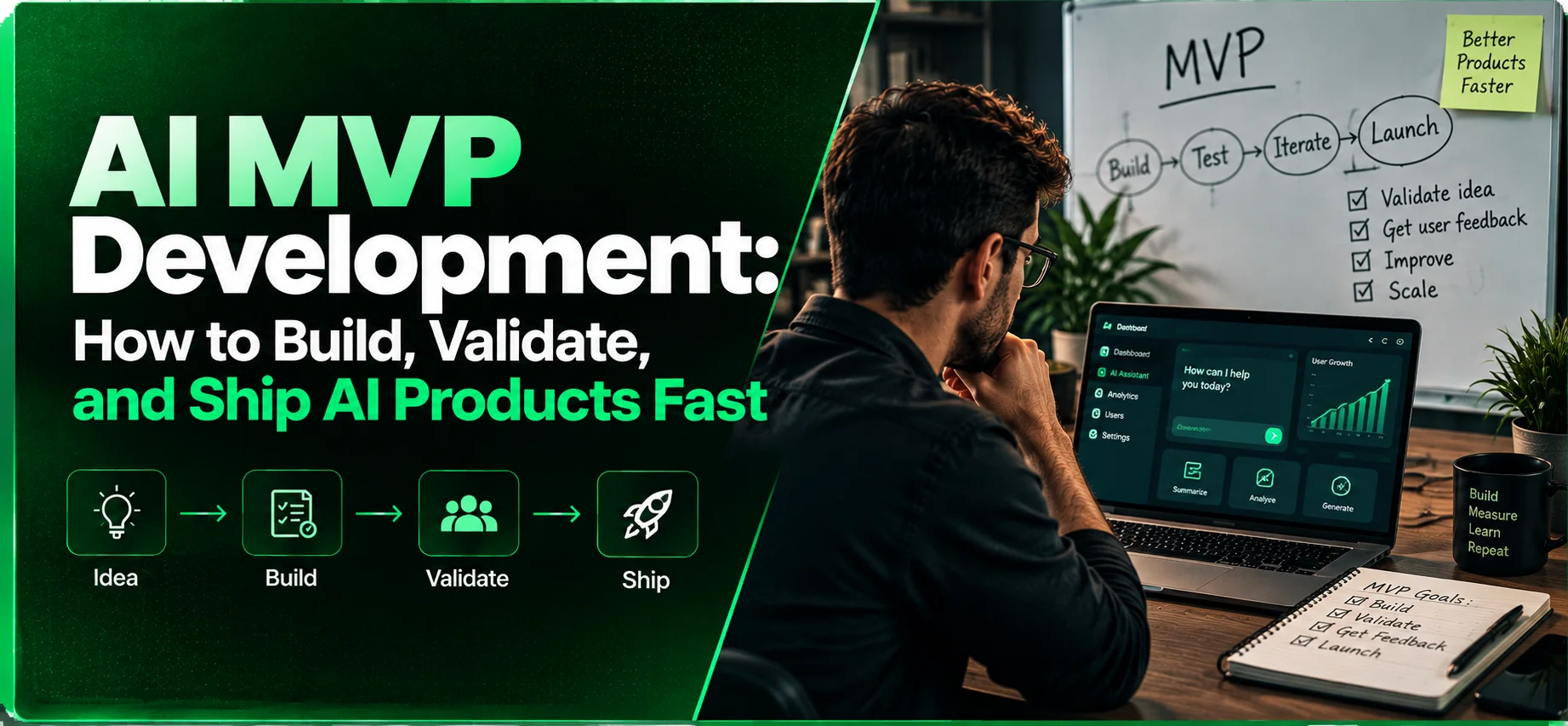
Most AI MVPs do not need more features. They need a sharper first bet.
That is the real purpose of AI MVP development: build the smallest usable version that can prove whether AI improves one specific workflow for one specific user group.
The risk is not that businesses lack interest in AI. The risk is that they move faster than their readiness. Cisco’s AI Readiness Index found that only 13% of companies are fully ready to capture AI’s potential, even as pressure to adopt AI keeps rising.
An AI MVP helps reduce that gap. It gives your team a structured discovery sprint to test the workflow, data, AI output, user behavior, and operating constraints before the product becomes expensive to change.
This guide explains how to plan, build, test, and improve an AI MVP without turning the first version into a bloated product or a polished demo that proves nothing useful.
What Is AI MVP Development?
AI MVP development is the process of building the first usable version of an AI-powered product to test whether one AI capability can improve one real workflow.
The goal is not to launch a complete product. It is to prove the right thing early.
A strong AI MVP usually answers three questions:
- Does The User Need This AI Workflow?
- Can The AI Produce Useful Output With The Available Data?
- Is The Product Worth Improving Into A Larger Version?
That makes an AI MVP different from a quick demo or static prototype. A demo may show that an idea looks interesting. A prototype may show how the interface could work. An AI MVP should be usable enough for real feedback, real workflow testing, and real product decisions.
| Concept | Purpose | What It Proves |
| AI Proof Of Concept | Tests technical feasibility | Can the AI capability work? |
| AI Interactive Prototype | Shows the user experience direction | How could users interact with it? |
| AI MVP | Tests real-world value | Will users adopt and benefit from it? |
| Full AI Product | Supports scale and reliability | Can the product grow safely? |
For example, an AI MVP for a document assistant may not need team accounts, billing, advanced analytics, and enterprise administration at first. It may only need one complete workflow: upload a document, generate a useful summary, show source references, collect user feedback, and measure whether the workflow saves time.
That is enough to learn.
Good AI MVP development keeps the first version narrow, but not shallow. The product still needs usable UX, basic data handling, AI integration, feedback capture, and enough testing to understand whether the idea deserves more investment.
Why Is AI MVP Development Different From Traditional MVP Development?
A traditional MVP tests whether a product idea has value.
An AI MVP has to test more than that.
It needs to prove that the AI capability improves the workflow, that users can understand and trust the output, and that the system can work with real data without creating too much cost, delay, or risk.
That makes AI MVP development more uncertain than standard MVP development. A normal app feature usually behaves the same way each time a user taps a button. AI output can vary depending on the prompt, the input, the data source, the model, the retrieval logic, and the user’s intent.
That does not make AI unreliable by default. It means the MVP has to test the right things.
| Traditional MVP Risk | AI MVP Risk |
| Users do not need the feature | Users do not trust the AI output |
| The workflow feels incomplete | The AI response is inconsistent |
| The interface needs improvement | The data behind the AI is weak |
| The backend needs more polish | Retrieval quality is poor |
| Adoption is lower than expected | Model usage cost grows too quickly |
| The product scope is too broad | Human review rules are unclear |
For example, a traditional support MVP may test whether users can submit tickets and receive responses. An AI support MVP also needs to test whether the AI retrieves the right help content, avoids unsupported answers, escalates unclear cases, and gives the support team enough control to review or improve responses.
This is why the first AI MVP should not be judged only by whether the feature works.
It should be judged by whether the workflow becomes easier, faster, safer, or more useful because AI is part of it.
What Should an AI MVP Validate First?
An AI MVP should not try to validate the entire product vision. Just as teams learn how to validate an idea before scaling it, an AI MVP should validate the highest-risk assumption first.
It should validate the highest-risk assumption first.
That assumption may be user demand, data quality, AI output reliability, workflow fit, or operating cost- the same variables that shape any MVP development roadmap.
For most teams, the first AI MVP should answer a focused question:
Does this AI capability make one important workflow better enough to justify the next version?
| Validation Area | What The MVP Should Prove |
| Problem Value | The workflow matters enough to improve |
| User Adoption | Users are willing to use AI in this moment |
| Data Fit | The available data can support useful output |
| Output Quality | The AI response is accurate enough for the task |
| Workflow Fit | AI reduces friction instead of adding another step |
| Cost Feasibility | Usage cost can stay reasonable as activity grows |
| Risk Control | Weak or uncertain outputs can be reviewed safely |
For example, an AI recruiting product does not need to automate the entire hiring process in its MVP. It may start with resume-to-job fit analysis and test whether recruiters save time without losing confidence in their decisions.
An AI customer support product does not need every helpdesk integration on day one. It may start by answering questions from approved help articles, measuring how often users accept the response, and identifying where human escalation is still needed.
The goal is not to prove that AI can do something impressive.
The goal is to prove that AI can improve a real workflow in a way users notice, trust, and repeat.
What Should Be Included in an AI MVP?
An AI MVP should be narrow enough to build quickly, but complete enough to test a real user workflow.
That means it cannot be only a model demo. It needs the minimum product layer around the AI capability so users can interact with it, respond to it, and show whether it creates value.
A strong AI MVP usually includes these core parts:
| AI MVP Component | What It Does |
| Core AI Workflow | Handles one meaningful task from start to finish |
| Simple User Interface | Lets users provide input, review output, and take action |
| Required Data Sources | Gives the AI system the information it needs to respond usefully |
| AI Integration | Connects the workflow to an LLM, ML model, RAG pipeline, OCR, or AI API |
| Basic Security | Protects users, access, data, and API usage |
| Feedback Capture | Shows whether users accept, reject, edit, or ignore the AI output |
| Usage Analytics | Tracks adoption, errors, latency, and cost signals |
The exact scope depends on the product, but the principle stays the same: one complete workflow is better than five unfinished features.
For example:
| AI Product Idea | Useful MVP Scope |
| AI Writing Assistant | Paste text, get suggestions, accept or reject edits, track accepted changes |
| Document AI Tool | Upload a file, extract key points, show sources, collect feedback |
| Support Assistant | Ask a question, retrieve approved answers, escalate unclear cases |
| Sales Assistant | Summarize a call, draft follow-up notes, send to CRM for review |
| Recruiting Assistant | Upload a resume, compare it to a job role, show fit reasoning |
| Healthcare Admin Tool | Draft visit summaries for staff review, not final medical decisions |
Notice what is missing from those examples: full dashboards, advanced admin systems, complex automation, multiple user roles, and every future feature on the roadmap.
Those may matter later. They do not always belong in the first AI MVP.
The first version should include just enough UX, backend API development, data handling, AI functionality, and feedback tracking to answer one question clearly:
Is this AI workflow useful enough to keep building?
The AI MVP Development Process
The AI MVP development process should move from workflow clarity to real-world testing. The order matters because each step reduces a different kind of risk before the product becomes larger and more expensive to change.
Step 1: Define the Workflow and Success Metric
Start with the workflow, not the model.
The first step is essentially product strategy consulting: define exactly what the user is trying to do, where the current process breaks down, and what improvement the AI MVP should create.
Define:
- Target User
- Current Workflow
- Main Friction Point
- AI’s Role In The Workflow
- Expected Output
- Measurable Success Metric
A good success metric keeps the MVP grounded. Instead of saying, “The AI should give better answers,” define what better means.
| Goal | Better Success Metric |
| Save time | Reduce manual review time by a measurable amount |
| Improve support | Increase accepted AI-suggested responses |
| Improve writing | Track accepted suggestions and clarity improvements |
| Improve document review | Reduce time spent extracting key information |
| Improve sales follow-up | Increase completed follow-up drafts after calls |
The clearer the metric, the easier it becomes to decide whether the AI MVP worked.
Step 2: Check Data Readiness Early
AI MVP development becomes risky when data is reviewed too late.
Before building the first version, check what information the AI system needs, where that data lives, how clean it is, and whether users are allowed to access it.
Review:
- Data Sources
- File Types
- Structured And Unstructured Data
- OCR Requirements
- Source Freshness
- Access Rules
- Sensitive Data
- Storage Requirements
- Integration Paths
For a RAG-based MVP, this step is especially important. The product may need documents, help articles, policies, PDFs, or database records to be organized before the AI can retrieve useful information.
If the data is weak, the MVP should expose that early. That is better than discovering the issue after building a larger product around unreliable information.
Step 3: Choose the Simplest AI Architecture That Can Prove the Workflow
The best AI MVP architecture is not always the most advanced one.
It is the simplest architecture that can test the workflow properly.
For example:
| MVP Need | Practical AI Approach |
| Summarize text | LLM API |
| Answer from private documents | RAG |
| Extract text from scanned files | OCR plus AI processing |
| Classify tickets or records | AI API or machine learning model |
| Generate drafts | LLM with prompt logic |
| Use tools or trigger actions | Controlled AI agent workflow |
Most AI MVPs do not need custom machine learning model training at the start. They usually need clear product logic, usable data, thoughtful prompting, evaluation, and a user experience that makes the output easy to review.
Step 4: Design the UX Around AI Output
The user experience matters because users do not interact with “AI architecture.” They interact with inputs, suggestions, explanations, approvals, edits, and results, which is why deliberate UI/UX design shapes whether they trust the output.
An AI MVP should make the output understandable and controllable.
That may include:
- Clear Input Fields
- File Uploads
- Source References
- Confidence Or Review States
- Accept And Reject Controls
- Edit Options
- Retry States
- Human Review Paths
- Feedback Buttons
- Error Messages
For example, if the MVP generates a customer support reply, users should be able to review it, edit it, approve it, or escalate the case. If the MVP summarizes documents, users should be able to see where the summary came from.
AI output should not feel like a black box in the product.
Step 5: Build With Monitoring From Day One
An AI MVP should collect learning signals from the beginning through structured post-launch analytics and iteration.
That does not require a complex analytics platform, but it does require enough tracking to understand how the product behaves in real use.
Track:
- Number Of Users
- Number Of AI Requests
- Accepted Outputs
- Rejected Outputs
- Edited Outputs
- Failed Outputs
- Average Response Time
- Cost Per Request
- Escalations
- User Feedback
Without monitoring, the team may only know that the MVP was launched. They will not know whether the workflow improved.
Step 6: Test With Real Users and Improve the Next Version
The final step is not launch. It is learning from real use.
An AI MVP should be tested with users who represent the real audience. Their feedback should guide what happens next: improve the workflow, tune the prompts, adjust the data, add review controls, refine the UX, or stop building in the wrong direction.
After testing, review:
- Did Users Complete The Workflow?
- Did They Trust The AI Output?
- Did They Edit Or Reject Responses Often?
- Did The AI Use The Right Data?
- Did Response Time Feel Acceptable?
- Did Usage Cost Stay Reasonable?
- Did The MVP Prove Enough To Justify The Next Version?
This is where AI MVP development creates value. It turns assumptions into evidence before the product becomes bigger.
Choosing the Right AI MVP Architecture
The architecture of an AI MVP should follow the workflow.
This is where many teams overbuild. They start with custom models, multi-agent systems, or complex AI pipelines before proving that users need the product. A better approach is to choose the simplest architecture that can test the core workflow with enough reliability.
Different AI MVPs need different technical paths.
| AI MVP Use Case | Practical MVP Architecture |
| AI Writing Assistant | LLM API, prompt logic, text editor, feedback tracking |
| Document Assistant | OCR, embeddings, vector database, RAG, source references |
| Support Assistant | Knowledge base ingestion, RAG, escalation rules, analytics |
| Sales Assistant | CRM integration, LLM summarization, follow-up draft workflow |
| Prediction Tool | Structured data pipeline, ML model, evaluation dashboard |
| AI Agent MVP | Tool APIs, permission rules, approval flow, audit logs |
For example, an AI writing assistant may not need retrieval or custom model training in the first version. It may only need a strong editing flow, prompt logic, output controls, and feedback tracking.
A document assistant is different. If users need answers from uploaded files, internal documents, or approved knowledge sources, the MVP may need OCR, embeddings, a vector database, retrieval-augmented generation, and source visibility.
An AI agent MVP needs even more control. If the system can use tools, trigger actions, or interact with business systems through system integration and API automation, the architecture should include permission checks, approval states, logs, and safe fallback paths.
The goal is not to select the most advanced stack. The goal is to select the stack that proves the workflow without locking the product into unnecessary complexity.
Common AI MVP architecture components include:
- Large Language Model APIs
- Prompt Logic
- Embeddings
- Vector Databases
- Retrieval-Augmented Generation
- OCR
- Backend APIs
- Authentication
- Role-Based Access
- Admin Controls
- Usage Analytics
- Monitoring
- Cloud Infrastructure
A good technical decision at the MVP stage should leave room for change. The model provider may change later. The prompts may be rewritten. The retrieval strategy may improve. The user experience may evolve after real feedback.
That flexibility matters.
The first architecture should help the team learn quickly, control risk, and avoid expensive rebuilds when the product direction becomes clearer.
AI MVP Development Cost and Timeline
AI MVP development cost depends on how much product, data, AI logic, and integration work is needed to test the first workflow properly.
A simple AI demo may be inexpensive, but a usable AI MVP needs more than a prompt connected to a model. It may need UX design, backend development, authentication, data processing, RAG, OCR, testing, deployment, monitoring, and feedback capture.
The right way to estimate cost is by scope complexity, not by the word “MVP.” For a broader look at how these numbers compare across different builds, see this breakdown of MVP development cost drivers.
| AI MVP Type | Typical Scope | Planning Range |
| AI Prototype | Demo, test workflow, limited backend | $5,000–$15,000 |
| Lean AI MVP | One AI workflow, simple UI, basic backend | $15,000–$40,000 |
| RAG MVP | Documents, embeddings, vector search, source-grounded output | $25,000–$70,000 |
| AI SaaS MVP | Users, dashboard, billing, admin controls, AI workflow | $40,000–$120,000+ |
| Secure Or Enterprise MVP | Roles, audit logs, compliance-aware workflows, integrations | $75,000–$150,000+ |
Timelines follow the same logic. The more data, integrations, review controls, and security requirements the MVP needs, the longer the build usually takes, a pattern that shows up clearly when teams build a fintech MVP under compliance pressure.
| MVP Type | Typical Timeline |
| Prototype | 2–4 weeks |
| Lean AI MVP | 6–10 weeks |
| RAG Or Document AI MVP | 8–12 weeks |
| AI SaaS MVP | 10–16 weeks |
| Enterprise Or Regulated MVP | 12–20+ weeks |
The biggest cost drivers usually include:
- Product Scope
- Data Quality
- RAG Complexity
- OCR Requirements
- Number Of Integrations
- User Roles
- UX Complexity
- Security Requirements
- Compliance Needs
- Model Usage
- Cloud Infrastructure
- Testing And Monitoring
AI MVPs also carry operating costs that should be considered early. Large language model APIs, token usage, vector databases, cloud hosting, storage, monitoring, and human review can all affect the real cost of running the product after launch.
A lower build estimate is not always better if it excludes the parts needed to test the workflow properly.
The better question is:
What is the minimum investment required to learn whether this AI product is worth building further?
That keeps the estimate tied to validation, not feature volume.
How to Test an AI MVP Before Scaling
An AI MVP should not be judged by one successful demo.
It should be tested against real inputs, real users, real data, and real workflow conditions. That is the only way to know whether the product is ready for a larger build.
Testing should cover both the software experience and the AI behavior.
| Test Area | What It Checks |
| Functional QA | Product features work correctly |
| Output Evaluation | AI responses are accurate, useful, and aligned with the workflow |
| Retrieval Testing | RAG pulls the right sources or documents |
| Hallucination Testing | Unsupported or invented answers are reduced |
| Permission Testing | Users cannot access restricted data |
| Latency Testing | Response time fits the user experience |
| Cost Testing | Usage cost stays sustainable |
| UX Testing | Users understand, trust, edit, or reject the output |
The most important question is not only, “Did the AI answer?”
The better question is:
Did the AI help the user complete the workflow with more speed, clarity, or confidence?
That means the MVP should track practical signals such as:
- Accepted Outputs
- Rejected Outputs
- Edited Responses
- Human Review Requests
- Escalations
- Source Match Quality
- Task Completion Rate
- Average Response Time
- Cost Per Request
- User Feedback
- Repeat Usage
For example, an AI document assistant may generate a summary that looks good in a demo, but testing should check whether users can verify the source, correct weak points, and complete the review faster. An AI support assistant may return fluent answers, but testing should check whether the answer is grounded in approved content and whether unclear cases are escalated instead of guessed.
Testing should also include edge cases.
Real users will upload messy files, ask unclear questions, use incomplete inputs, request restricted information, and expect the product to recover gracefully. If the MVP cannot handle every case, that is acceptable. But the team should know where it fails and what needs to change before scaling.
A successful AI MVP is proven when users can complete the workflow, trust the output enough to keep using it, and create measurable value without the system becoming too slow, expensive, or risky to operate.
Common AI MVP Development Mistakes
AI MVP development becomes expensive when the first version stops being focused, which lines up with the common reasons digital products fail.
The problem is rarely a lack of ambition. It is usually too much ambition too early. Teams try to build the future product before they have enough evidence from the first workflow.
Here are the mistakes to avoid.
1. Building Too Many AI Features
An AI MVP should not include every feature that may exist in the final product.
A writing assistant does not need team dashboards, enterprise accounts, browser extensions, and advanced analytics in the first version. A support assistant does not need every helpdesk integration before it proves that users trust the answers.
Start with the workflow that matters most.
2. Choosing the Model Before the Workflow
The model should not decide the product.
The workflow should decide whether the MVP needs an LLM API, RAG, OCR, a machine learning model, automation, or a controlled AI agent. Starting with the model often leads to impressive demos that do not fit the user’s real task.
3. Treating RAG as a Shortcut for Data Readiness
RAG can help AI systems answer from approved business information, but it cannot fix weak source material by itself.
If documents are outdated, duplicated, poorly organized, or missing context, retrieval quality will suffer. Data preparation still matters.
4. Ignoring UX Around AI Output
Users need to understand what the AI produced and what they should do next.
That may require source references, confidence states, edit controls, accept or reject actions, retry options, human review paths, or feedback buttons. Without those controls, users may treat AI output as either too trusted or not trusted at all.
5. Skipping Cost and Latency Tracking
A useful AI MVP can still fail if it is too slow or too expensive to run.
Track response time, model usage, API calls, token volume, and cost per request from the beginning. These numbers help the team understand whether the workflow can scale later.
6. Launching Without Human Review Rules
Not every AI output should go straight to the user.
If the MVP supports customer communication, account decisions, healthcare-adjacent workflows, financial information, legal content, or internal approvals, define when a human should review the output before action is taken.
A good AI MVP is not the version with the most AI inside it. It is the version that gives the team the clearest evidence about what should happen next.
AI MVP Builder vs Custom AI MVP Development
AI MVP builders and no-code AI tools can be useful when the goal is to test a simple idea quickly.
They can help teams create early demos, connect basic AI workflows, build internal tools, or show stakeholders how an AI concept might work. For some use cases, that is enough.
But not every AI MVP should be built that way.
The decision depends on what the MVP needs to prove and how close it is to a real product environment.
| Option | Best For | Limitations |
| AI MVP Builder | Fast demos, simple workflows, concept testing | Limited customization, weaker control, harder to scale |
| No-Code Or Low-Code AI Tools | Internal automation, simple forms, lightweight workflows | May struggle with complex UX, security, data ownership, and integrations |
| Custom AI Development (MVP) | Real users, proprietary data, SaaS products, secure workflows, integrations | Requires more planning, technical skill, and budget |
Use an AI MVP builder when speed matters more than control, the same trade-off explored in this comparison of AI app builders vs human developers.
That may work for a founder testing a pitch concept, a team exploring a simple internal workflow, or a product manager validating whether users understand the basic idea, a common pattern in software development for startups moving fast on limited budgets.
Choose custom AI MVP development when the first version needs to behave like a real product, which mirrors the signs a startup needs custom software development instead of an off-the-shelf tool.
That usually applies when the MVP needs:
- User Accounts
- Role-Based Access
- Proprietary Data
- RAG Or Document Search
- File Uploads
- OCR
- CRM Or ERP Integration
- Payment Or Subscription Logic
- Admin Controls
- Audit Logs
- Secure API Handling
- Custom UX Around AI Output
- Monitoring And Analytics
For example, a simple AI content generator can often start with a no-code tool. But an AI document assistant that handles private business files, shows source references, controls user access, and tracks feedback usually needs custom development.
The practical rule is simple:
Use tools to test the concept. Use custom development when the MVP needs to test the product.
A good AI MVP should not only prove that the idea can be demonstrated. It should prove whether the product can support real users, real data, and real workflow decisions.
When to Work With an AI Development Company
You do not always need an AI development company to test an early idea, though it is worth understanding whether AI will really replace app developers before deciding how much of the build to automate.
If the goal is a simple demo, an internal experiment, or a lightweight automation, an AI MVP builder or no-code tool may be enough. But once the MVP needs real users, proprietary data, secure workflows, integrations, or a path toward a scalable product, custom development becomes more practical.
Work with an AI development company when the MVP needs:
- Proprietary Business Data
- RAG Or Document Search
- User Accounts And Permissions
- Custom Product UX
- Backend APIs
- CRM, ERP, Or Helpdesk Integrations
- File Uploads Or OCR
- Secure Data Handling
- Admin Controls
- Audit Logs
- AI Output Evaluation
- Usage And Cost Monitoring
- A Clear Path To The Next Version
Choosing the right partner should not start by asking which model you want to use. It should start by understanding the workflow, the user, the data, the risk, and the decision the MVP needs to support.
That matters because the first AI MVP shapes the next product decision. If the MVP is scoped poorly, the team may learn very little even after spending real money. If the MVP is scoped well, it can show whether the product deserves more investment, what users actually trust, what data needs improvement, and what technical path makes sense next.
A good AI development company should help you reduce uncertainty, not add complexity.
It should help define the first workflow, choose the simplest architecture that can prove it, design the UX around AI output, build the backend, test model behavior, monitor usage, and prepare the product for iteration.
The best partner is not the one that promises the most advanced AI system first.
It is the one that helps you build the smallest version that proves something real.
How Inceptives Digital Approaches AI MVP Development?
Inceptives Digital approaches AI MVP development as a digital product studio, not as a model integration vendor.
That means we do not start by asking how many AI features can fit into the first version. We start by identifying the smallest product path that can prove whether the AI idea deserves more investment.
Our AI MVP development process focuses on the layers that make the first version useful:
- Product Discovery
- Workflow mapping and business process automation review
- AI Feasibility Review
- Data Readiness Review
- UX Design Around AI Output
- AI Architecture Planning
- Backend Development
- LLM, RAG, OCR, Or AI API Integration
- User Feedback Capture
- QA And AI Output Evaluation
- Deployment
- Monitoring And Iteration Planning
The goal is to build an MVP that feels focused, usable, and measurable. Not overbuilt. Not shallow. Not a demo that only works in a controlled presentation.
For example, if a client wants an AI assistant, we look at what the assistant actually needs to do inside the workflow. Does it answer from approved documents? Does it summarize user uploads? Does it prepare a draft for human review? Does it need account-specific data? Does it need an admin dashboard? Does it need source visibility, access rules, or usage monitoring?
Those decisions shape the first version.
A useful AI MVP should help the team answer what should happen next. Should the product move forward? Should the workflow change? Should the data be improved? Should the architecture stay simple or become more advanced? Should the next version add integrations, roles, subscriptions, or deeper automation?
That is the value of a focused AI MVP.
It gives the business enough evidence to make the next product decision with confidence.
Final Recommendation: Build the AI MVP That Proves the Right Thing
AI MVP development is not about building the smallest possible product.
It is about building the smallest version that can prove whether AI creates real value inside a specific workflow.
That distinction matters. A thin demo may look impressive, but it may not tell you whether users trust the output, whether the data is strong enough, whether the workflow improves, or whether the product can support the next stage.
A strong AI MVP should prove:
- The Problem Matters
- The Target User Understands The Workflow
- The AI Output Is Useful Enough
- The Required Data Can Support The System
- The Product Experience Makes AI Easy To Review
- The Cost And Latency Are Manageable
- The Risks Can Be Controlled
- The Next Version Is Worth Building
If the MVP cannot answer those questions, it may still be interesting, but it is not giving the business enough evidence.
The best first version is usually narrower than the original product idea. That is not a weakness. It is what makes the learning sharper.
Start with one user, one workflow, one AI capability, and one measurable outcome. Build enough product around it to test real behavior. Then use the evidence to decide what should be improved, expanded, delayed, or removed.
That is how an AI MVP becomes more than a first release.
It becomes a decision tool for building the right AI product.
Build the First AI Version That Proves Something Real
Work with Inceptives Digital to define the right AI MVP scope, validate the core workflow, and build a focused first version with the product, data, and AI architecture needed to learn fast.
Plan My AI MVPFAQs About AI MVP Development
AI MVP development is the process of building the first usable version of an AI-powered product to validate one core workflow, one target user need, and one measurable outcome. The goal is to learn whether the AI capability creates enough value before investing in a larger product.
AI MVP development cost depends on product scope, data readiness, AI architecture, integrations, security, UX complexity, and testing needs. A simple AI prototype may cost less, while a usable AI MVP with RAG, OCR, user accounts, backend logic, or integrations usually requires a larger budget.
A focused AI MVP often takes 6 to 12 weeks, depending on the workflow, data sources, AI integration, user interface, and testing requirements. Simpler prototypes can take less time, while document AI, SaaS, enterprise, or regulated MVPs can take longer.
An AI MVP should include one core AI workflow, a usable interface, required data sources, AI integration, basic security, feedback capture, analytics, and enough testing to evaluate real user value. It should be narrow, but still complete enough to test the workflow properly.
Usually, no. Many AI MVPs can start with existing AI models, LLM APIs, prompt logic, retrieval-augmented generation, embeddings, OCR, or workflow automation. Custom model training usually makes more sense after the use case, data, and performance requirements are clearer.
An AI prototype shows how an idea could work. An AI MVP is a usable first version that real users can test. A prototype helps demonstrate the concept, while an AI MVP helps validate whether the product creates measurable value.
Use an AI MVP builder for fast concept testing, internal demos, or simple workflows. Choose custom AI MVP development when the product needs real users, secure data, proprietary workflows, integrations, role-based access, RAG, OCR, admin controls, or a path to scale.
A successful AI MVP proves that AI improves a real workflow. It should show that users understand the product, trust the output, complete the task more effectively, and create enough measurable value to justify the next version.
Hire an AI development company when the MVP involves proprietary data, RAG, AI agents, document processing, secure workflows, user accounts, integrations, compliance concerns, custom UX, or long-term product planning. The right partner should help define the first workflow before recommending the technology.
After launch, the team should review user feedback, output quality, usage analytics, latency, cost per request, errors, and adoption signals. Those findings should guide whether to improve the MVP, change the workflow, strengthen the data layer, add integrations, or move toward a larger product.


