


- A no-code MVP can stay under $30,000 and reach a working version in roughly 2 to 8 weeks when the workflow is simple.
- A custom MVP typically costs $35,000 to $150,000 or more and takes 12 to 24 weeks, yet it removes platform limits on payments, offline use, and integrations.
- A hybrid MVP often lands between the two budgets and suits products with a simple front end and a demanding backend.
- Platform fees, workarounds, and migration can erase no-code savings within 12 to 24 months once usage grows.
- Pick the path by the riskiest assumption you need to test, then set a switch point before launch.
Picture two founders who hold the same idea and the same $60,000 budget. One launches in five weeks on a visual platform, while the other spends four months building custom code. A year later, either founder can hold the lead.
Gartner forecasts that AI agents will build and use the majority of software products by 2030. As AI reshapes both visual platforms and custom engineering, founders must look beyond launch speed to evaluate flexibility, ownership, and long-term development costs.
Cheap first builds can still turn into expensive rebuilds. Founders who plan mobile app development as part of the MVP feel this most, because payments, device features, and store rules can push a platform past its limits.
This guide compares no-code, hybrid, and custom MVP development paths on cost, speed, and risk. It adds two Inceptives Digital case studies, a decision scorecard, and a plan for the day your platform stops fitting.
Which MVP Path Costs Less and Launches Faster?
A no-code MVP costs less and launches faster when the workflow is simple. A custom MVP costs more upfront but gives you control over payments, data, and infrastructure, while a hybrid MVP sits between them.
| Path | Typical budget | Time to working version | Best fit |
| No-code MVP | Under $30,000 | 2 to 8 weeks | Demand tests, simple marketplaces, internal tools |
| Hybrid MVP | $30,000 to $75,000 | 8 to 16 weeks | Simple front end with a demanding backend |
| Custom MVP | $35,000 to $150,000 or more | 12 to 24 weeks | Payments, offline use, complex roles, compliance |
These ranges overlap because scope moves the bill more than the build method does, and the cost to build an MVP shifts with every feature you add.
What Is the Difference Between a No-Code, Hybrid, and Custom MVP?
Clear definitions keep budgets honest, because each path buys a different amount of control.
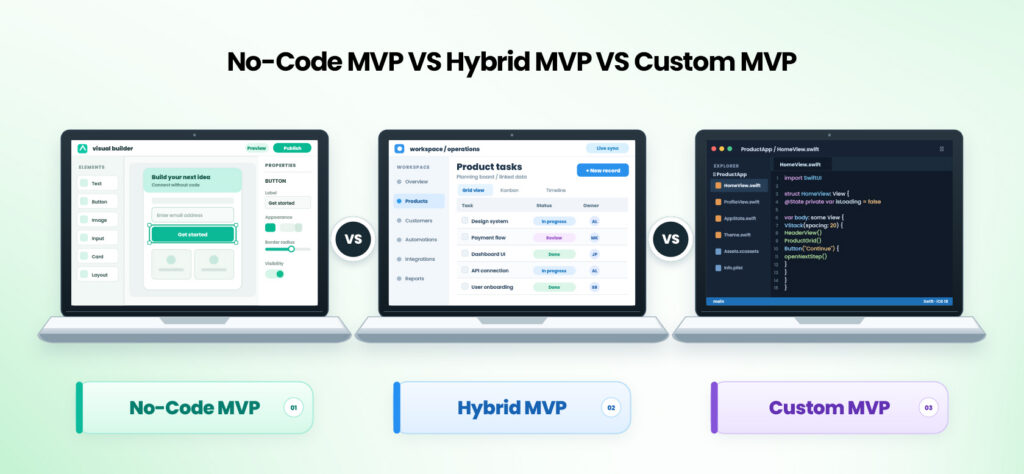
1. No-Code MVP
A no-code MVP assembles screens, databases, logins, and workflows on a visual platform such as Bubble, FlutterFlow, Adalo, Glide, or Softr. Many teams test the flow through interactive prototyping first, then build the winning version for under $30,000.
2. Custom MVP
A custom MVP uses engineered code for the front end, backend, database, and infrastructure, and budgets start near $35,000. Founders who compare custom software development vs digital product development before hiring avoid paying for the wrong scope.
3. Hybrid MVP
A hybrid MVP uses a visual platform for standard screens and engineered services where the product needs control. A common pattern pairs a no-code admin panel with a custom backend API development layer.
How Much Does a No-Code MVP Cost Beyond the Platform Fee?
The platform subscription forms one of the smaller lines in many no-code budgets. Design, configuration, integrations, and usage charges decide the real total.
| Cost line | What drives it | Budget effect |
| Platform plan | Users, storage, and usage-based workload | Recurring fee that rises with traffic |
| Design and configuration | Screens, roles, and data relationships | Often the largest one-time line |
| Integrations and plugins | Payments, CRM, messaging, analytics | Setup cost plus recurring third-party fees |
| Workarounds | Logic the platform does not support natively | Extra build hours with every exception |
| Migration reserve | Rebuild if the platform limits growth | Line item that founders often skip |
Founders who build alone still pay in time. Six weeks spent learning a platform carries a real cost, even without a developer invoice, and trimming scope early remains one of the simplest ways to reduce mobile app development cost before you pick a tool.
Many no-code builds ship as browser products. Therefore, a web app development company can help you judge platform limits before you commit funds.
What Drives the Cost of a Custom MVP in 2027?
A custom MVP typically costs $35,000 to $150,000 or more. Mobile app development cost climbs fastest with feature scope, platform count, integrations, and team model, so those four inputs deserve the most scrutiny.
| Stage | Typical timeline | What drives the cost |
| Discovery and planning | 1 to 3 weeks | Requirement depth and research |
| UX and UI design | 2 to 4 weeks | Screen count and custom interactions |
| Development | 6 to 12 weeks | Features, roles, integrations, architecture |
| Testing and QA | 2 to 3 weeks | Device coverage and security checks |
| Deployment and launch | 1 to 2 weeks | Cloud setup and store submission |
Cross-platform frameworks such as Flutter or React Native can trim 20 to 30% from the budget compared with two native apps.
In addition, dependable estimates need architecture decisions first, so a custom software development team should share its data model and integration plan before it quotes.
How Long Does It Take to Build a No-Code MVP vs a Custom MVP?
No-code wins the race to a first working version. However, the lead narrows once the product needs custom logic, strict security, or device features.
| Stage | No-code | Hybrid | Custom |
| Clickable prototype | Days | 1 to 2 weeks | 2 to 3 weeks |
| Working MVP | 2 to 8 weeks | 8 to 16 weeks | 12 to 24 weeks |
| Production-ready release | Depends on platform limits | Depends on the custom layer | Included in the 12 to 24 weeks |
Several steps stretch no-code schedules even though the building itself moves quickly. Data modeling, third-party approvals, and app store review all take calendar time, and none of them shrinks because the platform is visual.
Budget extra weeks for testing and store review, because every phase of the app development timeline stretches when scope grows.
Feature cuts save more weeks than any platform choice. A focused MVP development plan removes secondary features before design starts, and every removed feature lowers the invoice.
When Does a No-Code MVP Become More Expensive Than a Custom Build?
No-code costs less in the first months. Usage fees, plugin subscriptions, and workaround hours then grow with every new user, while a custom build spends most of its money upfront.
For products that gain traction, the two cost lines can cross within 12 to 24 months. On a visual platform, each new user raises the usage charge, while a custom system usually adds only incremental hosting once the build finishes. Use this timeline to see where each budget pressure appears.
- Months 0 to 6: No-code leads on both cost and speed.
- Months 6 to 18: Usage charges and workaround hours narrow the gap.
- Month 18 and beyond: A forced migration adds a second build budget.
A custom build needs the same 24-month view, and the hidden costs of custom software development include hosting, security updates, and maintenance that continue after launch.
Teams that treat the MVP as the first release of a digital product development roadmap budget for both sides from day one.
Price Both Paths Before You Commit
Share your feature list and Inceptives Digital will compare no-code, hybrid, and custom budgets side by side for your product.
Request My MVP Estimate!How Do You Choose Between No-Code and Custom Development?
Score each row for your product. Three or more answers in the right column point toward a hybrid or custom build.
| Question | Leans no-code | Leans hybrid or custom |
| Does the product move money between parties? | Simple checkout | Escrow, payouts, commissions |
| Does it need offline use? | No | Yes |
| How many user roles exist? | One or two | Three or more |
| Does it require compliance such as HIPAA or GDPR? | No | Yes |
| How many outside integrations does it need? | One to three standard connectors | Several, or custom APIs |
| Do you expect heavy traffic within 12 months? | No | Yes |
| What is the riskiest assumption? | Will people want this? | Will the technology work? |
| What is your budget ceiling? | Under $30,000 | $35,000 or more |
Read your score this way: zero to two answers in the right column favor no-code, three to five favor hybrid, and six or more favor a custom build. If your riskiest assumption sits in the right column, move one step toward custom even when the count looks low.
Run the demand question first with a short test, because you can validate a mobile app idea for far less than any build costs.
Next, turn your scores into a scoped feature list and budget. A product strategy consulting session can do that in a few days.
When Does a Hybrid MVP Beat Going Fully No-Code or Fully Custom?
A hybrid MVP spends custom engineering only where the product needs it. Budgets often land between $30,000 and $75,000, and timelines between 8 and 16 weeks.
- Teams build a no-code admin dashboard and pair it with a custom customer app.
- Teams build a custom backend and connect a no-code front end through APIs.
- Teams validate with a no-code prototype, then rebuild the proven flow in code.
Fewer features mean a smaller hybrid budget, so MVP mobile app development works best when the team cuts everything outside the validation path.
Clean boundaries matter most, so plan system integration and API automation before you split the work, because vague boundaries inflate integration costs.
Where AI App Builders Fit in 2027
A fourth option now sits beside the three paths above, and it changes the early budget more than the long-term one. Gartner expects around 4 in 5 software engineers to upskill by 2027 as generative AI reshapes their workflows, which makes AI tooling a budget line in every path.
Where AI Builders Save Money
AI app builders can draft screens and basic logic in hours, which trims prototype budgets. The real question in AI app builders vs human developers is where speed ends and engineering review begins.
Where AI Builders Add Risk
Generated code still needs review for security, data handling, and structure. Teams that skip review can repeat the common mistakes when building apps with AI, and those fixes cost more than the hours they saved.
When an AI Product Needs Engineering
An AI-native product needs evaluation, guardrails, and monitoring on top of the interface. That scope belongs in AI MVP development, with a budget separate from the front-end build.
Three Budget Scenarios: Which Path Fits Which Founder
The Demand Tester With Under $30,000
A solo founder who needs proof of paying users should favor no-code. Keep the scope to one workflow, because software development for startups rewards narrow first releases that test a single assumption.
The Seed-Stage Team Handling Payments
A funded startup that handles payouts, multiple roles, and compliance should budget at least $35,000 and start with a hybrid or custom build. The signs your startup needs custom software development become easy to spot once you list those requirements.
The AI Product Builder
A team that builds an AI-driven product should budget for model evaluation, guardrails, and review before the interface. The gap between an AI MVP vs full AI product decides how large that first release becomes.
What Is a Switch Point and How Do You Plan a No-Code Migration?
A switch point is the usage level, feature gap, or cost threshold that triggers a rebuild. Set it before launch so migration lands in the roadmap budget, because it adds a second build cost.
| Signal | What it means | Budget effect |
| A core feature needs a workaround | The platform lacks the capability | Rising build hours per feature |
| Platform bills grow faster than revenue | Usage pricing outpaces value | Custom hosting may cost less at scale |
| Performance slows under load | The platform reached its limit | Rebuild of the slowest modules |
| Compliance or security rules change | Platform controls fall short | Audit and rebuild costs |
| Integrations fail or need constant repair | Connectors turn unreliable | Custom API work |
A planned migration follows five steps:
- Document workflows, data fields, and integrations.
- Export all data and test the import path.
- Define the target architecture and stack.
- Rebuild the core features first and retest every workflow.
- Retire the platform once the new product runs live.
Document Before You Migrate
Write down workflows, data fields, and integrations while the product still runs. If the platform already blocks growth, a product rescue and scaling engagement can stabilize it during the rebuild.
Choose the Target Stack
Pick the stack from product needs and team skills. A cross-platform app development approach with one codebase can trim the rebuild budget for mobile products.
Decide Who Rebuilds
Weigh in-house development vs an app development partner by cost, speed, and handover risk, since each option changes the rebuild budget differently.
Manage Rebuild Risk
Plan for data loss, downtime, and scope creep before cutover. A structured app development risk management plan helps keep the rebuild inside its budget.
Pick the Path, Set the Switch Point, Protect the Budget
Four decisions carry most of the weight in this choice.
- Choose no-code under $30,000 when one workflow tests demand, and you need a working version in 2 to 8 weeks.
- Choose custom at $35,000 or more when payments, offline use, roles, or compliance carry the risk.
- Choose hybrid between $30,000 and $75,000 when only the backend needs engineering control.
- Set a switch point and reserve migration funds before the first user signs up.
Start with a discovery sprint to price your requirements before you commit to any path.
Turn Your Scorecard Into a Funded Build Plan
Bring your scorecard results to Inceptives Digital and leave with a scoped feature list, a budget range, and a timeline.
Get My MVP Build Plan!Frequently Asked Questions
A no-code MVP can stay under $30,000 for a scoped workflow, while a custom MVP typically costs $35,000 to $150,000 or more. Scope moves the numbers more than the method, so a complex no-code build can cost as much as a simple custom one.
A no-code MVP can reach a working version in about 2 to 8 weeks. A custom MVP usually needs 12 to 24 weeks across discovery, design, development, testing, and launch, and hybrid builds fall between the two at roughly 8 to 16 weeks.
Yes, for standard checkout flows, since many platforms connect to common payment services. Escrow, split payouts, commissions, and compliance checks usually call for custom engineering, as the Dropryde marketplace shows with its four connected products and Stripe Connect escrow.
The main hidden costs include usage-based platform fees, plugin subscriptions, workaround hours, third-party integration fees, and eventual migration. Together, these lines can erase early savings once the product gains users.
Move when a core feature needs a workaround, platform bills grow faster than revenue, performance drops under load, or compliance rules change. Set these triggers before launch so the rebuild fits the roadmap and budget.
AI app builders can speed up prototypes and lower early design costs. However, generated code still needs review for security, data handling, and structure, so treat these tools as a drafting aid that still needs engineering review.
Choose no-code, limit the MVP to one workflow, and run the demand test first. If the test succeeds, reserve part of the remaining budget for a migration plan before usage grows.












CTO Insight:
“No-code is a sound architecture decision until the product outgrows it, so design the exit path before building the first screen.”
— Atif Zaidy, CTO, Inceptives Digital