
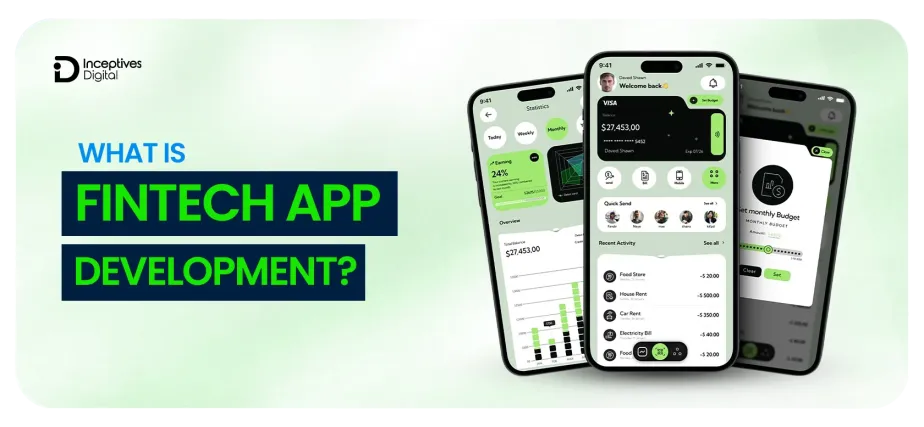

Fintech is short for financial technology, and it refers to applying modern technology to make financial services more accessible and effective for everyone involved.
This category covers digital banking, insurance technology (insurTech), online trading, digital payment systems, cryptocurrency, lending services, etc.
The demand for these apps is increasing among users and businesses alike. Building a FinTech app goes beyond a clean interface. It has three strong pillars as a foundation: compliance, scalability, and regulatory.
Because your app processes real money and sensitive data, encryption, identification verification, and API security are required from day one.
To cope with all these, you must work with an experienced FinTech app development company that helps you build a product that users trust and regulators approve faster and with fewer costly mistakes.
Key Takeaways
- FinTech app development creates secure digital financial products.
- Costs range from $20,000 to $500,000+.
- Key technologies include AI, blockchain, cloud computing, and open banking APIs.
- Essential features include MFA, KYC/AML, real-time payments, and fraud detection.
- Compliance with GDPR, PCI DSS, and AML regulations is mandatory.
What Is FinTech App Development?
FinTech app development is the process of designing, building, and deploying secure, compliant mobile and web applications that deliver financial services, including payments, banking, lending, and investing, using technologies like AI, blockchain, cloud infrastructure, and open banking APIs.
The core technical building blocks behind any FinTech app include:
- API connectivity: Connects the app securely to banks, payment processors, and third-party financial services
- Cloud infrastructure: Delivers always-available data storage and real-time processing at scale
- End-to-end encryption: Keeps sensitive data protected in transit and at rest
- Multi-factor authentication (MFA) blocks unauthorized access before it happens
- KYC/AML compliance tools: Automate identity verification and anti-money-laundering monitoring
- AI and machine learning: Power fraud detection, credit scoring, and personalized financial insights
- Blockchain: Records transactions in a transparent, decentralized, tamper-resistant ledger
How FinTech Apps Differ from Traditional Banking Software
Here is something worth understanding clearly. Traditional banking software was built decades ago to serve internal branch operations, and most of it still runs on monolithic architectures from the 1970s and 1980s. These systems take months to update, struggle to scale, and were never designed with mobile use in mind.
FinTech apps are a fundamentally different animal. They run on modern API-first, cloud-native, microservices architectures where each component updates, scales, or replaces independently. That design means faster development cycles, simpler integrations, and the ability to ship new features without rebuilding the entire system from scratch.
| Feature | Traditional Banking Software | FinTech Apps |
| Architecture | Monolithic | Microservices / API-first |
| Deployment | On-premise | Cloud-native |
| Update cycle | Months to years | Continuous (CI/CD pipelines) |
| Mobile support | Limited or retrofitted | Mobile-first by design |
| Integration | Closed, proprietary | Open APIs, third-party ready |
| Real-time processing | Limited | Native capability |
| User experience | Form-based, functional | Intuitive, personalized |
What are the Different Types of FinTech Apps
FinTech mobile app development covers a wide range of products, serving everyone from individual consumers to large financial institutions.
Before you plan your product, it helps to know exactly which category you are building in, because each one has different technical requirements, compliance obligations, and cost structures.
| FinTech App Type | Complexity | Cost |
| Wallet | Medium | $40k-$80k |
| Banking | High | $100k-$250k+ |
| Lending | High | $60k-$120k |
| Investment | High | $90k-$180k |
Digital Wallet Apps
Digital wallets let users store money electronically and pay instantly from their phone. They support P2P transfers, bill payments, and contactless NFC payments at checkout.
Security features like tokenization, end-to-end encryption, and biometric authentication keep every transaction protected. Apple Pay, Google Pay, and PayPal are the names most people know here.
In terms of cost, digital wallet app development typically runs between $40,000 and $80,000, depending on the feature depth and compliance requirements you need to meet.
Mobile Banking Applications
A mobile banking app gives your customers a full-service bank in their pocket. They can check balances, transfer money, pay bills, apply for loans, and get support, all without setting foot in a branch.
These mobile banking apps run on secure APIs and cloud platforms, which is what makes round-the-clock availability possible.
Investment and Trading Apps
Investment apps let users buy, sell, and manage stocks, ETFs, mutual funds, cryptocurrencies, and other instruments.
They combine real-time market data, AI-powered portfolio analytics, and interfaces that work equally well for a first-time investor and a seasoned trader.
Lending and Loan Apps
Lending app development takes the borrowing process completely digital. Automated underwriting, AI-powered credit scoring, and digital KYC verification replace the paperwork and branch visits that used to define this process.
InsurTech Applications
InsurTech apps bring insurance management fully online. Policy management, claims filing, premium payments, and renewal reminders all live in one place. Data analytics and automation improve how accurately insurers price risk and how quickly they settle claims.
Cryptocurrency and Blockchain Apps
Crypto app development gives users a secure environment to buy, sell, hold, and transfer digital assets. These apps run on blockchain technology, which records transactions in a decentralized ledger that no single party can alter after the fact.
Development teams focus heavily on wallet encryption, private key management, and regulatory compliance across jurisdictions. Coinbase, Kraken, and MetaMask are the most recognized names here.
Personal Finance and Budgeting Apps
Personal finance apps help people track spending, set savings targets, and manage budgets in real time. Most connect directly to bank accounts through open banking APIs and categorize transactions automatically.
AI then surfaces the patterns and savings opportunities users would otherwise never notice.
Payment Gateway Solutions
Payment gateway apps let businesses accept and process online payments securely. They connect to e-commerce platforms and banking APIs to support cards, ACH, digital wallets, and buy-now-pay-later options.
Fraud detection and transaction encryption run underneath every payment. Stripe, Square, and Adyen lead this space.
Core Features of a FinTech App
Every serious FinTech application balances security, compliance, and user experience as equal priorities. These are not trade-offs you choose between.
You need all three working together. Here are the features that set the baseline for any financial product worth shipping.
- User Authentication and Security: AES-256 encryption, MFA, and biometrics protect accounts and sensitive financial data.
- KYC and AML Compliance FinTech: Automated verification and monitoring ensure compliance and reduce financial crime risks.
- Real-Time Transactions and Notifications: Instant payments and notifications improve transparency and user confidence.
- Secure API and Banking Integrations: APIs connect banks, payment gateways, and financial service providers securely.
- AI-Powered Financial Insights: AI delivers spending analysis, savings recommendations, and fraud detection.
- Regulatory Compliance Framework: Supports GDPR, CCPA, PCI DSS, and local financial regulations.
Technologies Used in Fintech Application Development
The technology stack you choose shapes everything downstream, including reliability, scalability, compliance capability, and long-term maintenance cost. Here is what powers modern FinTech software development.
Artificial Intelligence and Machine Learning
AI and ML handle the most demanding parts of any FinTech product, letting platforms grow their user base without growing operational costs at the same rate. The core use cases include:
- Fraud detection that flags suspicious transactions in real time
- Credit risk scoring that evaluates borrower profiles faster than manual review
- Personalized financial recommendations based on individual spending behavior
- Robo-advisory services that deliver investment guidance at scale
- Customer service automation through AI-powered chat and voice assistants
Blockchain Technology
Blockchain records transactions in an immutable, decentralized ledger that no single authority controls. It cuts intermediary costs, reduces fraud risk in high-value transfers, and powers smart contracts that execute payments automatically. The main FinTech applications are:
- Cryptocurrency exchanges and digital asset platforms
- Cross-border payment rails that settle faster and cheaper than SWIFT
- Digital identity verification that reduces KYC friction
Cloud Infrastructure
AWS, Google Cloud, and Azure give FinTech apps the reliability and scale they need at any volume, without physical server overhead. This foundation is also what makes mobile app performance optimization achievable as your user base grows. Key capabilities include:
- Auto-scaling that handles traffic spikes without manual intervention
- Multi-region redundancy that keeps the app live during partial outages
- Encrypted storage and automated backups that meet compliance requirements
Big Data and Analytics
Big Data platforms process high volumes of financial transactions in real time. The analytics built on top make a FinTech product genuinely intelligent. Specifically, they:
- Reveal customer behavior patterns that inform product and pricing decisions
- Flag fraud anomalies that rule-based systems miss
- Support risk decisions with historical and predictive modeling
- Power the audit trails regulators expect during examinations
Open Banking APIs
Open banking frameworks like PSD2 enable banks and authorized apps to share financial data securely, reducing the time required to build valuable features on existing banking infrastructure.
The main features they unlock are:
- Account aggregation across multiple banks in a single interface
- Direct payment initiation without redirecting users to a bank portal
- Real-time balance and transaction data for budgeting and lending decisions
- Consent-based financial data portability that users control
Cybersecurity Frameworks
Every FinTech product is a target. The question is whether your security architecture is strong enough to hold. The baseline for any defensible posture includes:
- TLS/SSL encryption for all data in transit
- OAuth 2.0 for secure, token-based authorization
- Intrusion detection systems that flag unusual activity in real time
- Regular penetration testing by external specialists, not just internal audits
- PCI DSS and GDPR compliance built into data handling from day one
A layered defense-in-depth model is what actually stops breaches, phishing, and API-level attacks.
Cross-Platform Development with React Native and Flutter
Cross-platform development lets teams ship iOS and Android apps from a single codebase, reducing time and cost without sacrificing native performance. Both React Native and Flutter are strong choices in FinTech for their API integration support and active communities.
Real-World FinTech App Examples
Looking at what the best FinTech products have actually built gives you a realistic benchmark before you start. Here are five worth studying closely.
| App Category | Example | Why It’s a Strong FinTech Example |
| Digital Payments | PayPal | Scales to 430M+ users while maintaining security and reliability. |
| Payment Infrastructure | Stripe | Demonstrates how API-first development enables global financial automation. |
| Investment & Trading | Robinhood | Made commission-free investing accessible but highlighted compliance challenges. |
| Neobanking | Revolut | Serves 45M+ customers without operating physical branches. |
| Cryptocurrency | Coinbase | A compliance-first approach helped drive mainstream cryptocurrency adoption. |
How Inceptives Digital Builds FinTech Apps
At Inceptives Digital, we follow a structured seven-step process for every FinTech project. No shortcuts, no guesswork, just a proven approach that keeps builds on track and products working reliably from day one.
Step 1: Market Research and Idea Validation
We map your competitive landscape, define your target user, validate app ideas, and identify regulatory requirements before writing a single line of code. Wrong assumptions caught here cost a fraction of what they would cost mid-build.
Step 2: MVP Strategy
We get something real in front of your users fast. A focused FinTech MVP generates genuine behavioral feedback, keeps early costs lean, and gives the product a direction grounded in evidence.
Step 3: UI/UX Design
We design for the moment a user is transferring money or applying for a loan. That is not the time for a confusing interface. Our financial UX is clean, mobile-first, and built to convert trust into action.
Step 4: Backend and Frontend Development
Our web app development team builds both layers as one integrated process. We use microservices architecture, so every component scales independently, which means no single update puts the whole system at risk.
Step 5: Security Implementation
Security is in the architecture from sprint one, not added at the end. AES-256 encryption, MFA, KYC/AML tooling, fraud detection, and a full penetration test before launch. Our clients do not get handed a security problem after go-live.
Step 6: QA and Compliance Testing
Our FinTech mobile app testing frameworks are for functional correctness, performance under load, and security vulnerabilities. We also verify compliance with GDPR, PCI DSS, and SOC 2 before anything ships.
Step 7: Deployment and Maintenance
We deploy on secure, compliant cloud infrastructure and stay involved after launch. Security patches, feature updates, and performance tuning are part of the engagement, not an afterthought.
How Much Does FinTech App Development Cost?
FinTech app development typically costs between $20,000 and $500,000+, depending on complexity, security requirements, compliance needs, and integrations.
It depends on several factors, including app complexity, security requirements, compliance scope, the feature set, and where the development team is based.
The table below gives you realistic current market benchmarks to work from.
| App Type | Estimated Cost Range | Typical Timeline |
| MVP / Basic App | $20,000 – $60,000 | 3–5 months |
| Digital Wallet / Payments App | $40,000 – $80,000 | 4–6 months |
| Lending / Microfinance App | $60,000 – $120,000 | 5–8 months |
| Banking / Neobank App | $100,000 – $250,000+ | 8–14 months |
| Wealth / Investment Platform | $90,000 – $180,000 | 7–12 months |
| InsurTech App | $80,000 – $170,000 | 6–10 months |
| AI + Blockchain Enterprise Platform | $150,000 – $500,000+ | 12–18+ months |
What drives cost up most:
- AI and ML features, including fraud detection, robo-advisory, and credit scoring
- Blockchain integration and smart contract development
- Multi-jurisdictional compliance covering KYC, AML, GDPR, and PCI DSS
- Real-time data processing at scale
- Connecting to legacy banking core systems
- Dedicated cybersecurity infrastructure and pre-launch penetration testing
How FinTech Apps Benefit Users and Companies
Businesses keep investing in FinTech products because the returns are real and measurable. Here is what these products actually deliver for users and companies alike.
- 24/7 Access and Convenience: Users manage their finances from their phone, at any hour, from anywhere. No branch visits, no hold music, no waiting for business hours.
- Faster Transactions: FinTech platforms move money in seconds or minutes. A standard ACH transfer takes 1 to 3 business days. An international wire takes 3 to 5. That speed difference permanently changes how users interact with money.
- Better Financial Visibility: Real-time dashboards, automatic spending categorization, and budget tracking give users a far more accurate picture of their finances than a monthly bank statement ever could.
- Stronger Security: Modern FinTech apps run AES-256 encryption, biometric authentication, device fingerprinting, behavioral analytics, and real-time fraud monitoring simultaneously, often outperforming legacy banking systems built decades ago.
- Lower Costs for Users: Leaner infrastructure means lower transaction fees, no monthly maintenance charges, better exchange rates, and higher savings interest rates, making financial services accessible to people traditional banks have historically underserved.
Challenges in FinTech App Development
No honest guide to FinTech development would skip the hard parts. Here are the challenges you need to plan for, not discover mid-project.
Regulatory and Legal Compliance
- Challenge: KYC, AML, GDPR, PSD2, and PCI DSS requirements vary by country, and non-compliance means fines, app removal, or criminal liability.
- Solution: Build compliance into the architecture from day one and engage a legal specialist for each target market before development starts.
Data Security and Privacy
- Challenge: The average financial sector data breach can cost millions, making FinTech apps a high-value target for cybercriminals.
- Solution: Implement a layered security architecture with AES-256 encryption, regular third-party penetration testing, and a documented incident response plan before launch.
Integration with Legacy Banking Systems
- Challenge: Many banks still run on COBOL-based mainframe infrastructure from the 1970s and 1980s, making modern integrations slow and expensive.
- Solution: Plan for custom middleware and detailed API mapping during scoping, not after development has already started.
High Development and Maintenance Costs
- Challenge: Secure, compliant FinTech development requires experienced engineers, security specialists, and compliance experts, and the cost continues well beyond launch.
- Solution: Budget for the full lifecycle upfront, including post-launch maintenance, security patches, and ongoing compliance monitoring.
Building and Maintaining User Trust
- Challenge: A single security incident or compliance failure can permanently damage user confidence in a financial product.
- Solution: Make transparent communication, consistent uptime, and strong data practices non-negotiable standards, not afterthoughts.
Profitable FinTech App Ideas for Startups in 2026
The most attractive opportunities in FinTech right now center on underserved segments, AI-driven automation, and embedded finance.
Some of the strongest Fitech startup app ideas are:
- AI-powered personal finance assistants that coach individuals on budgeting and savings, particularly those that mainstream advisory services overlook entirely.
- Neobanks for niche segments serving gig workers, freelancers, immigrants, and students, people that traditional banks have never designed products for.
- B2B payment automation platforms that help small and mid-size businesses manage invoicing, payroll, vendor payments, and cash flow in one place.
- RegTech solutions that automate KYC and AML compliance reporting for institutions carrying heavy regulatory workloads.
- Embedded finance APIs that let e-commerce, SaaS, and logistics companies offer lending, payments, or insurance natively inside their own products.
- AI-driven alternative lending that uses non-traditional data for credit scoring in markets where thin-file borrowers have no path to credit through conventional channels.
- Decentralized finance (DeFi) interfaces that make blockchain-based financial products usable for everyday people, not just crypto-native audiences.
Have a FinTech App Idea? Let’s Build It.
FinTech app development is not just about building a good-looking app. It is about getting security, compliance, and scalability right from day one. The businesses winning in this space are the ones that treat those three things as foundations, not features.
Whether you are starting with an MVP or planning a full-scale platform, the decisions you make early shape everything that follows. Build it right the first time, and the product works for you long after launch.
Frequently Asked Questions
It is the process of designing and deploying secure financial apps, covering payments, banking, lending, and investing, using AI, blockchain, and cloud infrastructure.
They connect users to financial services through secure APIs and encrypted channels. A transaction that authenticates via MFA is processed through a secure API call and returns a result in seconds.
Digital wallets, mobile banking apps, investment platforms, lending apps, InsurTech applications, cryptocurrency apps, personal finance tools, and payment gateway solutions.
A basic MVP runs $20,000 to $60,000. Mid-complexity apps cost $60,000 to $150,000. Enterprise platforms with AI and blockchain can exceed $500,000. See our full cost breakdown.
An MVP takes 3 to 5 months. A full enterprise platform takes 12 to 18 months or more, depending on complexity, compliance scope, and integrations. See our app development timeline guide.
KYC, AML, GDPR, PCI DSS, and PSD2 are the core ones. Local licensing requirements also apply. The exact rules depend on what the app does and where it operates.
AI, ML, blockchain, cloud platforms like AWS and Azure, open banking APIs, Big Data analytics, cybersecurity frameworks, and cross-platform tools like React Native and Flutter.
Payments and money transfer, lending and credit, investment and wealth management, and insurance technology. Blockchain and digital banking infrastructure are increasingly recognized as additional pillars.
