- FinTech startup apps create business opportunities across digital banking, payments, lending, and financial management.
- AI-powered financial assistants help users manage budgets, track spending, and receive personalized financial insights.
- Digital banking and P2P payment apps provide convenient alternatives to traditional financial services.
- BNPL, embedded finance, and cross-border payment solutions address different consumer and business payment needs.
- Blockchain, AI, cloud computing, and open banking APIs support modern FinTech app development.
- A focused FinTech MVP may cost $40,000 – $80,000, excluding additional licensing, financial infrastructure, and external compliance expenses.
- Security measures and regulatory requirements such as KYC, AML, and PCI DSS affect development costs.
- Choosing a profitable FinTech app idea requires clear market demand and a sustainable revenue model.
From instant payments to AI-driven investing, FinTech startup apps are opening powerful new revenue opportunities for modern businesses.
According to a McKinsey report, the global FinTech industry could reach $2 trillion in annual revenue by 2030, nearly three times its estimated $650 billion revenue last year. This projected growth highlights expanding opportunities for startups across digital banking, payments, lending, and investment services. A clear signal that FinTech is not just a niche but a mainstream profit-generating opportunity for new businesses.
For modern businesses, building or investing in FinTech startup apps isn’t just about following in on a trend. It’s about solving real financial challenges, creating lasting customer value, and gaining a competitive edge in a rapidly evolving digital economy.
In this blog, we’ll explore 10+ high-potential FinTech startup app ideas that can inspire your next successful business venture. From essential digital banking and payment tools to niche innovations, a FinTech app development company can help build apps like RegTech and AI-powered financial assistants.
10+ Lucrative FinTech Startup App Ideas
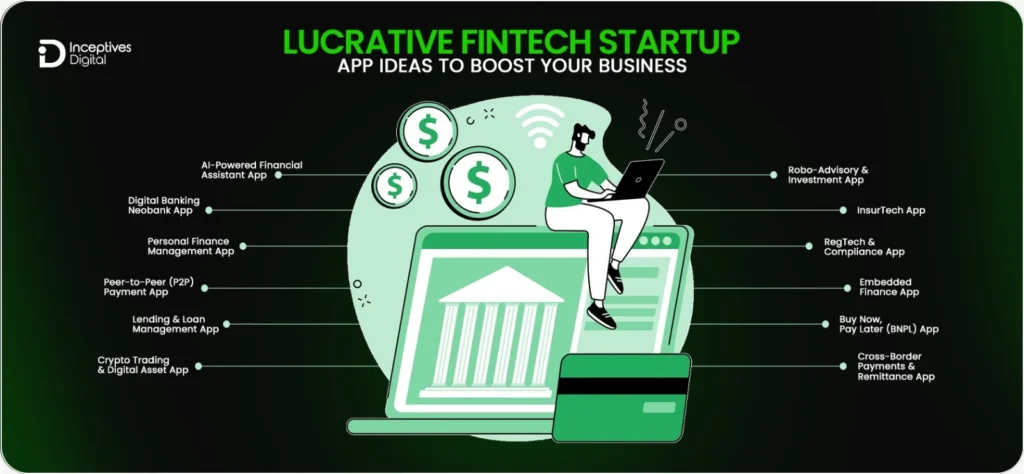
Finance is evolving faster, and it is no longer limited to traditional banks; digital solutions are now driving the pace of innovation. As user expectations are transforming towards personalization, speed, and security, FinTech apps are the most powerful tools for market disruption and business growth.
The following are some high-potential mobile app ideas for FinTech startups with real-world examples targeting in-demand sectors like digital banking, payments, lending, and wealth management, and most promising for future growth.
1. AI-Powered Financial Assistant App
The growing adoption of AI by financial institutions is focused on improving customer experience in the digital banking sector.
AI-powered financial assistant apps analyze transaction patterns, categorize spending, and help users manage budgets or savings goals. Through AI chatbot development services, startups can introduce conversational financial guidance and personalized insights, while regulated investment advice may require additional oversight and compliance controls.
Examples
| App Name | Core Function | Target Users |
| Erica (Bank of America) | AI chatbot for banking & insights | Retail banking customers |
| Cleo | AI-driven budgeting assistant | Young consumers |
| Plum | Automated savings & spending analysis | Personal finance users |
2. Digital Banking / Neobank App
Digital-first banking has changed how customers manage accounts, transfer money, and access financial services. Neobanks deliver these experiences through mobile banking apps, often without operating physical branches.
Some neobanks hold banking licenses, while others partner with regulated financial institutions to provide deposit accounts and payment services. Their revenue models include subscriptions, interchange fees, and additional financial products.
Examples
| App Name | Core Function | Market Focus |
| Revolut | Digital banking & global payments | Global consumers |
| Chime | Fee-free mobile banking | US retail users |
| N26 | Mobile-first banking | European market |
3. Personal Finance Management App
As users are getting smarter in controlling their money, the demand for managing financial solutions continues to grow.
Personal finance management apps help businesses target customers who record their expenses, make budgets, and set financial goals. Ideal for consumer-focused startups working with financially conscious users, these apps are great for taking the first step towards the budget-friendly market.
Additionally, AI app development services can add insights that benefit user spending habits and give personalized money management suggestions
Examples
| App Name | Core Function | User Segment |
| Monarch Money | Budgeting, expense tracking & financial planning | Individuals & households |
| YNAB | Zero-based budgeting | Budget-focused user |
| PocketGuard | Spending control & savings | Young professionals |
4. Peer-to-Peer (P2P) Payment App
Peer-to-peer payment apps allow users to transfer money directly between supported accounts, often within seconds. However, settlement times depend on the provider, payment network, and withdrawal method.
These applications serve consumers, freelancers, and small businesses that need convenient digital transfers, payment requests, and transaction tracking without relying on cash.
Examples
| App Name | Core Function | Primary Use |
| Venmo | Social P2P payments | Consumers |
| Cash App | Transfers & investing | Individuals & SMEs |
| Zelle | Bank-to-bank transfers | Banking customers |
5. Lending & Loan Management App
Loan originations, approvals, and repayments are completely digitized by modern lending and loan apps. They implement different credit scoring models and AI-based risk assessment techniques built through machine learning development services to widen access to a larger range of users.
These apps are suitable for banks, NBFCs, and startups targeting underserved markets.
Examples
| App Name | Core Function | Market |
| LendingClub | Digital lending & personal loans | US consumers |
| Funding Circle | SME loans | Small businesses |
| Upstart | AI-based credit scoring | Retail lending |
6. Crypto Trading & Digital Asset App
With the growing attention on digital assets, secure and easy-to-use trading platforms have now become a necessity.
Blockchain development enables verifiable transaction records, while digital asset platforms require additional controls for wallet security, custody, identity verification, and transaction monitoring. Their reliability depends on both the underlying network and the platform’s security architecture.
These applications generate income from trading commissions, custody services, and advanced analytical tools.
Examples
| App Name | Core Function | Focus |
| Coinbase | Crypto trading & storage | Retail investors |
| Binance | Advanced crypto exchange | Global traders |
| Kraken | Secure crypto trading | Institutional & retail |
7. Robo-Advisory & Investment App
Automated investment platforms make portfolio management more accessible through algorithm-based financial planning, portfolio allocation, and rebalancing. Some platforms also incorporate AI to enhance financial insights and personalization.
Investors and asset managers are now adopting AI, which is deployed through robo-advisory apps for fully automated investment planning and portfolio management. These apps lower costs while making wealth management accessible to a broader audience.
Examples
| App Name | Core Function | Target Users |
| Betterment | Automated investing | Retail investors |
| Wealthfront | Goal-based portfolios | Professionals |
| Schwab Intelligent Portfolios | Automated portfolio management & rebalancing | Long-term investors |
8. InsurTech App
With the ongoing digital transformation, insurance companies are now achieving better efficiency and higher customer satisfaction by leveraging these apps.
InsurTech applications use custom software development to digitize policy management, claims processing, customer support, and risk assessment. These capabilities help insurers reduce manual work, improve service accessibility, and identify opportunities for operational savings.
Examples
| App Name | Core Function | Insurance Type |
| Lemonade | AI-driven insurance | Home & renters |
| Root | Usage-based insurance | Auto insurance |
| Oscar Health | Digital health insurance | Healthcare |
9. RegTech & Compliance App
When regulations get more complicated, financial companies rely on more intelligent compliance solutions.
RegTech applications help financial institutions automate identity verification, transaction screening, regulatory reporting, and compliance monitoring. They reduce repetitive work and improve visibility, while compliance teams remain responsible for reviewing exceptions and maintaining effective controls.
Examples
| App Name | Core Function | Use Case |
| Trulioo | Identity verification | Global KYC |
| Entrust (Onfido) | AI-powered identity verification | Digital KYC & fraud prevention |
| ComplyAdvantage | AML monitoring | Financial compliance |
10. Embedded Finance App
To provide users with seamless experiences, businesses are slowly embedding financial functions into their platforms through system integration api automation.
Embedded finance allows non-financial platforms to offer payments, lending, insurance, or financial accounts within their existing products. Businesses typically work with licensed financial institutions or specialized providers to deliver regulated services without becoming banks themselves.
Examples
| Platform | Embedded Feature | Industry |
| Shopify | Embedded payments & loans | E-commerce |
| Uber | Driver payouts & wallets | Mobility |
| Stripe | Embedded payment infrastructure | SaaS platforms |
11. Buy Now, Pay Later (BNPL) App
Shifts in consumer purchasing behavior have fueled the rapid growth of flexible payment solutions. Buy Now, Pay Later (BNPL) applications allow consumers to split purchases into smaller installments, often through interest-free repayment plans. However, some plans charge interest or late-payment fees, while merchants use BNPL options to support conversions and flexible checkout experiences.
Retailers integrate BNPL to offer more flexible checkout options and potentially improve conversion rates or average order values. Results depend on customer demand, approval rates, financing terms, and the merchant’s product category.
BNPL platforms also open up data-driven credit and merchant partnership opportunities.
Examples
| App Name | Core Function | Market |
| Klarna | Consumer BNPL | Global retail |
| Afterpay | Installment payments | E-commerce |
| Affirm | Flexible financing | Online merchants |
12. Cross-Border Payments & Remittance App
An increase in international trade with the rise of remote work has led to a demand for international payments that are faster and cheaper.
Cross-border payment apps help individuals and businesses transfer money internationally with clearer exchange rates, payment tracking, and competitive fees. Transfer speed and cost still depend on currencies, payment networks, regulatory checks, and destination countries.
For internationally active SMEs, freelancers, and eCommerce businesses, features such as multicurrency accounts, transfer tracking, and transparent exchange rates can simplify cross-border financial operations.
Examples
| App Name | Core Function | Target Users |
| Wise | Low-cost international transfers | Individuals & SMEs |
| Remitly | Global remittances | Migrant workers |
| Payoneer | Cross-border business payments | Freelancers & businesses |
This list of innovative app ideas is just the start; bringing them to life requires a solid technology stack to ensure performance, security, and a smooth user experience.
Make Your FinTech App Idea the Next Game-Changing Solution!
Don’t just read about innovation, build a secure, scalable FinTech app that disrupts the market and drives growth.
Launch Your FinTech App NowKey Technologies Required to Build FinTech Apps
To develop a FinTech app that performs well and gets the desired customer base, a robust technology stack is necessary for a secure and scalable app development project. The following core technologies are mainly responsible for modern-day financial applications.
Artificial Intelligence & Machine Learning
AI development and ML are changing the face of FinTech by enhancing decision-making and providing automation. The financial sector is utilizing these technologies to provide personalized financial advice, analyze spending, set budgets automatically, and detect fraud. Moreover, AI can analyze a huge amount of financial data for predictive insights and intelligent solutions to improve user experience and operational efficiency.
Blockchain & Smart Contracts
The benefits of blockchain technologies include verifiable transaction records, digital asset transfers, and programmable financial agreements. Smart contracts can automate specific actions, such as releasing funds when predefined conditions are met.
However, lending, insurance, and international payment workflows may still require external data, regulatory approvals, and financial intermediaries. Startups should assess whether blockchain offers a practical advantage over conventional financial infrastructure.
Cloud Computing
Cloud infrastructure offers the scalability and flexibility necessary for FinTech apps to handle large volumes of transactions and user data. Hosting apps on cloud platforms allows for real-time processing, secure storage, and rapid deployment of updates. Cloud computing also supports AI and analytics functionalities, enabling seamless financial insights for both businesses and consumers.
Open Banking APIs
Open banking APIs allow authorized FinTech applications to access supported financial data and, where available, initiate payments through participating providers.
Through backend API development, startups can integrate account aggregation, financial insights, and supported payment services without building every financial component from scratch.
Having covered the key FinTech app ideas and their underlying technologies, let’s look at the mobile app development cost of bringing such an app to life.
How Much Does It Cost to Develop a FinTech Startup App?
The FinTech startup app cost can be estimated based on various strategic and technical factors, such as the complexity of features and compliance requirements. Digital financial services continue to gain users worldwide. According to Juniper Research, global digital wallet users are projected to exceed 6 billion by 2030, representing more than three-quarters of the world’s population. This growing adoption highlights opportunities for FinTech startups, making realistic development budgets essential for entering an increasingly competitive market.
The development budget is shared among several important cost drivers like feature complexity, platform selection (iOS, Android, web), third-party integrations, UI/UX design, and rigorous security and compliance requirements such as KYC, AML, PCI-DSS, and GDPR. Developing a basic MVP with core features like payments or account management can be built at a lower cost, while incorporating advanced functionalities such as AI analytics, real-time processing, or blockchain development leads to a substantial increase in both time and cost.
MVP development may require an estimated $40,000 – $80,000 when it uses established financial integrations and limits its initial feature scope.
Production-ready platforms can require $120,000 – $300,000 or more. Complex banking, lending, and investment products may exceed these ranges because of regulatory obligations, infrastructure requirements, and transaction-processing complexity.
These figures are indicative development budgets, not industry averages. Licensing, external audits, financial service provider fees, and ongoing operations may require separate investment.
The key to building a successful FinTech app lies not just in innovative features but in balancing functionality and a secure, compliant foundation as you reduce app development costs.
Need a Realistic Budget for Your FinTech App?
FinTech development costs depend on your features, integrations, and compliance needs. Get a project-specific estimate from Inceptives Digital before committing to development.
Get a Development EstimateSecurity & Compliance Considerations in FinTech Apps
Ensuring strong security and compliance is a top priority for any FinTech app, as even minor app development mistakes can lead to financial loss, regulatory penalties, and loss of customer trust. To protect sensitive financial data and meet legal requirements, developers must focus on key areas such as encryption, authentication, and adherence to regulatory standards.
The following considerations highlight the most important measures to build a secure and compliant FinTech app through app development risk management.
Data Encryption and Authentication
To strengthen mobile app security, FinTech apps need robust encryption protocols for both storage and transmission. Measures like multi-factor authentication (MFA), biometric sign-ins, and secure session control protect accounts from unauthorized access, thus minimizing fraud and hacking of transactions.
Regulatory Standards
FinTech compliance requirements depend on the financial services offered, customer locations, transaction types, and data processed.
Key frameworks and obligations may include:
- PCI DSS v4.0.1:Establishes security requirements for entities that store, process, or transmit cardholder data, including systems within the applicable cardholder data environment and connected or security-impacting systems.
- GDPR: Governs the processing of personal data by organizations within its territorial scope, including certain businesses operating outside the European Union.
- KYC/AML: Identity verification, customer due diligence, transaction monitoring, and reporting controls help financial institutions identify and mitigate money laundering and related financial crime risks.
Startups should establish their regulatory obligations before development because licensing, security architecture, and third-party partnerships can affect the entire product roadmap.
How to Choose the Right FinTech App Idea for Your Business
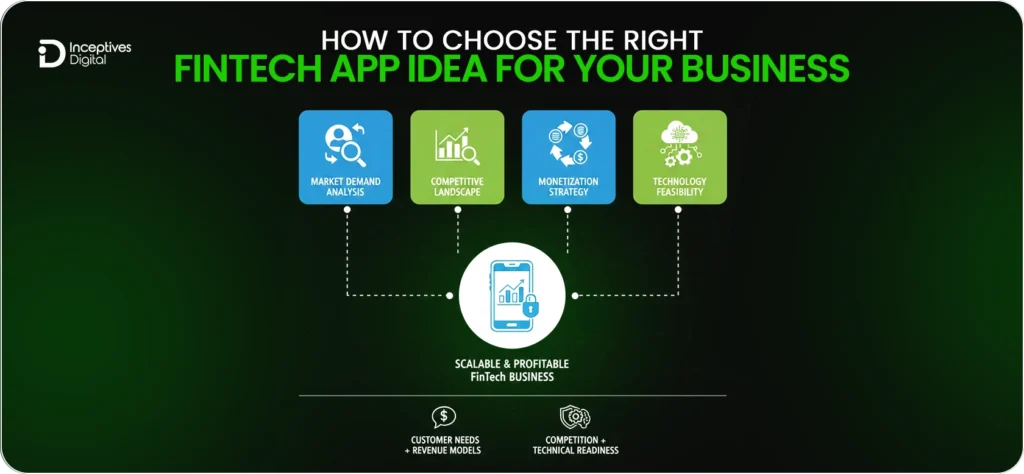
Selecting the right FinTech app idea is crucial for turning an innovative concept into a profitable and scalable business. Product strategy consulting helps balance market opportunities, competitive positioning, monetization strategies, and technical feasibility to ensure long-term success. The following factors can guide startups in identifying the most viable FinTech app idea.
Market Demand Analysis
Understanding the target audience and their pain points is the first step. Conduct market research to validate your app idea by evaluating customer needs, adoption rates, and emerging trends in digital finance. Apps that address urgent financial challenges or offer unique solutions tend to gain traction faster.
Competitive Landscape
Analyzing existing competitors helps identify gaps in the market and potential differentiators. Study their offerings, pricing models, and user feedback to position your app uniquely and deliver a superior UI UX design experience.
Monetization Strategy
A sustainable monetization strategy is essential for business viability. Consider subscription plans, transaction fees, premium features, or partnerships that align with your app’s value proposition while generating consistent revenue.
Technology Feasibility
Assess the technical requirements, including cross-platform app development choices, security measures, integrations, and scalability. Ensure that your team has the capability or access to resources to develop and maintain the app efficiently.
By evaluating market demand, competition, monetization potential, and technical feasibility, businesses can confidently select a FinTech app idea that maximizes both user value and growth opportunities.
Final Thoughts: Turning FinTech App Ideas into Profitable Businesses
The FinTech space offers immense opportunities for startups ready to build a FinTech MVP and solve real financial challenges. From AI-powered assistants to digital banking, P2P payments, and cross-border solutions, these app ideas show how technology can transform banking, investing, and payments.
Success requires more than just a great digital product development idea. It demands innovation, compliance, and scalability. Apps that are secure, user-friendly, and regulation-compliant build trust, retain users, and create sustainable growth.
By focusing on these principles and leveraging FinTech mobile app development services, startups can turn high-potential FinTech app ideas into profitable, long-term businesses that address real customer needs.
Planning to convert your FinTech app idea into a profitable business?
Let our expert guide you through each step of developing a high-growth FinTech App startup.
Get Assistance Now!Frequently Asked Questions (FAQs)
FinTech applications solve real financial issues, improve user experience, and open new revenue streams. AI-enabled budget management apps, online banking, and global money transfers attract a huge user base globally, as well as enhance operations and the trust customers have in the services.
The cost of fintech app development will depend on its features, the chosen platform, and compliance requirements. A basic MVP will cost around $40,000-$80,000, while a full-featured, scalable app with advanced technologies like AI, blockchain, or real-time processing will cost $120,000-$300,000 or even more.
High-demand FinTech app ideas encompass AI-enabled financial assistants, digital banking apps, P2P payment services, lending platforms, crypto trading applications, BNPL services, and solutions for cross-border payments. These areas cater to the urgent financial needs of both consumers and businesses.
FinTech apps commonly use secure backend infrastructure, cloud computing, APIs, and encryption. AI can support fraud detection and personalization, while blockchain and smart contracts serve specific digital asset or programmable transaction requirements.
Startups must conduct thorough market research to gauge demand, evaluate competitors, formulate a long-term profitable strategy, and evaluate the technical aspects. The most successful ideas address urgent user needs, differentiate from competitors, and leverage technology effectively for growth.