Skip to content
  • Services
    Services
    Application Development
    • Mobile App Development
    • Blockchain Development
    By Platform
    • iOS App
    • Android App
    • React Native App
    • Flutter
    • Kotlin Multiplatform
    By Type
    • Web App Development
    • Backend and API
    • Cross-Platform Development
    • Web Development
    • Mobile Game Development
    • AR App Development
    • VR Development
    Launch & Growth
    • App Store Optimization
    • Product Launch Strategy
    • Post Launch Analytics and Iteration
    Artificial Intelligence
    AI Services
    • AI Development
    • AI App Development
    • AI Chatbot Development
    • AI Agent Development
    • Generative AI Development
    • Machine Learning Development
    • NLP Development
    • AI MVP Development
    Automation
    • AI Automation
    • System Integration & API Automation Services
    • Business Process Automation Services
    • RPA Development
    • IoT Development
    Digital Product Development
    By Engagement
    • Digital Product Development
    • Discovery Sprint
    • MVP Development
    • Product Rescue & Scaling
    • Product Strategy & Consulting
    • Custom Software Development
    • Staff Augmentation
    By Craft
    • UI/UX Design
    • Interactive Prototyping
  • Industries
    Industries
    • Healthcare App Development
    • Fitness App Development
    • Fintech App Development
    • Education App Development
    • Real Estate App Development
    • Travel App Development
    • Food Delivery App Development
    • Dating App Development
  • Locations
    Locations
    • San Francisco
    • New York
    • Austin
    • Toronto
    • London
    • Dubai
    • Singapore
  • Case Studies
  • Company
    Company
    • About
    • Blogs
    • Press & Media
    • Partnership
    • Life At Inceptives Digital
    • Leadership
    • Founder's Letter
    • Contact Us
Inceptives Digital
  • (469) 788-8527
Get In Touch
  • Blogs
App Development
  • Mobile App Architecture: How to Choose the Right Tech Stack for Mobile App Development

Mobile App Architecture: How to Choose the Right Tech Stack for Mobile App Development

  • Last Updated: March 23, 2026
  • Picture of Shahzaib Khan Written By: Shahzaib Khan
On this page
Share
Mobile App Tech stack

In most of the app failures, the idea is blamed, but that is not true for everyone. A larger number of apps struggle due to performance and growth issues. Research found that apps that take longer than three seconds encounter a 53% decline in users. It highlights how crucial the architecture and tech stack are for an app’s success.

Just think about the famous companies like Uber, TikTok, and Instagram. They handle billions of users daily. Attractive design is not enough at this level of scalability. Reaching those heights requires the right tech stack for mobile app development. It will play a huge role in whether your app will get the kind of recognition they have or will get unnoticed like the millions of apps on the App Store and Google Play Store.

If your plan is to build an application, a wise option would be collaborating with an experienced mobile app development company. They will help map a clear strategy, right architecture planning to ensure a fast, reliable, scalable mobile application.

Read this guide till the end to learn how a mobile app architecture works, how to decide on a strong tech stack, and what will be the best combination of technologies according to your business objectives.

What is Mobile App Architecture? Understanding Its Role in Scalable App Development

A mobile app architecture is what makes sure the functionality and interactivity of each component of a mobile application. It ensures the app meets the required standards and handles growth over time. There are different types of mobile app architecture. The suitable one depends upon the app’s complexity and your scalability needs.

Key Components of Mobile App Architecture

1. Frontend (Client-Side)

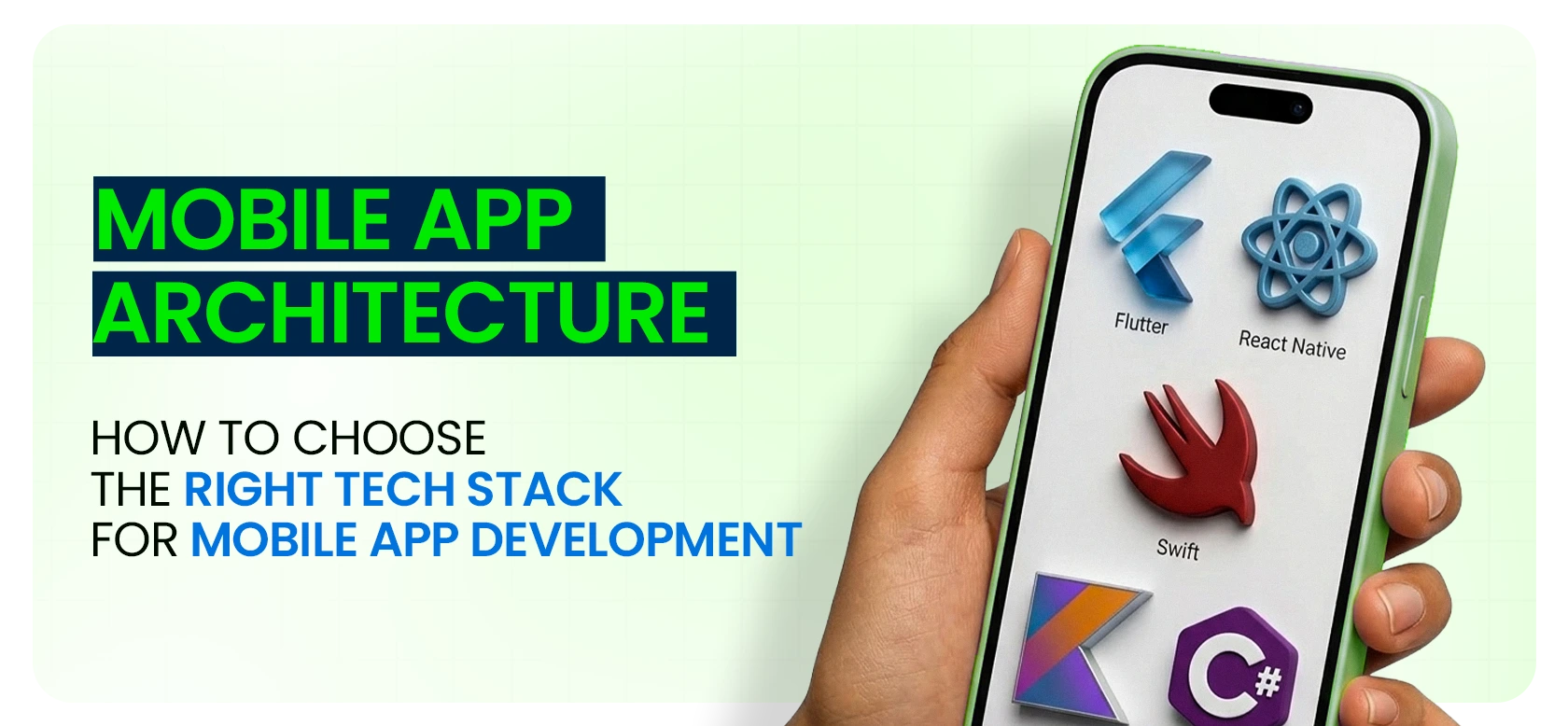
It is the first impression of your application that allows users to interact. It includes a user interface, navigation, animations, and overall user experience. React Native, Flutter, Swift, and Kotlin are the most common technologies used in frontend development.

2. Backend (Server-Side)

Backend is the brain behind core logics, user authentications, push notifications, and API management. Common tools used in backend development include Node.js, Python, Java, Ruby on Rails, and .NET, along with cloud platforms to ensure reliability and scalability.

3. Database

A database is a storage space for managing and storing the overall app data, such as user profiles, transactions, and other content. Commonly used databases are:

  • SQL (MySQL, PostgreSQL)
  • NoSQL (MongoDB, Firebase, DynamoDB)

4. APIs (Application Programming Interfaces)

Facilitate communication between frontend and backend, third-party integrations, and microservices via RESTful APIs, GraphQL, or WebSocket APIs.

Types of Mobile App Architecture: Choosing the Right Architecture for Scalable Mobile Apps
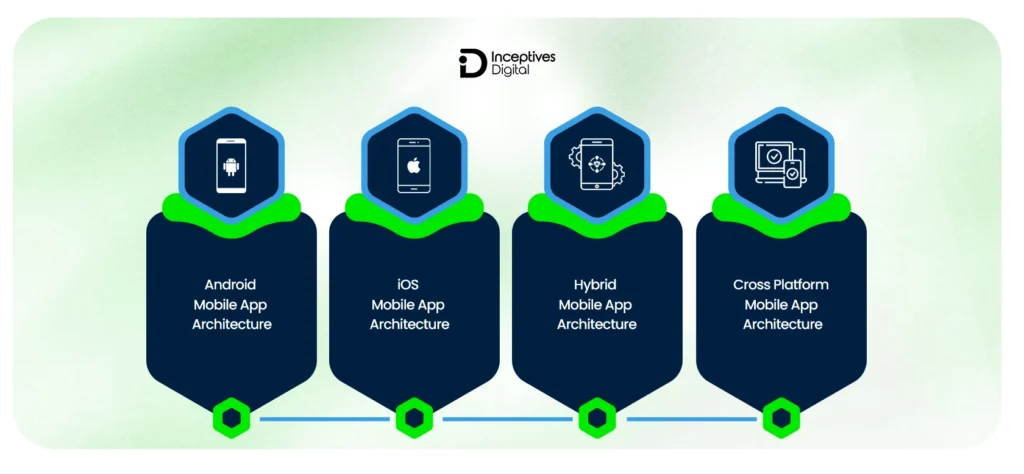
Types of Mobile App Architecture

Your app requires an appropriate mobile application architecture because it needs to handle increasing user demands and new features that will be added over time. Your application performance depends on the architectural design you choose because it determines your system’s capacity to manage user traffic, process information, and work with current technological advancements.

A well-planned, scalable mobile app architecture delivers improved performance, together with quicker updates and reduced future maintenance expenses. The following section presents the most commonly used architectural designs together with their appropriate usage situations.

iOS Mobile App Architecture

iOS architecture applies specifically to Apple devices to improve performance and security and create a seamless user experience. The primary programming language for iOS app development used by developers is Swift, along with Apple’s official software development kits.

When to Choose iOS Architecture

  • Premium user experience focus
  • High-security applications
  • Apps targeting Apple ecosystem users

Android Mobile App Architecture

Android architecture system supports various devices because it allows multiple devices to function properly on different screen sizes and hardware specifications. The tech stack for Android app development uses both Kotlin and Java programming languages, together with Android SDKs.

When to Choose Android Architecture

  • Wider audience reach
  • Device compatibility requirements
  • Scalable consumer apps

Cross-Platform Mobile App Architecture

Cross-platform architecture enables developers to create applications that run on multiple platforms by using one shared codebase. The standard technology stack used in cross-platform app development incorporates both Flutter and React Native.

When to Choose Cross-Platform Architecture

  • Faster time-to-market
  • Cost-efficient development
  • MVP and startup apps

Hybrid Mobile App Architecture

Hybrid architecture combines web and native technologies, which allow developers to create applications through web technologies packaged inside a native container. The two main tools used in hybrid app development are Apache Cordova and Ionic.

When to Choose Hybrid Architecture

  • Simple applications
  • Content-based apps
  • Quick MVP launches

Scalable Mobile App Architecture Patterns for Modern App Development

To make sure your app functions smoothly during peak traffic times and remains maintainable with increasing features. To help you decide the best choice for your mobile app, we have listed the most effective mobile app architecture patterns:

1. Monolithic vs Microservices Architecture for Scalable Mobile App Development

Monolithic Architecture

A unified codebase delivers simple development for initial tasks but presents challenges when your application needs to expand.

Microservices Architecture

It divides the application into separate modules, which allow for better scaling, updating, and maintenance processes.

Technologies & Tools:

  • Docker
  • Kubernetes
  • Spring Boot
  • Node.js microservices frameworks

Best For: Large-scale apps, high-traffic systems, apps with multiple integrations.

2. Serverless Architecture and Cloud-Based Tech Stack

A serverless configuration eliminates the requirement for handling physical servers. The cloud looks after scaling, storage, and execution automatically.

Technologies & Tools:

  • Amazon Web Services (AWS Lambda, API Gateway)
  • Google Cloud Platform (Cloud Functions)
  • Firebase
  • Azure Functions

Best For: Apps with unpredictable traffic, rapidly growing startups, and event-driven systems.

3. Layered (N-Tier) Architecture

It divides the app into distinct layers, including presentation, business logic, and data components. Layered architecture enables better system maintenance through its design, allowing separate teams to develop each system component.

Technologies & Tools:

  • .NET N-Tier framework
  • Java EE
  • Spring MVC
  • Django

Best For: Enterprise apps, complex workflows, and apps requiring long-term maintainability.

4. Event-Driven Architecture

Handles real-time event processing through its ability to utilize messaging systems and event queues. It performs best when the app needs to respond instantly to user interactions and changes in data.

Technologies & Tools:

  • Apache Kafka
  • RabbitMQ
  • AWS SNS/SQS
  • Google Cloud Pub/Sub

Best For: Messaging apps, ride-hailing platforms, live streaming apps.

What is a Tech Stack in Mobile App Development? 
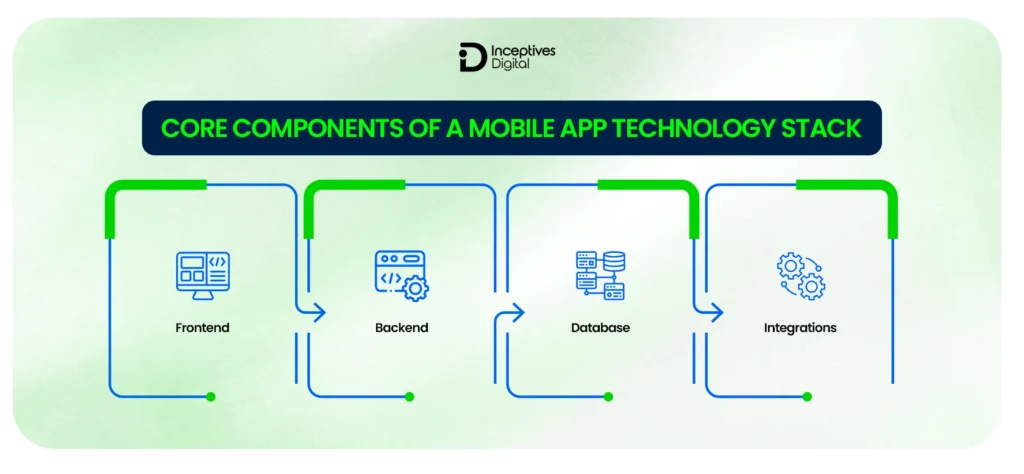
Tech Stack in Mobile App Development

Tech stack for a mobile app development process is a set of tools that include programming languages, frameworks, libraries, and databases. The tech stack you choose determines the way your app functions, handles data, server connections, and provides user experience. Let’s break down the components of the tech stack for the mobile app to explore it in more detail.

Key Components of a Mobile App Tech Stack: Tools and Technologies for Mobile App Development

A mobile app tech stack includes four essential parts: frontend, backend, database system, and APIs. The application requires specific tools and technologies at each layer to maintain its efficient operation while handling increased user demand. Here are the four main components of the mobile app development tech stack.

1. Frontend Technologies for Mobile App Development and Front-End Development Tech Stack

Users interact with the frontend of the application. The frontend controls the interface and navigation system and the total user experience of the application.

Popular Frontend Technologies:

  • Flutter
  • React Native
  • Swift (iOS)
  • Kotlin (Android)
  • UI/UX design tools (Figma, Adobe XD)

2. Backend Technologies and Software Development Tech Stack for Mobile Apps

The backend provides essential support to the application by managing user authentication, executing server-side operations, delivering push notifications, and enforcing business regulations.

Common Backend Technologies:

  • Node.js
  • Python (Django, Flask)
  • Java (Spring Boot)
  • Ruby on Rails
  • .NET
  • Cloud platforms (AWS, Firebase, Google Cloud)

3. Database Technologies in Mobile App Development Tech Stack

Databases store and manage application data that includes user profiles, transaction records, and content items. The database you choose has a direct effect on your app’s performance.

Database Options:

  • SQL: MySQL, PostgreSQL
  • NoSQL: MongoDB, Firebase Realtime Database, DynamoDB

4. APIs and Integrations in Modern Mobile App Tech Stack

APIs enable various components of an application to connect while also enabling the application to connect with external services. These components make sure the app functions properly, ensure data transfer, and modular architecture.

Common API Technologies:

  • RESTful APIs
  • GraphQL
  • WebSocket APIs
  • Third-party services (payment gateways, analytics, cloud services)

How to Choose the Right Tech Stack for Mobile App Development

Selecting the right tech stack requires businesses to establish technology requirements that support operational objectives, meet customer demands, and sustain future development needs. The following framework provides a practical solution to help you select the right tech stack for your mobile app.

1. Define Business Goals Before Choosing the Tech Stack

You need to define your app’s purpose before you begin developing it. Your technology decisions will be determined by your objectives, which can be either fast market entry, high system performance, or long-term growth.

For instance, a quicker and cost-efficient stack might be necessary for a Minimum Viable Product, while a larger-scale product will need to have more structured and scalable solutions.

2. Understand Target Audience and Platform Requirements

Your audience determines where and how your app should perform. You need to consider factors, such as device usage, location, and platform usage between iOS, Android, or both.

A cross-platform solution works well when users of your app access multiple platforms. Native development provides optimal performance for applications that require performance as their main focus.

3. Evaluate App Complexity and Feature Requirements

Complexity level of your application is a key factor in deciding the tech stack for your mobile app.

Basic feature applications require simpler technology stacks, whereas advanced applications that use real-time updates, integrations, and handle large volumes of data require advanced backend technologies and architectural frameworks.

4. Choose a Scalable Mobile App Architecture and Tech Stack

You should create plans that accommodate future growth needs. A properly built scalable mobile architecture enables your application to manage rising user numbers, new system capabilities, and added external connections without experiencing performance problems.

Early selection of scalable technologies protects organizations from future expensive migration and rebuilding costs.

5. Budget, Timeline, and Development Cost Considerations

Your budget and app development timeline determine the tech stack choice. Some technologies enable faster development times, whereas other technologies need extended development times but provide superior long-term advantages.

Sustainable decision making needs cost, performance, and scalability to be balanced against each other.

6. Team Expertise and Hiring or Staff Augmentation Strategy

The success of your stack choice is largely dependent on your team of developers. It is crucial to choose technologies that your team has gained experience with or can quickly adapt to.

You should hire staff augmentation services if your organization needs specialized developers to boost its development capacity without committing to permanent employment.

Common Mistakes to Avoid When Choosing a Tech Stack for App Development

Most of the time, businesses neglect the importance of a tech stack for a mobile app, which later on results in performance issues, budget overruns, and maintenance problems. To help you avoid such costly mistakes, we have curated a list that includes the most common mistakes businesses make when choosing a mobile app tech stack.

1. Choosing Technology Based on Trends Instead of Needs

You should pick frameworks or tools that best suit your project instead of picking based on the basis of popularity. Define your goals, core features, and target audience, and choose the best that suits your situation.

2. Ignoring Scalability from the Start

When developers create applications without planning for future growth. The app suffers from performance problems that require expensive redesigns for resolution. Mobile app developers must select software stacks that allow creating mobile applications that will grow with business needs throughout the entire project.

3. Overcomplicating the Tech Stack

Excessive usage of tools, frameworks, and services leads to challenges in both development and maintenance processes. The most effective and manageable tech stack for app development and maintenance work is a basic technology stack.

4. Not Considering Team Expertise

Development becomes slower, and errors increase when your team selects an unfamiliar technology stack. Your tech stack should match your team’s capabilities, or you must recruit or train employees.

5. Ignoring Long-Term Maintenance Costs

Some technologies may seem cost-effective initially, but become expensive to maintain after the launch. Assess updates and scalability requirements, together with support options, before reaching a final decision.

6. Poor Integration Planning

Your application requires planning for third-party integrations, APIs, and future features to function properly. Your integration needs should be supported by your stack from the beginning of your project.

7. Skipping Proper Testing and Validation

Tech stack selection for MVPs requires early testing to prevent major problems. The verification of your technology choices needs to be conducted through prototype development and small-scale experiments before you proceed with complete app development.

Cost and Scalability Considerations in Mobile App Architecture and Tech Stack Selection
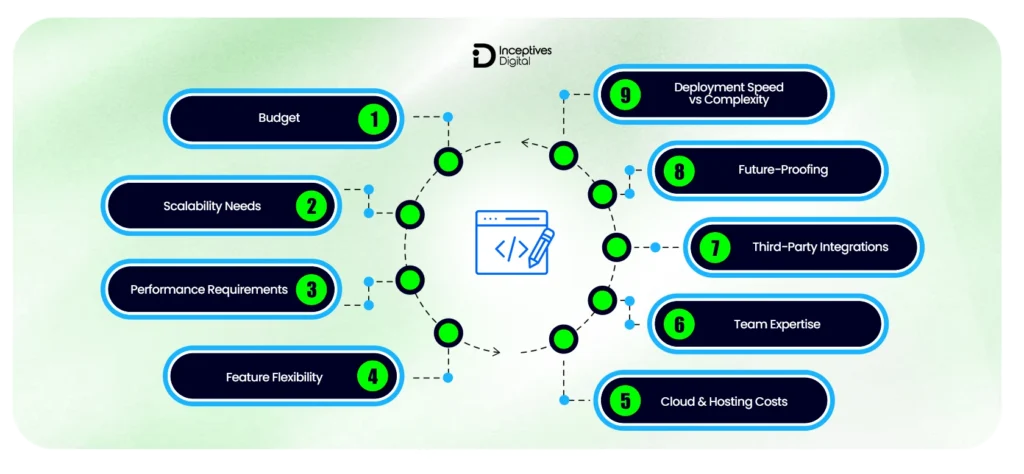
Your mobile app architecture and tech stack decision not only impact the long-term growth, but also the app development cost. Here are the important factors you should consider before making the final decision.

1. Initial Development Cost vs Long-Term Investment

A simpler tech stack may reduce upfront costs, but it will create higher expenses later when the system needs to scale or new features need to be added. The correct architectural investment is needed at the beginning because it protects the organization from expensive future construction work.

2. Scalability and Future Growth

Your architecture design must support user growth, traffic surges, and new feature development while maintaining system performance. Scalable systems provide benefits because they decrease operational downtime and maintain steady user experiences.

3. Infrastructure and Cloud Costs

A significant proportion of total expenses comes from hosting, servers, and cloud services. Flexibility and scalability are the two major benefits of a cloud-based solution, which must be implemented with consideration to avoid overspending.

4. Performance and Resource Optimization

When you spend less time using the added resources, this leads to cost and speed being directly proportional. A properly optimized architecture will lead to quicker load times and overall better performance while not overusing infrastructure.

5. Maintenance and Upgrade Costs

This increases the cost of mobile app maintenance, updates, and bug fixing. Using the correct technologies makes your app easier to maintain & update with time.

6. Choosing the Right Development Approach

Choosing the right balance between cost and scalability often needs customized solutions. Template-based software can also be customized, but many businesses prefer custom software development as it allows them to develop applications for a price that suits them and within their specific terms of future growth.

Real-World Mobile App Tech Stack Examples and Architecture Use Cases

Exploring real-world app development tech stacks will help you make better decisions. Applications select their technology stack and system architecture based on maximum user capacity, required performance, and expected user behavior.

E-commerce App (Example: Amazon)

E-commerce apps need to handle massive traffic, secure payments, and real-time inventory updates.

Typical Tech Stack:

  • Frontend: React Native / Native (Swift, Kotlin)
  • Backend: Java (Spring Boot), Node.js
  • Database: DynamoDB, PostgreSQL
  • APIs: REST APIs for payments and logistics

Architecture: Microservices for scalability and fault isolation

Fintech App (Example: PayPal)

Fintech apps prioritize security, compliance, and real-time transaction processing.

Typical Tech Stack:

  • Frontend: Native (Swift, Kotlin)
  • Backend: Java, Python
  • Database: PostgreSQL
  • Security: Encryption, secure APIs

Architecture: Microservices with secure API layers

Messaging App (Example: WhatsApp)

Messaging apps require real-time communication and the ability to handle millions of concurrent users.

Typical Tech Stack:

  • Frontend: Native apps
  • Backend: Erlang-based systems, Node.js
  • Database: Distributed databases
  • APIs: WebSockets for real-time messaging

Architecture: Event-driven + distributed systems

Ride-Hailing App (Example: Uber)

These apps rely heavily on real-time location tracking, matching algorithms, and scalability.

Typical Tech Stack:

  • Frontend: React Native / Native
  • Backend: Node.js, Python
  • Database: MongoDB
  • Integrations: Maps, payment gateways

Architecture: Microservices + event-driven architecture

Fitness App (Example: MyFitnessPal)

Fitness apps focus on tracking user activity, integrating with wearables, and managing user data efficiently.

Typical Tech Stack:

  • Frontend: Flutter / React Native
  • Backend: Node.js
  • Database: Firebase, PostgreSQL
  • Integrations: Health APIs, wearable devices

Architecture: Layered or microservices architecture

To see how these approaches are applied in real business scenarios, explore our portfolio, where we build scalable applications by using modern architectural frameworks and optimized technology platforms.

Conclusion: Choosing the Best Tech Stack for Mobile App Development Success

We hope that from the first click on this blog till now, you have got what you are here for. We discussed how a strategic decision in mobile app architecture and tech stack can make a huge difference in your app’s success. A strategic approach not only reduces the overall cost but also plays a key role in enhancing the performance and long-term growth.

If you have made up your mind to revolutionize your business with an advanced mobile app. An ideal option would be partnering with a team that offers reliable mobile app development services. They will make sure the app is aligned with your goal and truly represents your business in the best way possible, while keeping the cost in control and avoiding pitfalls.

Ready to Build a Scalable Mobile App? Let’s Get Started

Turn your app idea into a scalable, high-performing product with the right architecture and tech stack tailored to your business goals.

Get Your Consultation

FAQs on Mobile App Development Tech Stack and Architecture

1. What is the best tech stack for mobile app development?

The best tech stack for mobile app development depends on your app’s needs. Native stacks (Swift, Kotlin) offer top performance, while cross-platform tools like Flutter or React Native are faster and more cost-effective.

2. How to choose the right tech stack for a mobile app?

To choose the right tech stack, align it with your business goals, app complexity, target audience, budget, and scalability needs. Pick technologies your team can efficiently work with.

3. Which tech stack is best for startups and scalable apps?

A flexible tech stack for mobile apps like Flutter or React Native with Node.js and Firebase works well for startups due to faster development and easy scaling.

4. What is the difference between native and cross-platform tech stacks?

Native stacks are platform-specific and deliver better performance. Cross-platform stacks use one codebase for multiple platforms, saving time and cost.

5. How does the tech stack impact mobile app performance and scalability?

The tech stack for mobile apps affects speed, responsiveness, and scalability. A well-chosen stack ensures smooth performance and supports growth without major rework.

Picture of Shahzaib Khan

Shahzaib Khan

Shahzaib is an experienced SEO content writer at Inceptives Digital, specializing in crafting high-quality, SEO-optimized content that boosts traffic and enhances online visibility. With a strong command of SEO principles, he creates engaging blogs, articles, and web copy tailored for diverse industries, including mobile app development company clients. His content is designed to drive results and support businesses in achieving their digital marketing goals. Shahzaib keeps up with the latest SEO trends and best practices, ensuring that his work consistently delivers maximum impact.
✦ Summarize with AI
ChatGPT Claude Perplexity Gemini Grok

Have a Product in Mind?

Let’s build it the right way, together
Start the Conversation
Blog / App Development / Mobile App Architecture: How to Choose the Right Tech Stack for Mobile App Development

Mobile App Architecture: How to Choose the Right Tech Stack for Mobile App Development

Shahzaib Khan
WRITTEN BY Shahzaib Khan
On This Page
What is Mobile App Architecture? Understanding Its Role in Scalable App DevelopmentKey Components of Mobile App Architecture1. Frontend (Client-Side)2. Backend (Server-Side)3. Database4. APIs (Application Programming Interfaces)Types of Mobile App Architecture: Choosing the Right Architecture for Scalable Mobile AppsiOS Mobile App ArchitectureAndroid Mobile App ArchitectureCross-Platform Mobile App ArchitectureHybrid Mobile App ArchitectureScalable Mobile App Architecture Patterns for Modern App Development1. Monolithic vs Microservices Architecture for Scalable Mobile App Development2. Serverless Architecture and Cloud-Based Tech Stack3. Layered (N-Tier) Architecture4. Event-Driven ArchitectureWhat is a Tech Stack in Mobile App Development?Key Components of a Mobile App Tech Stack: Tools and Technologies for Mobile App DevelopmentHow to Choose the Right Tech Stack for Mobile App Development1. Define Business Goals Before Choosing the Tech Stack2. Understand Target Audience and Platform Requirements3. Evaluate App Complexity and Feature Requirements4. Choose a Scalable Mobile App Architecture and Tech Stack5. Budget, Timeline, and Development Cost Considerations6. Team Expertise and Hiring or Staff Augmentation StrategyCommon Mistakes to Avoid When Choosing a Tech Stack for App Development1. Choosing Technology Based on Trends Instead of Needs2. Ignoring Scalability from the Start3. Overcomplicating the Tech Stack4. Not Considering Team Expertise5. Ignoring Long-Term Maintenance Costs6. Poor Integration Planning7. Skipping Proper Testing and ValidationCost and Scalability Considerations in Mobile App Architecture and Tech Stack Selection1. Initial Development Cost vs Long-Term Investment2. Scalability and Future Growth3. Infrastructure and Cloud Costs4. Performance and Resource Optimization5. Maintenance and Upgrade Costs6. Choosing the Right Development ApproachReal-World Mobile App Tech Stack Examples and Architecture Use CasesE-commerce App (Example: Amazon)Fintech App (Example: PayPal)Messaging App (Example: WhatsApp)Ride-Hailing App (Example: Uber)Fitness App (Example: MyFitnessPal)Conclusion: Choosing the Best Tech Stack for Mobile App Development SuccessReady to Build a Scalable Mobile App? Let’s Get StartedFAQs on Mobile App Development Tech Stack and Architecture
Share This Article
Mobile App Architecture: How to Choose the Right Tech Stack for Mobile App Development

In most of the app failures, the idea is blamed, but that is not true for everyone. A larger number of apps struggle due to performance and growth issues. Research found that apps that take longer than three seconds encounter a 53% decline in users. It highlights how crucial the architecture and tech stack are for an app’s success.

Just think about the famous companies like Uber, TikTok, and Instagram. They handle billions of users daily. Attractive design is not enough at this level of scalability. Reaching those heights requires the right tech stack for mobile app development. It will play a huge role in whether your app will get the kind of recognition they have or will get unnoticed like the millions of apps on the App Store and Google Play Store.

If your plan is to build an application, a wise option would be collaborating with an experienced mobile app development company. They will help map a clear strategy, right architecture planning to ensure a fast, reliable, scalable mobile application.

Read this guide till the end to learn how a mobile app architecture works, how to decide on a strong tech stack, and what will be the best combination of technologies according to your business objectives.

What is Mobile App Architecture? Understanding Its Role in Scalable App Development

A mobile app architecture is what makes sure the functionality and interactivity of each component of a mobile application. It ensures the app meets the required standards and handles growth over time. There are different types of mobile app architecture. The suitable one depends upon the app’s complexity and your scalability needs.

Key Components of Mobile App Architecture

1. Frontend (Client-Side)

It is the first impression of your application that allows users to interact. It includes a user interface, navigation, animations, and overall user experience. React Native, Flutter, Swift, and Kotlin are the most common technologies used in frontend development.

2. Backend (Server-Side)

Backend is the brain behind core logics, user authentications, push notifications, and API management. Common tools used in backend development include Node.js, Python, Java, Ruby on Rails, and .NET, along with cloud platforms to ensure reliability and scalability.

3. Database

A database is a storage space for managing and storing the overall app data, such as user profiles, transactions, and other content. Commonly used databases are:

  • SQL (MySQL, PostgreSQL)
  • NoSQL (MongoDB, Firebase, DynamoDB)

4. APIs (Application Programming Interfaces)

Facilitate communication between frontend and backend, third-party integrations, and microservices via RESTful APIs, GraphQL, or WebSocket APIs.

Types of Mobile App Architecture: Choosing the Right Architecture for Scalable Mobile Apps

Types of Mobile App Architecture

Your app requires an appropriate mobile application architecture because it needs to handle increasing user demands and new features that will be added over time. Your application performance depends on the architectural design you choose because it determines your system’s capacity to manage user traffic, process information, and work with current technological advancements.

A well-planned, scalable mobile app architecture delivers improved performance, together with quicker updates and reduced future maintenance expenses. The following section presents the most commonly used architectural designs together with their appropriate usage situations.

iOS Mobile App Architecture

iOS architecture applies specifically to Apple devices to improve performance and security and create a seamless user experience. The primary programming language for iOS app development used by developers is Swift, along with Apple’s official software development kits.

When to Choose iOS Architecture

  • Premium user experience focus
  • High-security applications
  • Apps targeting Apple ecosystem users

Android Mobile App Architecture

Android architecture system supports various devices because it allows multiple devices to function properly on different screen sizes and hardware specifications. The tech stack for Android app development uses both Kotlin and Java programming languages, together with Android SDKs.

When to Choose Android Architecture

  • Wider audience reach
  • Device compatibility requirements
  • Scalable consumer apps

Cross-Platform Mobile App Architecture

Cross-platform architecture enables developers to create applications that run on multiple platforms by using one shared codebase. The standard technology stack used in cross-platform app development incorporates both Flutter and React Native.

When to Choose Cross-Platform Architecture

  • Faster time-to-market
  • Cost-efficient development
  • MVP and startup apps

Hybrid Mobile App Architecture

Hybrid architecture combines web and native technologies, which allow developers to create applications through web technologies packaged inside a native container. The two main tools used in hybrid app development are Apache Cordova and Ionic.

When to Choose Hybrid Architecture

  • Simple applications
  • Content-based apps
  • Quick MVP launches

Scalable Mobile App Architecture Patterns for Modern App Development

To make sure your app functions smoothly during peak traffic times and remains maintainable with increasing features. To help you decide the best choice for your mobile app, we have listed the most effective mobile app architecture patterns:

1. Monolithic vs Microservices Architecture for Scalable Mobile App Development

Monolithic Architecture

A unified codebase delivers simple development for initial tasks but presents challenges when your application needs to expand.

Microservices Architecture

It divides the application into separate modules, which allow for better scaling, updating, and maintenance processes.

Technologies & Tools:

  • Docker
  • Kubernetes
  • Spring Boot
  • Node.js microservices frameworks

Best For: Large-scale apps, high-traffic systems, apps with multiple integrations.

2. Serverless Architecture and Cloud-Based Tech Stack

A serverless configuration eliminates the requirement for handling physical servers. The cloud looks after scaling, storage, and execution automatically.

Technologies & Tools:

  • Amazon Web Services (AWS Lambda, API Gateway)
  • Google Cloud Platform (Cloud Functions)
  • Firebase
  • Azure Functions

Best For: Apps with unpredictable traffic, rapidly growing startups, and event-driven systems.

3. Layered (N-Tier) Architecture

It divides the app into distinct layers, including presentation, business logic, and data components. Layered architecture enables better system maintenance through its design, allowing separate teams to develop each system component.

Technologies & Tools:

  • .NET N-Tier framework
  • Java EE
  • Spring MVC
  • Django

Best For: Enterprise apps, complex workflows, and apps requiring long-term maintainability.

4. Event-Driven Architecture

Handles real-time event processing through its ability to utilize messaging systems and event queues. It performs best when the app needs to respond instantly to user interactions and changes in data.

Technologies & Tools:

  • Apache Kafka
  • RabbitMQ
  • AWS SNS/SQS
  • Google Cloud Pub/Sub

Best For: Messaging apps, ride-hailing platforms, live streaming apps.

What is a Tech Stack in Mobile App Development? 

Tech Stack in Mobile App Development

Tech stack for a mobile app development process is a set of tools that include programming languages, frameworks, libraries, and databases. The tech stack you choose determines the way your app functions, handles data, server connections, and provides user experience. Let’s break down the components of the tech stack for the mobile app to explore it in more detail.

Key Components of a Mobile App Tech Stack: Tools and Technologies for Mobile App Development

A mobile app tech stack includes four essential parts: frontend, backend, database system, and APIs. The application requires specific tools and technologies at each layer to maintain its efficient operation while handling increased user demand. Here are the four main components of the mobile app development tech stack.

1. Frontend Technologies for Mobile App Development and Front-End Development Tech Stack

Users interact with the frontend of the application. The frontend controls the interface and navigation system and the total user experience of the application.

Popular Frontend Technologies:

  • Flutter
  • React Native
  • Swift (iOS)
  • Kotlin (Android)
  • UI/UX design tools (Figma, Adobe XD)

2. Backend Technologies and Software Development Tech Stack for Mobile Apps

The backend provides essential support to the application by managing user authentication, executing server-side operations, delivering push notifications, and enforcing business regulations.

Common Backend Technologies:

  • Node.js
  • Python (Django, Flask)
  • Java (Spring Boot)
  • Ruby on Rails
  • .NET
  • Cloud platforms (AWS, Firebase, Google Cloud)

3. Database Technologies in Mobile App Development Tech Stack

Databases store and manage application data that includes user profiles, transaction records, and content items. The database you choose has a direct effect on your app’s performance.

Database Options:

  • SQL: MySQL, PostgreSQL
  • NoSQL: MongoDB, Firebase Realtime Database, DynamoDB

4. APIs and Integrations in Modern Mobile App Tech Stack

APIs enable various components of an application to connect while also enabling the application to connect with external services. These components make sure the app functions properly, ensure data transfer, and modular architecture.

Common API Technologies:

  • RESTful APIs
  • GraphQL
  • WebSocket APIs
  • Third-party services (payment gateways, analytics, cloud services)

How to Choose the Right Tech Stack for Mobile App Development

Selecting the right tech stack requires businesses to establish technology requirements that support operational objectives, meet customer demands, and sustain future development needs. The following framework provides a practical solution to help you select the right tech stack for your mobile app.

1. Define Business Goals Before Choosing the Tech Stack

You need to define your app’s purpose before you begin developing it. Your technology decisions will be determined by your objectives, which can be either fast market entry, high system performance, or long-term growth.

For instance, a quicker and cost-efficient stack might be necessary for a Minimum Viable Product, while a larger-scale product will need to have more structured and scalable solutions.

2. Understand Target Audience and Platform Requirements

Your audience determines where and how your app should perform. You need to consider factors, such as device usage, location, and platform usage between iOS, Android, or both.

A cross-platform solution works well when users of your app access multiple platforms. Native development provides optimal performance for applications that require performance as their main focus.

3. Evaluate App Complexity and Feature Requirements

Complexity level of your application is a key factor in deciding the tech stack for your mobile app.

Basic feature applications require simpler technology stacks, whereas advanced applications that use real-time updates, integrations, and handle large volumes of data require advanced backend technologies and architectural frameworks.

4. Choose a Scalable Mobile App Architecture and Tech Stack

You should create plans that accommodate future growth needs. A properly built scalable mobile architecture enables your application to manage rising user numbers, new system capabilities, and added external connections without experiencing performance problems.

Early selection of scalable technologies protects organizations from future expensive migration and rebuilding costs.

5. Budget, Timeline, and Development Cost Considerations

Your budget and app development timeline determine the tech stack choice. Some technologies enable faster development times, whereas other technologies need extended development times but provide superior long-term advantages.

Sustainable decision making needs cost, performance, and scalability to be balanced against each other.

6. Team Expertise and Hiring or Staff Augmentation Strategy

The success of your stack choice is largely dependent on your team of developers. It is crucial to choose technologies that your team has gained experience with or can quickly adapt to.

You should hire staff augmentation services if your organization needs specialized developers to boost its development capacity without committing to permanent employment.

Common Mistakes to Avoid When Choosing a Tech Stack for App Development

Most of the time, businesses neglect the importance of a tech stack for a mobile app, which later on results in performance issues, budget overruns, and maintenance problems. To help you avoid such costly mistakes, we have curated a list that includes the most common mistakes businesses make when choosing a mobile app tech stack.

1. Choosing Technology Based on Trends Instead of Needs

You should pick frameworks or tools that best suit your project instead of picking based on the basis of popularity. Define your goals, core features, and target audience, and choose the best that suits your situation.

2. Ignoring Scalability from the Start

When developers create applications without planning for future growth. The app suffers from performance problems that require expensive redesigns for resolution. Mobile app developers must select software stacks that allow creating mobile applications that will grow with business needs throughout the entire project.

3. Overcomplicating the Tech Stack

Excessive usage of tools, frameworks, and services leads to challenges in both development and maintenance processes. The most effective and manageable tech stack for app development and maintenance work is a basic technology stack.

4. Not Considering Team Expertise

Development becomes slower, and errors increase when your team selects an unfamiliar technology stack. Your tech stack should match your team’s capabilities, or you must recruit or train employees.

5. Ignoring Long-Term Maintenance Costs

Some technologies may seem cost-effective initially, but become expensive to maintain after the launch. Assess updates and scalability requirements, together with support options, before reaching a final decision.

6. Poor Integration Planning

Your application requires planning for third-party integrations, APIs, and future features to function properly. Your integration needs should be supported by your stack from the beginning of your project.

7. Skipping Proper Testing and Validation

Tech stack selection for MVPs requires early testing to prevent major problems. The verification of your technology choices needs to be conducted through prototype development and small-scale experiments before you proceed with complete app development.

Cost and Scalability Considerations in Mobile App Architecture and Tech Stack Selection

Your mobile app architecture and tech stack decision not only impact the long-term growth, but also the app development cost. Here are the important factors you should consider before making the final decision.

1. Initial Development Cost vs Long-Term Investment

A simpler tech stack may reduce upfront costs, but it will create higher expenses later when the system needs to scale or new features need to be added. The correct architectural investment is needed at the beginning because it protects the organization from expensive future construction work.

2. Scalability and Future Growth

Your architecture design must support user growth, traffic surges, and new feature development while maintaining system performance. Scalable systems provide benefits because they decrease operational downtime and maintain steady user experiences.

3. Infrastructure and Cloud Costs

A significant proportion of total expenses comes from hosting, servers, and cloud services. Flexibility and scalability are the two major benefits of a cloud-based solution, which must be implemented with consideration to avoid overspending.

4. Performance and Resource Optimization

When you spend less time using the added resources, this leads to cost and speed being directly proportional. A properly optimized architecture will lead to quicker load times and overall better performance while not overusing infrastructure.

5. Maintenance and Upgrade Costs

This increases the cost of mobile app maintenance, updates, and bug fixing. Using the correct technologies makes your app easier to maintain & update with time.

6. Choosing the Right Development Approach

Choosing the right balance between cost and scalability often needs customized solutions. Template-based software can also be customized, but many businesses prefer custom software development as it allows them to develop applications for a price that suits them and within their specific terms of future growth.

Real-World Mobile App Tech Stack Examples and Architecture Use Cases

Exploring real-world app development tech stacks will help you make better decisions. Applications select their technology stack and system architecture based on maximum user capacity, required performance, and expected user behavior.

E-commerce App (Example: Amazon)

E-commerce apps need to handle massive traffic, secure payments, and real-time inventory updates.

Typical Tech Stack:

  • Frontend: React Native / Native (Swift, Kotlin)
  • Backend: Java (Spring Boot), Node.js
  • Database: DynamoDB, PostgreSQL
  • APIs: REST APIs for payments and logistics

Architecture: Microservices for scalability and fault isolation

Fintech App (Example: PayPal)

Fintech apps prioritize security, compliance, and real-time transaction processing.

Typical Tech Stack:

  • Frontend: Native (Swift, Kotlin)
  • Backend: Java, Python
  • Database: PostgreSQL
  • Security: Encryption, secure APIs

Architecture: Microservices with secure API layers

Messaging App (Example: WhatsApp)

Messaging apps require real-time communication and the ability to handle millions of concurrent users.

Typical Tech Stack:

  • Frontend: Native apps
  • Backend: Erlang-based systems, Node.js
  • Database: Distributed databases
  • APIs: WebSockets for real-time messaging

Architecture: Event-driven + distributed systems

Ride-Hailing App (Example: Uber)

These apps rely heavily on real-time location tracking, matching algorithms, and scalability.

Typical Tech Stack:

  • Frontend: React Native / Native
  • Backend: Node.js, Python
  • Database: MongoDB
  • Integrations: Maps, payment gateways

Architecture: Microservices + event-driven architecture

Fitness App (Example: MyFitnessPal)

Fitness apps focus on tracking user activity, integrating with wearables, and managing user data efficiently.

Typical Tech Stack:

  • Frontend: Flutter / React Native
  • Backend: Node.js
  • Database: Firebase, PostgreSQL
  • Integrations: Health APIs, wearable devices

Architecture: Layered or microservices architecture

To see how these approaches are applied in real business scenarios, explore our portfolio, where we build scalable applications by using modern architectural frameworks and optimized technology platforms.

Conclusion: Choosing the Best Tech Stack for Mobile App Development Success

We hope that from the first click on this blog till now, you have got what you are here for. We discussed how a strategic decision in mobile app architecture and tech stack can make a huge difference in your app’s success. A strategic approach not only reduces the overall cost but also plays a key role in enhancing the performance and long-term growth.

If you have made up your mind to revolutionize your business with an advanced mobile app. An ideal option would be partnering with a team that offers reliable mobile app development services. They will make sure the app is aligned with your goal and truly represents your business in the best way possible, while keeping the cost in control and avoiding pitfalls.

Ready to Build a Scalable Mobile App? Let’s Get Started

Turn your app idea into a scalable, high-performing product with the right architecture and tech stack tailored to your business goals.

Get Your Consultation

FAQs on Mobile App Development Tech Stack and Architecture

1. What is the best tech stack for mobile app development?

The best tech stack for mobile app development depends on your app’s needs. Native stacks (Swift, Kotlin) offer top performance, while cross-platform tools like Flutter or React Native are faster and more cost-effective.

2. How to choose the right tech stack for a mobile app?

To choose the right tech stack, align it with your business goals, app complexity, target audience, budget, and scalability needs. Pick technologies your team can efficiently work with.

3. Which tech stack is best for startups and scalable apps?

A flexible tech stack for mobile apps like Flutter or React Native with Node.js and Firebase works well for startups due to faster development and easy scaling.

4. What is the difference between native and cross-platform tech stacks?

Native stacks are platform-specific and deliver better performance. Cross-platform stacks use one codebase for multiple platforms, saving time and cost.

5. How does the tech stack impact mobile app performance and scalability?

The tech stack for mobile apps affects speed, responsiveness, and scalability. A well-chosen stack ensures smooth performance and supports growth without major rework.

✦ Summarize with AI

Shahzaib Khan
WRITTEN BY

Shahzaib Khan

Shahzaib is an experienced SEO content writer at Inceptives Digital, specializing in crafting high-quality, SEO-optimized content that boosts traffic and enhances online visibility. With a strong command of SEO principles, he creates engaging blogs, articles, and web copy tailored for diverse industries, including mobile app development company clients. His content is designed to drive results and support businesses in achieving their digital marketing goals. Shahzaib keeps up with the latest SEO trends and best practices, ensuring that his work consistently delivers maximum impact.

✦ Summarize with AI

Have a Product in Mind?

Discuss your idea with our product development team.

Start the Conversation →
On This Page
What is Mobile App Architecture? Understanding Its Role in Scalable App DevelopmentKey Components of Mobile App Architecture1. Frontend (Client-Side)2. Backend (Server-Side)3. Database4. APIs (Application Programming Interfaces)Types of Mobile App Architecture: Choosing the Right Architecture for Scalable Mobile AppsiOS Mobile App ArchitectureAndroid Mobile App ArchitectureCross-Platform Mobile App ArchitectureHybrid Mobile App ArchitectureScalable Mobile App Architecture Patterns for Modern App Development1. Monolithic vs Microservices Architecture for Scalable Mobile App Development2. Serverless Architecture and Cloud-Based Tech Stack3. Layered (N-Tier) Architecture4. Event-Driven ArchitectureWhat is a Tech Stack in Mobile App Development?Key Components of a Mobile App Tech Stack: Tools and Technologies for Mobile App DevelopmentHow to Choose the Right Tech Stack for Mobile App Development1. Define Business Goals Before Choosing the Tech Stack2. Understand Target Audience and Platform Requirements3. Evaluate App Complexity and Feature Requirements4. Choose a Scalable Mobile App Architecture and Tech Stack5. Budget, Timeline, and Development Cost Considerations6. Team Expertise and Hiring or Staff Augmentation StrategyCommon Mistakes to Avoid When Choosing a Tech Stack for App Development1. Choosing Technology Based on Trends Instead of Needs2. Ignoring Scalability from the Start3. Overcomplicating the Tech Stack4. Not Considering Team Expertise5. Ignoring Long-Term Maintenance Costs6. Poor Integration Planning7. Skipping Proper Testing and ValidationCost and Scalability Considerations in Mobile App Architecture and Tech Stack Selection1. Initial Development Cost vs Long-Term Investment2. Scalability and Future Growth3. Infrastructure and Cloud Costs4. Performance and Resource Optimization5. Maintenance and Upgrade Costs6. Choosing the Right Development ApproachReal-World Mobile App Tech Stack Examples and Architecture Use CasesE-commerce App (Example: Amazon)Fintech App (Example: PayPal)Messaging App (Example: WhatsApp)Ride-Hailing App (Example: Uber)Fitness App (Example: MyFitnessPal)Conclusion: Choosing the Best Tech Stack for Mobile App Development SuccessReady to Build a Scalable Mobile App? Let’s Get StartedFAQs on Mobile App Development Tech Stack and Architecture
Locations

Get in touch!

Scalable solutions from teams worldwide!

  • Privacy Policy
  • |
  • Terms of Services
Inceptives Digital

We build apps, digital products, and AI-powered systems for businesses that cannot afford to get it wrong.

  • info@inceptivesdigital.com
  • (469) 788-8527
Linkedin Instagram Facebook
Services
  • Mobile App Development
  • AI Development
  • Digital Product Development
  • Mobile App Development
  • AI Development
  • Digital Product Development
Industries
  • Healthcare
  • Fitness
  • Dating
  • Education
  • Real Estate
  • Travel
  • Food Delivery
  • Healthcare
  • Fitness
  • Dating
  • Education
  • Real Estate
  • Travel
  • Food Delivery
Case Studies
  • WordSmith Pro
  • DPS Airem
  • State of the Art Chiropractic
  • Family Entertainment Group
  • StakBread
  • WordSmith Pro
  • DPS Airem
  • State of the Art Chiropractic
  • Family Entertainment Group
  • StakBread
Locations
  • San Francisco
  • Toronto
  • Austin
  • New York
  • Singapore
  • London
  • Dubai
  • San Francisco
  • Toronto
  • Austin
  • New York
  • Singapore
  • London
  • Dubai
Company
  • About
  • Blog
  • Press & Media
  • Partnership
  • Life At Inceptives Digital
  • Leadership
  • Founder’s Letter
  • Contact Us
  • About
  • Blog
  • Press & Media
  • Partnership
  • Life At Inceptives Digital
  • Leadership
  • Founder’s Letter
  • Contact Us
Recognized and Reviewed On

Independent reviews and industry recognition from established B2B platforms.

Clutch Review Badge
Bark Review Badge
Trustpilot Review Badge
Our Locations
United States
New York, USA

1178 Broadway, 3rd Floor New York, NY 10001 United States

United States
San Francisco, USA

490 Post St, Ste 500 San Francisco, CA 94102 United States

United States
Austin, USA

5900 Balcones Drive, Suite 100 Austin, Texas 78731 United States

United States
Allen, USA

450 Century Parkway, Suite 250 1005 Allen, TX 75013, USA

Canda
Toronto, Canada

2482 Yonge Street Toronto, ON M4P 2H5 Canada

united kingdom
London, UK

Office 1776, 60 Tottenham Court Road, Fitzrovia, London W1T 2EW

Dubai, UAE

IFZA Business Park Building A2, Dubai Silicon Oasis Dubai, UAE

Singapore
Singapore

No. 7 Temasek Boulevard #12-07, Suntec Tower One Singapore 038987

Pakistan
Karachi, Pakistan

Office No. 1, Najeeb Center 172-B Tariq Road, PECHS Karachi 74400, Pakistan

© 2026 IT Core Solutions LLC DBA Inceptives Digital. All Rights Reserved.

  • Privacy Policy
  • Terms of Use
DMCA.com Protection Status

Get Expert Direction for Your Next Digital Product

Inceptives Digital has helped businesses across regions bring their visions to life. See what their experience says about working with us. We don’t do magic. We build with expertise.

“
Inceptives Digital has been professional, responsive, and genuinely committed to understanding our vision for Evoltion Enterprise. The team communicated clearly, explained technical details patiently, and made payments hassle-free. Special thanks to Aaron Francis for his clarity and support throughout. Highly recommend them as a transparent, easy-to-work-with technology partner
Tyrrell Gibson CEO, Evoltion Enterprise
When I came to these guys, it was just me in an idea. I’ve had ideas before that. I thought were good and sat on them only to watch others take the initiative and reap the rewards because I lacked confidence. When I had the idea for my app I figured, “Not this time.
Edward Eller, GoRyde
I absolutely recommend this company. This team is absolutely Amazing!
I can't say enough good things about them. I had tried 3 other app makers before finding them. All of them fell short in the end. The Inceptive team was the literal answer of my prayers.
DC & Owner, State of the Art Chiropractic
AWARDS & RECOGNITION
Inceptives Digital award badge 1
Top Mobile App Developers 2025
Inceptives Digital award badge 3
RightFirms company badge
Inceptives Digital award badge 5
FEATURED ON MEDIA & REVIEW PLATFORMS
Associated Press
Trustpilot
Google
The New York Times
The Globe and Mail
USA Today

Let us help you build the next innovative digital product with precision and expertise. Share your idea and get a customized roadmap to your app within 24 hours.

Fully NDA-Protected
  • Privacy Policy
  • |
  • Terms of Services

Schedule a Meeting

Loading calendar...
Calendar is taking longer than expected

Please try again, or open Calendly directly to book your meeting.

Open Calendly