When planning a mobile application, one of the first concerns that businesses mostly have is how much it will cost to develop an app.
The fact is that app development costs are not the same for every project. It depends on multiple factors like features, platforms(iOS, Android, or cross-platform), tech stack, UI/UX design, and the mobile app development company you collaborated with. Whether you are building a simple app, a startup, or an enterprise-level solution, strategic budget planning is the key to success.
Here is a general formula through which you can find out a rough estimate for an app development idea.
The average value to develop an app:
(Event App Features × Time) × Hourly Price Rate = App Development Cost
This simply means more features take more time, and the higher the hourly rate of your developers is, the more your overall app development cost will be.
To make it easier for you, we have prepared this guide to break down the key factors that affect mobile app development cost, provide practical insights on how to reduce the cost without losing the quality, and help you set a realistic budget for your app idea. By the end, you will have a clear roadmap to estimate your app development cost and make informed decisions.
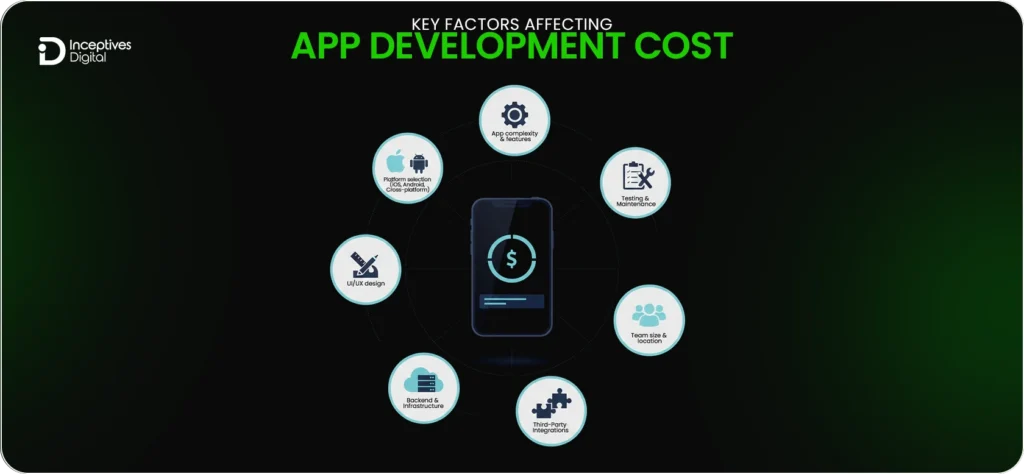
1. App Feature Complexity and Development Cost
The complexity level of your application is one of the key factors that affect app development cost. For example, a simple app with basic features will obviously cost less than a complex application having advanced features like real-time AI recommendations and secured payment gateways. Complex apps require more specialized developers and rigorous testing, which adds up to a big chunk to the overall app development cost.
Here’s a general breakdown of app development costs based on complexity:
| Complexity Level | Features & Scope | Estimated Cost Range |
| Simple App | Basic functionality: static content, contact forms, simple calculators, basic UI | $5,000 – $30,000 |
| Medium Complexity App | Interactive features: user login, social sharing, APIs, push notifications, simple backend | $30,000 – $80,000 |
| Complex App | Advanced features: real-time chat, AI/ML, payment gateways, multi-user dashboards, cloud integration, high-end UI/UX | $80,000 – $200,000+ |
By carefully planning the features and giving priority to essentials, it is possible to cut down costs without impacting the user experience. To confirm their concept before committing to complete development, a lot of startups initially release a Minimum Viable Product (MVP).
2. Platform Selection: iOS, Android, or Cross-Platform
Platform selection has a significant effect on app development cost. Native apps cost more than cross-platform apps because it requires separate apps and codebases for iOS and Android, which increases both development time and budget. While cross-platform development utilizes frameworks like Flutter and React Native, which use a single code base for both platforms, this reduces both app development time and cost.
Estimated App Development Cost by Platforms:
| Platform | Scope & Notes | Cost Range |
| iOS Native | Optimal performance, Apple ecosystem, high-quality design | $30,000 – $150,000+ |
| Android Native | Wide device coverage, Google Play ecosystem | $25,000 – $140,000+ |
| Cross-Platform | Single codebase for iOS & Android, faster launch, slightly less native performance | $20,000 – $120,000+ |
Key Considerations:
- Native applications deliver the highest performance but are more expensive when developed for several platforms.
- Cross-platform applications are perfect for MVPs or new businesses wanting fast market penetration.
- Besides, the choice of platform influences maintenance cost, frequency of updates, and quality of user experience.
3. UI/UX Design Cost and Requirements for Mobile Apps
Smooth UI/UX design plays a key role in improving the user experience and user retention, but also affects the overall app development cost. Apps with simple layout requirements and standard components cost less than applications requiring custom animations, complex user flows, and branded visuals, for example, mobile game app development projects.
The purpose of a good UI/UX design is not just to provide engaging visuals. It includes user research, wireframing, prototyping, and usability testing. Each of the stages is valuable, but it also puts a share in the overall app development cost. Apps that want to foster retention and conversion rates in highly competitive markets usually invest more in UI/UX design.
Estimated UI/UX Design Cost:
- Basic UI/UX (templates, minimal customization): $2,000 – $5,000
- Custom UI/UX (branding, animations, advanced flows): $5,000 – $15,000+
It is critically important to find the right mix of visual appeal and functionality. An interface that is aesthetically pleasing and easy to use can reduce development corrections as well as save more on maintenance costs in the long run.
4. Backend Development and Infrastructure
Backend functions as the brain for mobile applications and contributes a major part to the app development cost. It is responsible for data storage, user authentication, APIs, and third-party integrations. The most costly and time-consuming applications are the ones requiring real-time data processing or complex integrations.
Cloud, Server infrastructure, and databases also affect the app development cost. Choosing reliable solutions like AWS, Google Cloud, or Azure can increase the cost initially, but saves you from performance issues and redevelopment costs.
Estimated Backend Development Cost:
- Basic Backend (simple APIs, limited data): $5,000 – $15,000
- Advanced Backend (real-time sync, scalability, integrations): $15,000 – $50,000+
Backend structure has a great effect on application performance, security, and maintenance, which is why it is considered to be an important investment and not a place where cost can be reduced.
5. Third-Party Integrations and APIs
Integrating third-party APIs can heavily affect your app development budget. You can save development time, but you have to pay the licensing fees and may face additional complexity for features like payment gateways, social logins, maps, analytics, or cloud services.
Cost Factors Include:
- Number of integrations: A greater number of APIs translates to longer periods for development and testing.
- Complexity: Advanced backend work is necessary for custom APIs or real-time data syncing.
- Licensing & subscription fees: Certain services impose a charge based on the number of users, monthly, or transactions.
Estimated Cost Impact:
- Simple Integrations (e.g., Google Maps, basic social login): $500 – $3,000
- Complex Integrations (e.g., payment systems, custom APIs, real-time syncing): $3,000 – $15,000+
Integrations that are well-thought-out can cut down time and improve the capabilities, yet bad implementation can lead to more bugs, longer time, and higher maintenance costs.
6. App Development Team Cost and Location Impact
Different regions have different hourly rates for developers, high or low, depending on their experience and expertise. A bigger and highly experienced team definitely costs more, but ensures quality and speed. An inexperienced team can save you money upfront but increases the chances of quality issues. This is how team composition and location affect the app development cost.
Location Wise Hourly Rates of Developers:
| Location | Average Hourly Rate (USD) | Notes |
| North America | $50 – $150 | High expertise, premium rates, shorter timelines |
| Western Europe | $40 – $120 | Skilled developers, high-quality output, moderate cost |
| Eastern Europe | $30 – $60 | Cost-effective, good quality, popular for outsourcing |
| Latin America | $30 – $60 | Nearshore option for North America, reliable quality |
| Asia / South Asia | $15 – $40 | Most affordable, wide talent pool, may need more management |
Need Help Picking the Right Development Team?
Choose the best team for your budget, timeline, and quality expectations to avoid hidden costs.
Explore Team Options7. Development Methodology and Timeline
The app development methodology you are following has a direct impact on your app development cost. Agile app development can bring down the cost up to 10–20% in contrast to the strict Waterfall methods. MVP development costs are typically 30–50% less than building a full-featured app upfront. A basic application may take 2–3 months, a medium complex one 4–6 months, and complex applications 6–12+ months, subject to the methodology. Choosing the right methodology (Agile, Waterfall, or phased development) can reduce risk, improve quality, and save you thousands of bucks
Key Points:
- Agile Development: With iterative sprints, you get early testing and feedback. Thereby, it is possible to save costs by early detection and rework avoidance on a large scale.
- MVP Approach: The launching of a Minimum Viable Product puts emphasis on the most essential features only, thus lowering the initial cost of development and proving the concept with further investment in advanced features.
- Project Timeline: A longer timeline is generally synonymous with a higher cost. Agile and phased development techniques allow cost to be distributed over time while ensuring quicker releases for the most important features.
8. Testing, Quality Assurance, and Security
To deliver a secure, reliable, and high-performing mobile app, thorough testing and quality assurance (QA) are very important. It makes your app perform optimally across devices, maintains stability, and protects user information. Performing security audits, performance, and functional evaluations mitigates the risk of bugs, crashes, and vulnerabilities.
Estimated Cost:
- Basic QA & Functional Testing: $2,000 – $5,000
- Advanced Testing & Security Audit: $5,000 – $15,000+
- Performance Testing: $3,000 – $10,000+
9. Post-Launch Maintenance and Support Costs
Ongoing maintenance and updates are essential to keep your app secure, up-to-date, engaging, and competitive. Post-launch activities make sure the performance, reliability, and user satisfaction of your application.
Fixing bugs, OS updates, performance monitoring, security updates, and enhancements according to user feedback are common practices included in maintenance. Early planning for post-launch maintenance costs avoids costly emergency fixes and ensures long-term success.
Estimated Annual Maintenance Costs:
- Basic Maintenance: $2,000 – $5,000 per year
- Standard Maintenance: $5,000 – $15,000 per year
- Advanced Maintenance: $15,000 – $50,000+ per year
Mobile App Development Cost Breakdown
A clear understanding of the app development cost will make it easy to plan a sufficient budget and prioritize the essential features. The development cost depends on the complexity, features, platform selection, and team composition.
Here is a general app development cost breakdown:
Estimated Cost Ranges by App Complexity:
- Simple App: $5,000 – $30,000
Basically, static content, contact forms, simple calculators, and slight UI customization are among the basic features. - Medium Complexity App: $30,000 – $80,000
Includes user login, social sharing, APIs, push notifications, and a straightforward backend among the interactive features. - Complex App: $80,000 – $200,000+
The advanced features include real-time chat, AI/ML capabilities, payment gateways, multi-user dashboards, cloud integration, and high-end UI/UX.
Wondering How Much Your App Will Cost?
Get a realistic estimate for your app idea and plan your budget confidently before development begins.
Estimate My App CostHow to Reduce Mobile App Development Cost Without Compromising Quality
Most of the time, businesses think cutting some essential features will reduce the app development cost, but eventually it heavily impacts the quality of your application which causes user dissatisfaction. Below are the strategies recommended by industry experts that can really help you keep the budget within the limit without losing the quality and experience.
- Start with an MVP.
- Use cross-platform development instead of native.
- Prioritize core features first.
- Leverage third-party tools
- Choose the right development partner
Common Mistakes That Increase App Development Cost
Most of the time, app development projects exceed their planned budget due to mismanagement and execution mistakes, which often increase the development cost and delays. Below are the most common app development mistakes that you need to avoid.
- The project started without documented requirements.
- The team skipped MVP planning and developed multiple features before they completed the initial product.
- Development work experienced constant changes because of changing project requirements.
- The development team selected an inappropriate technology stack, which did not support the application development objectives.
- The team did not recognize the full extent of time and resources needed for UI/UX design and testing activities.
- The team developed the application without considering ongoing maintenance needs and future software updates.
Avoiding and fixing all these app development mistakes shall save you costly overruns, prevent any unforeseen costs, and help your project stay within budget.
Wrapping Up
Well-defined planning and decision-making are the key to smart mobile app budgeting. The app development cost depends on factors like features, level of complexity, platform selection, and avoiding redevelopments that create disbalance in quality, performance, and budget.
If you have concerns regarding cost estimation and what the right app development approach is for your app, hiring professional mobile app development services can really make the process much smoother for you. Expert guidance helps validate ideas early to build cost-efficient mobile apps that align with your business objectives.
Plan, Execute, and Scale Your App Effectively With Inceptives Digital
From MVP to full-featured deployment, optimize processes to control costs and maximize performance.
Start My App StrategyFrequently Asked Questions
The following factors impact the mobile app development cost:
1. App Feature Complexity and Development Cost
2. Platform Selection: iOS, Android, or Cross-Platform
3. UI/UX Design Cost and Requirements for Mobile Apps
4. Backend Development and Infrastructure
5. Third-Party Integrations and APIs
6. App Development Team Cost and Location Impact
7. Development Methodology and Timeline
8. Testing, Quality Assurance, and Security
10. Post-Launch Maintenance and Support Costs
A simple app may cost between $10,000–$30,000, a medium-complexity app typically ranges from $30,000–80,000 and complex or enterprise apps can exceed $100,000, depending on requirements.
Yes, cross-platform is usually more cost-effective compared to Native app development. That is because in a cross platform approach, a single code base is used for both iOS and Android, which eventually cuts down the development cost and time.
App development timelines vary by complexity. Simple apps may take 2–3 months, medium apps around 4–6 months, and complex apps can take 8 months or longer.
Yes, costs can be reduced by refining features, prioritizing core functionality, switching to phased development, or adjusting the development approach without compromising the app’s core quality.