

Summary: Custom software development costs extend far beyond coding. This guide explains hidden expenses across discovery, scope, architecture, integrations, security, cloud, AI, testing, migration, maintenance, and operations, helping decision-makers compare proposals and build realistic budgets before development begins.
INTRODUCTION
A development quote can feel reassuring until the missing pieces start appearing.
Custom software development rarely becomes expensive because of one dramatic invoice. More often, the budget leaks through decisions that seemed minor at the start.
More than 200 verified projects have shown that companies plan for the build but rarely plan for the maintenance, scaling, and training costs that follow it.
Those hidden expenses can inflate a project’s total price by 30 to 50 percent, turning a $100,000 build into a $150,000 commitment before year one closes.
The State of FinOps report found that participating organizations managed more than $69 billion in cloud spend, while 63% reported managing AI-related costs.
So where does the rest of the budget go?
This guide breaks down costs that often sit outside the initial estimate and shows how to surface them before they become expensive surprises.
What Are Hidden Costs in Custom Software Development?
Hidden costs are expenses that do not always appear in an initial software estimate but still affect the total cost of creating, launching, operating, and changing the product.
They can originate from requirements, architecture, integrations, security, infrastructure, migration, testing, third-party services, or future enhancements.
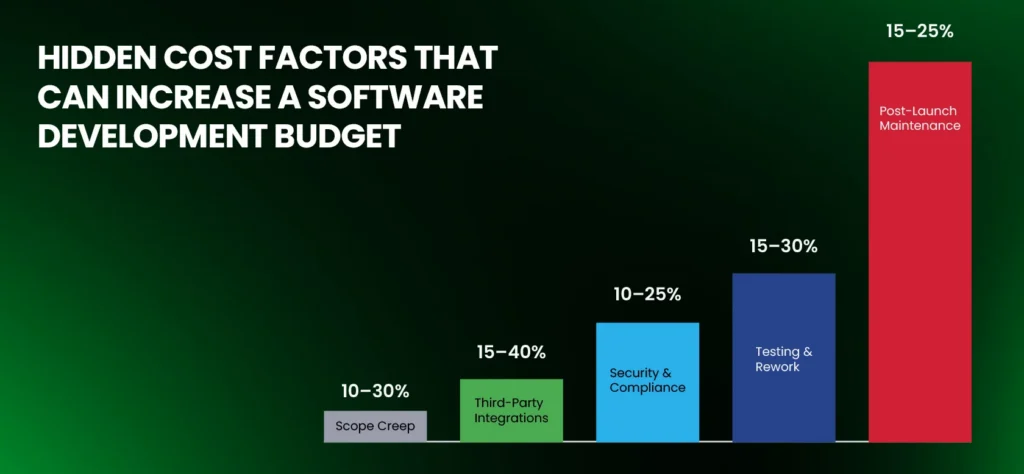
Importantly, a hidden cost does not automatically mean a vendor priced the project unfairly.
Some work remains difficult to estimate until the team understands the product properly.
Other costs appear because businesses focus on the build itself while overlooking everything required to run the software reliably.
That distinction becomes important when evaluating custom software development.
A lower quote does not necessarily represent a lower-cost project.
A higher quote does not automatically represent better engineering either.
The stronger comparison is whether both proposals describe the same outcome, responsibilities, constraints, and post-launch obligations.
Why the Development Quote Is Not the Full Cost
Most software proposals focus heavily on engineering.
However, a functioning product also requires discovery, design, security, testing, deployment, data preparation, infrastructure, monitoring, maintenance, and future change.
A more realistic model is:
Total software cost = Build cost + launch cost + operating cost + change cost + risk exposure
Each category creates different financial obligations.
| Cost category | What it covers | Typical timing |
| Product discovery | Research, requirements, validation | Before development |
| Engineering | Frontend, backend, APIs | During development |
| Quality assurance | Functional, regression, performance testing | During development |
| Security | Architecture, controls, testing | Throughout |
| Infrastructure | Cloud, databases, storage, monitoring | During and after launch |
| Data | Migration, cleansing, validation | Before and during launch |
| Change management | Requirement changes and rework | Throughout |
| Maintenance | Fixes, upgrades, support | After launch |
| Optimization | Performance and infrastructure improvements | After launch |
This explains why two teams can estimate the same product at significantly different prices.
They may not be estimating the same responsibilities.
Businesses building a broader digital product should also consider digital product development, where product strategy, engineering, design, and ongoing evolution need to work together.
The practical rule is simple:
Compare included outcomes, not only quoted development hours.
1. Discovery and Requirements Analysis
Many hidden costs begin before developers write production code.
A vague requirement can produce a precise-looking estimate while leaving important decisions unresolved.
Consider a customer platform with accounts, payments, reporting, messaging, and administration.
The initial feature list seems straightforward.
Discovery may reveal multiple user types, approval rules, legacy data, external billing systems, audit requirements, accessibility expectations, and regional constraints.
The scope has barely changed.
The actual complexity has.
That is why a discovery sprint can materially improve the quality of an early estimate.
What Discovery Needs to Clarify
Teams often underestimate the effort required to define:
- User journeys
- Business rules
- Permissions
- Edge cases
- Data relationships
- Integration requirements
- Reporting logic
- Operational workflows
- Non-functional requirements
These details influence architecture, testing, delivery effort, and future maintenance.
Inceptives Digital’s product perspective places those decisions before implementation: teams should challenge the problem, users, business consequences, exclusions, and failure conditions before expensive execution begins.
That principle has a direct financial consequence.
Clarifying uncertainty during discovery generally costs less than redesigning around it later.
How to Reduce Discovery-Related Cost
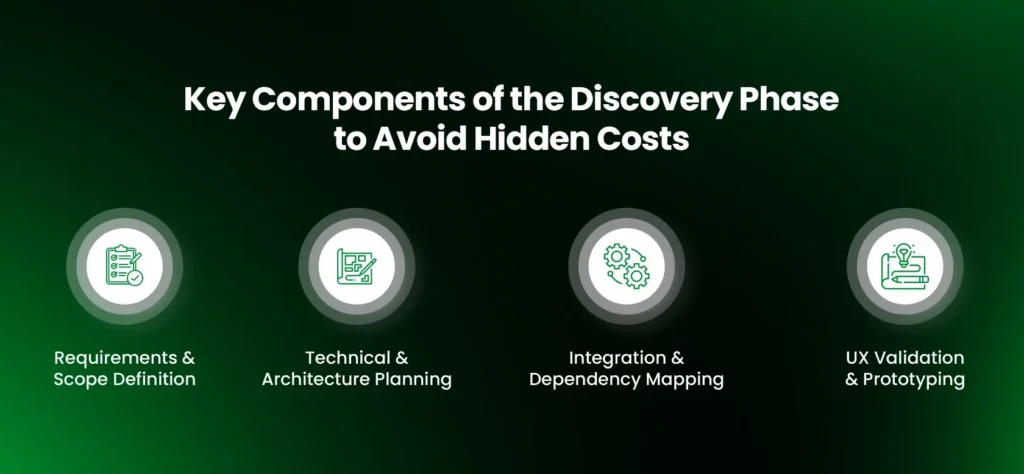
A useful discovery process should establish:
| Output | Decision it supports |
| User journeys | What users actually need |
| Requirements | What belongs in scope |
| Architecture direction | How the product should work |
| Integration map | Which dependencies matter |
| Data model | What information the system needs |
| Risk register | What could increase cost |
| MVP boundary | What can wait |
For products that still carry significant market uncertainty, MVP development can also help separate validation requirements from later expansion.
The goal is not more documentation.
The goal is less expensive ambiguity.
2. Scope Creep and Requirement Changes
Scope creep rarely arrives as one large request.
It usually enters through small additions.
- Can administrators export this?
- Can another role approve it?
- Can users edit one more field?
- Can the same workflow support another country?
Each change sounds manageable.
Together, they can alter databases, interfaces, permissions, integrations, testing, analytics, and documentation.
Why Small Changes Become Expensive
Software features rarely exist independently.
A single feature can affect:
- Database structures
- API contracts
- User interfaces
- Permissions
- Notifications
- Analytics
- Automated tests
- Documentation
That makes screen-based estimates unreliable.
The same issue appears in factors affecting app development cost, where complexity extends beyond the visible interface.
Use a Change-Control Model
Every meaningful change should pass through:
Requested change → affected components → additional effort → schedule impact → business value → approval
This creates visibility without blocking legitimate product evolution.
Inceptives Digital’s leadership framework makes the same point from a product perspective: restraint is not about building less for the sake of saving money.
Each feature should earn its place through user value, operational value, or commercial consequence.
Build an MVP Boundary
For early products, separate requirements into:
| Priority | Decision |
| Critical | Required for launch |
| Valuable | Important but can follow |
| Optional | Add after evidence |
This keeps the first release focused without locking the product into a permanent feature set.
Teams considering the economics of that approach can also review MVP development cost.
The important point is not to make the MVP artificially small.
It is to stop unvalidated functionality from consuming the budget prematurely.
3. Architecture Decisions That Become Expensive Later
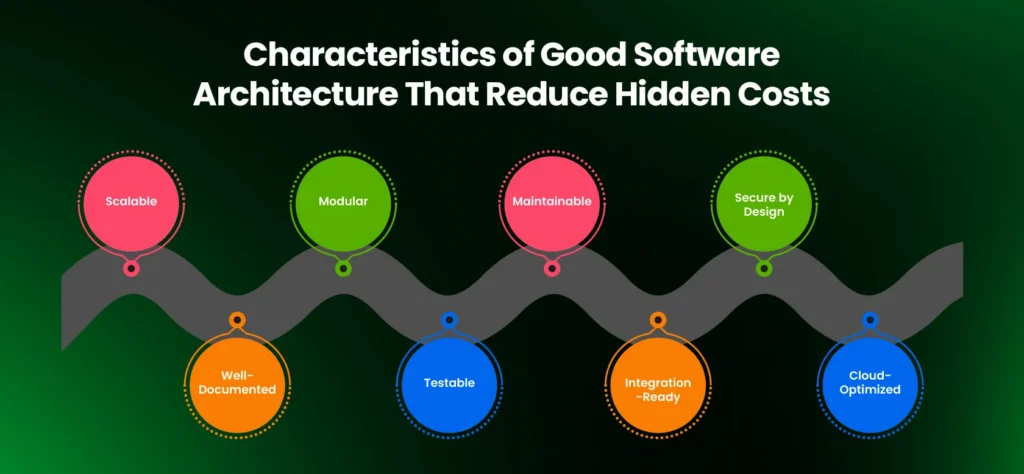
Architecture creates financial consequences long after the first development invoice.
- A framework may speed up implementation.
- A database may work perfectly at the initial scale.
- A monolithic architecture may simplify the first release.
None of those choices automatically creates a problem.
The cost appears when architecture stops fitting the product’s actual conditions.
Teams evaluating early technical decisions can explore backend API development, particularly when APIs, data boundaries, and external systems form a core part of the product.
Where Architectural Costs Appear
- Scalability
Growing workloads can require caching, queues, database restructuring, or infrastructure changes.
- Performance
A system that works with thousands of records may behave very differently with millions.
- Maintainability
Difficult codebases make ordinary changes slower and riskier.
- Extensibility
Tightly coupled components can turn modest requirements into significant engineering work.
- Migration
A poor technical choice can eventually require partial replacement or a broader rewrite.
The engineering perspective makes the issue particularly clear: week-one architecture decisions can become long-term constraints, especially around data, tenancy, identity, integrations, and observability.
Four Architecture Questions Worth Asking
- What scale must the first release support?
- Which integrations could become business-critical?
- Which components may eventually need independent scaling?
- Which decisions would be expensive to reverse?
Do not engineer around an imaginary future.
Design deliberately for the next credible stage.
That principle also matters when assessing cross-platform app development, native delivery, or technology choices for products expected to evolve significantly.
The right stack is the one the product can support.
4. Third-Party Integrations and API Costs
Integrations often look simple in proposals.
- Connect Stripe.
- Integrate Salesforce.
- Add mapping.
- Connect the ERP.
The actual implementation may involve authentication, data mapping, webhooks, retries, rate limits, synchronization, error handling, monitoring, and fallback logic.
Why Integrations Create Hidden Costs
External services have their own:
- Pricing
- API versions
- Rate limits
- Authentication models
- Data formats
- Service availability
- Compliance requirements
- Maintenance cycles
That creates both development costs and recurring operating costs.
A service can also charge based on transactions, API calls, storage, active users, or other usage measures.
Questions to Ask Before Integration
| Question | Why it matters |
| Is an API available? | Determines feasibility |
| Is usage charged? | Creates recurring cost |
| Are webhooks supported? | Affects synchronization |
| What limits apply? | Influences architecture |
| How does authentication work? | Affects security |
| What happens during downtime? | Requires fallback logic |
| How often does the API change? | Creates maintenance work |
When multiple business systems need to exchange information, system integration should be treated as part of the architecture rather than a late-stage technical task.
That is different from business process automation, which changes how work moves through the organization itself.
Both can affect the final project budget.
5. Data Migration and Data Cleanup
Data migration frequently receives less attention than feature development.
That becomes expensive when the new system needs to inherit years of operational records.
Legacy datasets may contain duplicates, inconsistent formats, missing fields, outdated identifiers, or undocumented business rules.
Moving the data is therefore not simply an import exercise.
Migration Work Can Include
- Data profiling
- Field mapping
- Transformation
- Deduplication
- Validation
- Historical-data handling
- Migration scripts
- Trial migrations
- Reconciliation
- Backup and rollback planning
The older and more fragmented the source environment, the greater the uncertainty.
How to Control Migration Costs
Treat migration as its own workstream.
Map:
Source systems → data owners → data quality → transformation rules → migration method → validation
Then test a representative sample early.
Finding a data problem during discovery is cheaper than finding it immediately before launch.
The same logic applies to enterprise web app development, where a product may need to replace several disconnected systems without interrupting the business.
6. Security and Compliance Costs
Security should not become an emergency work package near launch.
Modern applications need security decisions across architecture, identity, data, dependencies, infrastructure, and monitoring.
The OWASP Top 10 identifies broken access control, security misconfiguration, software supply chain failures, cryptographic failures, insecure design, and authentication failures among critical web application risks.
Security Costs Can Include
| Area | Potential work |
| Identity | Authentication, MFA, SSO |
| Authorization | Roles and access policies |
| Data protection | Encryption and secrets |
| Application security | Secure development and testing |
| Infrastructure | Cloud and network controls |
| Dependencies | Vulnerability monitoring |
| Monitoring | Logging and alerting |
| Compliance | Controls and evidence |
Security can become particularly significant in regulated applications.
For financial products, FinTech app development often requires more deliberate attention to authentication, transaction integrity, data security, integrations, and regulatory obligations.
Healthcare products present their own privacy and interoperability considerations, particularly when patient information moves across systems.
Security should therefore become a design constraint early rather than an inspection at the end.
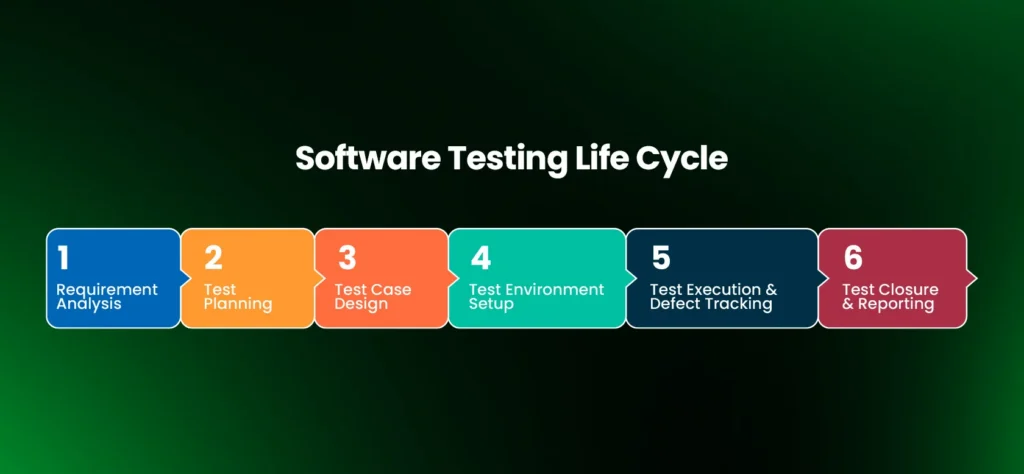
7. Testing and Quality Assurance
Testing becomes a hidden cost when project budgets treat development as the dominant activity and QA as a final-stage task.
A production application needs more than happy-path verification.
Depending on the product, testing may include:
- Functional testing
- Integration testing
- Regression testing
- Performance testing
- Security testing
- Accessibility testing
- Browser testing
- Device testing
- Data validation
- Failure testing
The engineering persona describes testing as an attempt to expose failure rather than a final confirmation exercise.
That distinction changes how teams budget for quality.
A requirement defect discovered during planning may take minutes to correct.
The same defect discovered after implementation and integration can create substantial rework.
For mobile products, mobile app testing strategies illustrate how device, platform, and workflow variation expands the quality problem.
Define Acceptance Criteria With the Feature
Feature: Password reset
Acceptance criteria:
- Reset instructions reach the correct user.
- Tokens expire correctly.
- Tokens cannot be reused.
- Password requirements apply.
- Repeated failures trigger appropriate protections.
- Previous credentials become invalid after successful reset.
Quality becomes measurable when acceptance criteria exist before development is declared complete.
8. Cloud Infrastructure and Operational Spend
Cloud expenditure continues after development ends.
Compute, databases, storage, network transfer, monitoring, backups, queues, managed services, and specialized workloads can all affect monthly operating costs.
The FinOps report highlights workload optimization, waste reduction, allocation, forecasting, and governance as important parts of managing cloud expenditure.
That makes infrastructure cost an architectural concern, not merely a finance concern.
Where Cloud Spending Can Increase
- Oversized resources
- Unused environments
- Excessive logging
- High storage consumption
- Network transfer
- Duplicate services
- Always-on development environments
- Inefficient workloads
- Poorly controlled backups
Track Cost Against Business Activity
Instead of looking only at the monthly cloud invoice, track:
Resource → usage → unit cost → business activity
For example, infrastructure cost per active customer or transaction can provide more useful insight than a raw monthly total.
That becomes increasingly important as products scale across mobile, web, and backend environments.
9. AI Can Introduce Variable Costs
AI-enabled products add another layer of financial uncertainty because usage can directly affect operating costs.
An AI application may incur costs for inference, embeddings, vector storage, retrieval, data processing, evaluation, monitoring, and external model providers.
DORA‘s research describes AI as an amplifier of existing organizational strengths and weaknesses rather than a replacement for sound engineering systems.
That distinction matters when businesses decide where AI actually belongs.
Why AI Costs Can Change Quickly
AI expenditure can depend on:
- Request volume
- Input length
- Output length
- Model choice
- Context size
- Retrieval volume
- Embedding frequency
- Automated workflow volume
A workflow that looks affordable during development may become considerably more expensive at scale.
The product position is useful here: AI should earn its place when removing it would break the intended outcome.
Calculate AI Unit Economics
A simple starting model is:
Cost per request × requests per user × active users = estimated usage cost
Then test whether each workflow needs its current model.
Teams evaluating AI-heavy products can compare AI development, AI automation, or AI agent development according to the actual business role AI needs to perform.
For conversational interfaces, AI chatbot development represents a different cost structure from autonomous workflows.
The product decision should come before the technology selection.
10. Project Management and Stakeholder Coordination
Project management is often treated as administrative overhead.
That can hide a meaningful part of delivery cost.
Custom software development requires decisions across product, engineering, design, security, operations, finance, legal, and leadership.
Those decisions consume time.
Poor coordination consumes substantially more.
Common Coordination Costs
- Requirement clarification
- Stakeholder reviews
- Approval delays
- Vendor coordination
- Access management
- Feedback consolidation
- Dependency management
- Release planning
- Documentation
A technically capable team can still lose significant time when decision ownership remains unclear.
The commercial operating perspective reinforces the same issue from the delivery side: sales should ensure the project enters delivery with realistic expectations, sufficient information, and a scope the team can responsibly support.
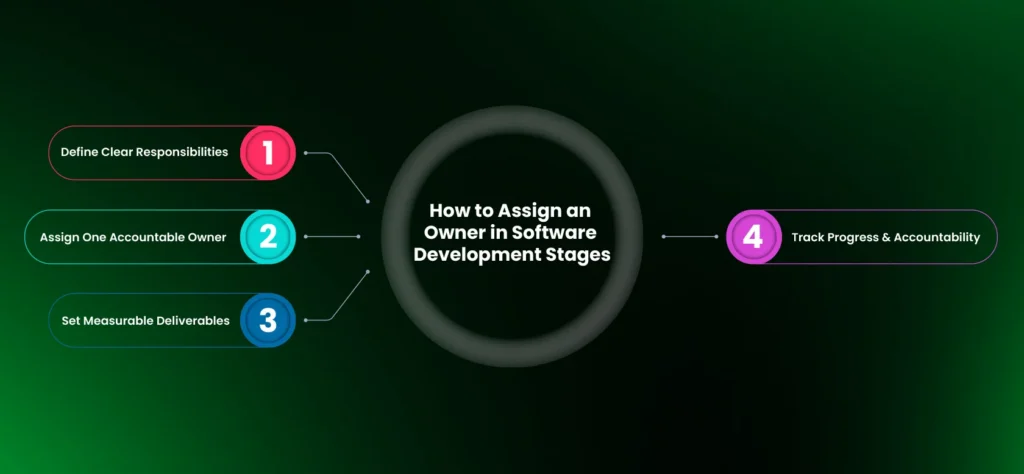
Define Decision Ownership
| Responsibility | Owner |
| Business priorities | Product owner |
| Architecture | Technical lead |
| User experience | Design lead |
| Quality | QA lead |
| Security | Security owner |
| Major investment decisions | Executive sponsor |
This reduces decision latency without creating unnecessary layers.
11. Documentation and Knowledge Transfer
Documentation rarely gets attention when deadlines become tight.
Its absence becomes expensive when employees leave, vendors change, or another engineering team needs to maintain the product.
A maintainable system should document the information necessary to operate and change it safely.
Practical Documentation Areas
- Architecture decisions
- API documentation
- Deployment procedures
- Environment configuration
- Data structures
- Integration details
- Security controls
- Operational runbooks
- Troubleshooting procedures
A system that only its original developers can understand becomes a dependency rather than a durable asset.
That makes documentation part of delivery quality.
It should not appear as an afterthought during handover.
12. Post-Launch Maintenance Costs
Launch does not end software expenditure. It begins the operating phase.
Post-launch work can include:
- Bug fixes
- Security patches
- Dependency updates
- OS compatibility
- Browser compatibility
- Infrastructure changes
- Monitoring
- Performance tuning
- Support
- Product enhancements
The same principle appears in post-launch analytics, where real production behavior becomes evidence for future product decisions.
Ask What Happens After Launch
Before signing, clarify:
| Area | Question |
| Warranty | What defects are covered? |
| Support | What response expectations apply? |
| Infrastructure | Who owns the cloud environment? |
| Maintenance | Who handles upgrades? |
| Security | Who addresses vulnerabilities? |
| Enhancements | How are future changes priced? |
| Ownership | Who owns code and documentation? |
Businesses that ignore these questions can underestimate the first-year software cost substantially.
Maintenance should be treated as part of the product’s financial model from the beginning.
Which Hidden Costs Matter Most?
Not every project carries the same exposure. The most important risks depend on the product.
| Software type | Common hidden-cost risks |
| SaaS platform | Cloud, scaling, integrations, support |
| FinTech product | Security, compliance, payments |
| Healthcare platform | Privacy, interoperability, security |
| E-commerce system | Payments, performance, integrations |
| Enterprise software | Migration, integrations, governance |
| AI application | Model usage, data, evaluation |
| Internal platform | Migration, workflows, adoption |
| Consumer mobile app | Device testing, scaling, support |
For commerce businesses, for example, ecommerce app development can create additional integration and transaction-related exposure.
For education products, education app development may introduce different user roles, content, and operational requirements.
The important point is to identify the risks specific to your product rather than applying the same generic contingency to every project.
How to Read a Custom Software Development Quote
A proposal should never be evaluated only by its final number.
Read it through five lenses.
1. Scope
What exactly will the vendor deliver?
Look for specific functionality rather than broad descriptions such as a complete platform.
2. Assumptions
What does the estimate assume about data, integrations, infrastructure, users, and third-party services?
3. Exclusions
Which activities remain outside the quoted price?
This can reveal more than the feature list itself.
4. Change Management
What happens when requirements change?
The proposal should explain how additional work gets assessed and approved.
5. Post-Launch Ownership
Who handles infrastructure, monitoring, maintenance, security, support, and future development?
This framework also helps when evaluating how to choose the right mobile app development company.
The cheapest proposal may simply exclude more work.
A Hidden-Cost Checklist for Vendor Evaluation
Before signing an agreement, test the proposal against these areas.
Product Scope
- Is the MVP boundary documented?
- Are user roles defined?
- Are edge cases identified?
- Are acceptance criteria included?
Technical Scope
- Is architecture documented?
- Are integrations identified?
- Are deployment environments included?
- Are infrastructure responsibilities clear?
Quality
- Is QA included?
- Is automated testing included?
- Are performance requirements defined?
- Is security testing included?
Infrastructure
- Who owns the cloud account?
- Who pays infrastructure bills?
- Are staging environments included?
- Is monitoring included?
Data
- Is migration included?
- Is data cleansing included?
- Who validates migrated records?
- Is rollback planning included?
Commercial Terms
- What happens when scope changes?
- Which services create recurring fees?
- What does the warranty cover?
- What does support cost afterward?
When the answers are unclear, the development estimate should not yet be treated as the full project budget.
How to Build a More Accurate Software Budget
Instead of asking for one number, divide the financial model into layers.
Layer 1: Product Definition
Include discovery, requirements, research, UX validation, and technical feasibility.
For products still validating their concept, interactive prototyping can also help expose usability issues before full engineering investment.
Layer 2: Product Delivery
Include design, frontend, backend, APIs, infrastructure, testing, deployment, and documentation.
The design portion should not disappear from financial planning.
A sound UI UX design process can prevent expensive experience changes after engineering begins.
Layer 3: Launch Readiness
Include migration, security testing, production configuration, training, analytics, and release support.
Layer 4: First-Year Operations
Include cloud infrastructure, monitoring, maintenance, support, security updates, and third-party services.
Layer 5: Change Reserve
Reserve funding for uncertainty that remains after structured discovery.
The size should reflect actual project risk.
Do not apply a universal contingency percentage simply because a spreadsheet requires one.
Fixed Price vs. Time and Materials vs. Hybrid Pricing
Commercial structure influences how project uncertainty reaches the budget.
| Model | Best suited to | Main consideration |
| Fixed price | Clearly defined scope | Changes can become expensive |
| Time and materials | Evolving requirements | Needs budget controls |
| Milestone-based | Clear delivery stages | Milestones need precise definitions |
| Hybrid | Mixed certainty | Requires disciplined contracts |
Fixed Price
Fixed pricing works best when scope, deliverables, and acceptance criteria are sufficiently defined.
It becomes less suitable when major product or technical questions remain unresolved.
Time and Materials
This model supports evolving requirements.
However, the buyer needs visibility into effort, priorities, progress, and remaining budget.
Hybrid
A hybrid structure can separate discovery from implementation.
That can make sense when early uncertainty remains material, but the buyer still wants stronger budget controls.
The commercial model should match the project’s uncertainty.
How Governance Controls Software Costs
Strong governance does not mean creating unnecessary bureaucracy.
It means making consequential decisions visible.
A practical monthly review can track:
| Metric | Why monitor it |
| Budget consumed | Shows financial trajectory |
| Scope completed | Shows actual progress |
| Approved changes | Shows scope expansion |
| Defect trend | Reveals quality issues |
| Cloud spend | Tracks operating exposure |
| Technical debt | Signals future engineering cost |
| Delivery risks | Identifies emerging threats |
The sales process should protect delivery rather than simply create work for it.
His framework treats qualification as an operational control, because poor-fit engagements can damage margins, delivery quality, and client trust.
That makes commercial discipline part of software cost management.
An unclear sales promise does not disappear at contract signature.
It usually becomes a delivery problem.
The Questions Decision-Makers Should Ask
Before approving custom software development, ask:
- What assumptions created this estimate?
- Which requirements remain uncertain?
- Which costs are explicitly excluded?
- Which third-party services create recurring charges?
- Who owns the infrastructure account?
- How are changes approved and priced?
- How will existing data move into the new system?
- Which security activities are included?
- What does the first year of operation cost?
- Who maintains the software after launch?
- Which technical decisions would be expensive to reverse?
- What evidence will determine what gets built next?
These questions shift the discussion from price to responsibility.
They also separate vendors that estimate implementation from partners that understand the full product lifecycle.
A Better Way to Think About Affordable Software
Affordable software does not always mean software with the lowest development quote.
It means the total investment makes sense against the value the product creates.
A $300,000 platform that removes significant operational inefficiency may create stronger economics than a $120,000 application that requires continuous rework.
Similarly, an MVP investment can be more sensible than a large first release when the market remains uncertain.
For companies evaluating that distinction, software development for startups provides useful context around building under constrained resources.
The same logic applies when comparing internal development with an external partner, where in-house development vs. an app development partner becomes a broader question of capability, ownership, and operating cost.
The financial equation should consider:
Initial cost + operating cost + change cost + risk exposure + business value
That provides a stronger basis for investment decisions than a development quote alone.
Before You Approve the Budget, Check These Five Numbers
Your software business case should include five financial views.
- Build cost: What does it take to create the product?
- Launch cost: What does it take to put it safely into production?
- Operating cost: What does it cost to keep the system running?
- Change budget: What funding will support future improvements?
- Risk reserve: What financial buffer covers material uncertainty?
Without those figures, the development budget remains incomplete.
The initial estimate may still be correct.
The investment decision may not be.
Conclusion: Budget for the Product, Not Just the Build
Custom software development becomes expensive when businesses budget for coding but overlook the system surrounding the code.
Discovery, integrations, migration, security, cloud infrastructure, AI usage, testing, maintenance, support, and scope changes can all reshape the final economics.
The answer is not predicting every expense perfectly.
Instead, identify the major cost drivers, expose assumptions, distinguish one-time expenses from recurring commitments, and make uncertainty visible before development begins.
That is ultimately what cost control should accomplish.
Not making software artificially cheap.
Making the investment understandable before the business commits to it.
Build With Cost Visibility From Day One
Stop guessing at your software budget. Talk to Inceptives Digital about pricing your full project cost, timeline, and risk upfront.
Book a Free ConsultationBuild With Cost Visibility From Day One
Stop guessing at your software budget. Talk to Inceptives Digital about pricing your full project cost, timeline, and risk upfront.
Book a Free Consultation
FAQs
Hidden costs can include discovery, scope changes, integrations, migration, security, testing, infrastructure, third-party services, maintenance, support, and future engineering.
Budgets usually expand when requirements remain unclear, scope increases, technical complexity grows, integrations create rework, or teams discover important issues after implementation begins.
Custom software often requires more upfront investment, but it can provide stronger workflow alignment, integration flexibility, ownership, and control over long-term product direction.
Begin with discovery, define requirements clearly, document assumptions, assess integrations, plan security early, validate data, control scope, and estimate ongoing operational costs.
A detailed quote should explain scope, deliverables, assumptions, exclusions, integrations, testing, deployment, ownership, change procedures, support, and recurring infrastructure or service costs.
Cloud expenses usually become operating costs, although development and staging environments also generate infrastructure charges that should appear in the broader project financial model.
APIs can introduce implementation effort, usage charges, authentication requirements, rate limits, monitoring needs, maintenance obligations, and dependency risks after the product launches.
Maintenance becomes costly when systems accumulate technical debt, depend on outdated components, lack documentation, require frequent changes, or need continuous security and compatibility updates.
Yes. A contingency reserve can cover material uncertainty, especially when requirements, integrations, migration complexity, or technical feasibility remain unresolved during initial planning.
No. Fixed pricing can improve budget certainty, but unclear scope can create exclusions, change requests, compromises, or contractual disputes that increase total project spending.
There is no universal price. Cost depends on scope, complexity, integrations, architecture, security requirements, team structure, technology choices, geography, and post-launch responsibilities.
Requirement uncertainty often creates the widest downstream impact because unclear decisions can trigger redesign, rework, architectural changes, additional testing, and schedule extensions.


