
- Startups should prioritize digital transformation projects that solve immediate business problems.
- Limited budgets make it important to measure potential returns before investing in new technology.
- Technical debt can slow product releases and make future growth more expensive.
- Connecting disconnected business tools can reduce manual work and improve data accuracy.
- Poor data quality makes reporting less reliable and creates problems across departments.
- Security improvements should begin before customer growth exposes serious vulnerabilities.
- Scaling infrastructure too early wastes money, while delaying upgrades can affect product performance.
- Startups can hire external specialists instead of building a large in-house technology team.
- A phased transformation roadmap helps startups manage costs and test results before expanding.
- Buying software works for standard business needs, while custom development makes sense for capabilities that create a competitive advantage.
Startups invest in digital product development and digital transformation to compete with larger, well-funded rivals, yet the process rarely moves in a straight line.
Founders often underestimate the operational, financial, and cultural shifts that new technology demands from a small team. Budget limits, skill gaps, and legacy habits slow adoption long before results appear.
This guide breaks down the real challenges startups face during digital transformation and pairs each one with a practical solution you can apply right away.
You will find clear numbers instead of vague estimates, a step-by-step roadmap, and a comparison table that maps every challenge to its fix. By the end, you will know exactly where your startup stands and what to do next.
What Is Digital Transformation for a Startup?
Digital transformation means redesigning how a startup operates, serves customers, manages information, and delivers its product through digital technology.
For an early-stage company, transformation does not necessarily mean replacing every existing system. Targeted business process automation services can improve existing operations without requiring a complete rebuild.
Instead, it usually means improving a specific business constraint through better technology, processes, data, or customer experiences.
A startup might transform by:
- Replacing spreadsheets with a centralized operational platform.
- Moving manual customer onboarding into a digital workflow.
- Connecting payment, CRM, analytics, and support systems through APIs.
- Rebuilding an MVP architecture before customer growth exposes its limits.
- Introducing automated testing and deployment.
- Migrating workloads to scalable cloud infrastructure.
- Creating a unified customer account and data model.
- Adding analytics to product and operational decisions.
- Strengthening security before entering regulated markets.
- Developing a mobile, web, or SaaS product around validated customer demand.
The distinction matters because startups cannot afford transformation for transformation’s sake.
A $50,000 modernization project that removes a $10,000 monthly operational bottleneck may create a strong business case.
A $100,000 platform rebuild that improves architecture without affecting revenue, reliability, or delivery speed may not deserve priority.
Digital Transformation vs. Digital Product Development
These concepts overlap, but they solve different problems.
| Factor | Digital Transformation | Digital Product Development |
| Primary goal | Improve how the business operates | Create or improve a digital product |
| Scope | Business-wide or departmental | Product-focused |
| Typical work | Process redesign, systems, data, automation | Discovery, UX, engineering, testing, launch |
| Main stakeholders | Leadership, operations, finance, IT, product | Product, design, engineering, customers |
| Typical trigger | Operational inefficiency or growth constraint | New opportunity or customer problem |
| Success measures | Cost, speed, productivity, adoption, risk | Retention, revenue, engagement, conversion |
| Common investment | $25,000–$250,000+ | $20,000–$500,000+ depending on complexity |
For many startups, digital transformation should happen alongside the digital product development process to improve both operations and the customer experience.
The product becomes stronger when the operational systems behind it can support customer growth.
Why Digital Transformation Becomes Difficult for Startups
Startups have an advantage over established enterprises: they can make decisions quickly without replacing decades of legacy infrastructure.
However, they also face tighter constraints.
A startup might have 5–30 employees, limited technical leadership, a small technology budget, and a product roadmap that changes every quarter.
Consequently, even a seemingly straightforward software development decision for startups can affect hiring, customer support, infrastructure, security, sales, and cash flow.
The most common challenge involves sequencing.
A startup may know that it needs better analytics, automation, security, integrations, and infrastructure. It still needs to determine which investment should happen first.
A useful prioritization model evaluates every transformation initiative against four factors:
Business impact × urgency × implementation effort × dependency risk
This approach helps leadership distinguish between problems that require immediate action and improvements that can wait.
10 Digital Transformation Challenges Startups Need to Overcome
1. Choosing What to Transform First
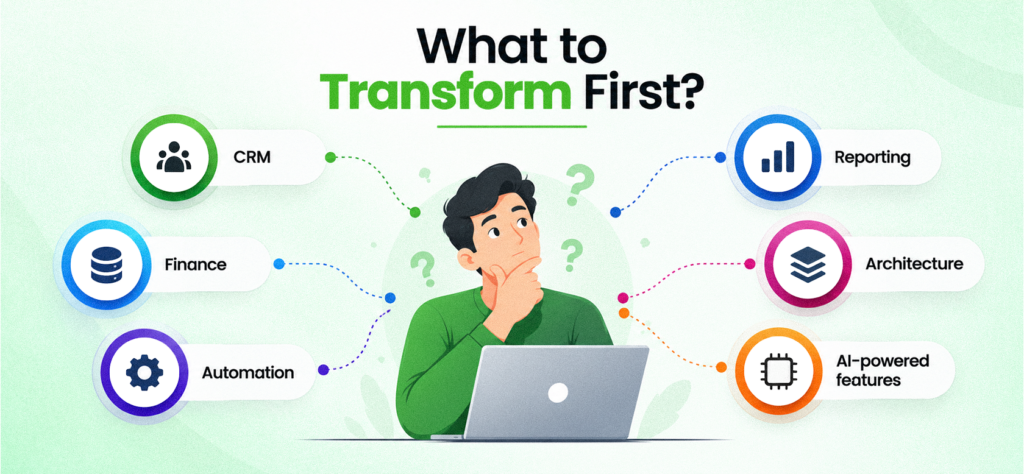
Startups often identify too many problems at once. Poor prioritization is among the common reasons digital products fail when teams attempt to solve everything simultaneously.
The CRM needs improvement. The application needs a redesign. Finance wants automation. Operations wants reporting. Engineering wants a better architecture. Leadership wants AI-powered features.
Trying to solve everything simultaneously creates competing priorities and increases delivery risk. Early product strategy consulting can help startups identify which initiatives deserve investment first.
The Solution: Build a Transformation Priority Matrix
Score every proposed initiative from 1 to 5 across:
- Revenue impact
- Customer impact
- Operational savings
- Risk reduction
- Implementation complexity
- Dependency on other projects
- Time to measurable value
Then calculate a simple priority score:
Priority Score = Business Impact + Urgency + Risk Reduction − Complexity
A startup should generally prioritize projects that improve a measurable constraint within three to six months.
For example, replacing an unreliable payment workflow may deserve priority over redesigning an internal dashboard if payment failures directly affect revenue.
Decision Benchmark
| Situation | Recommended action |
| Process costs less than $2,000/month and causes minimal friction | Defer major transformation |
| Process costs $2,000–$5,000/month | Investigate targeted automation |
| Process costs $5,000–$15,000/month | Build a quantified transformation case |
| Process costs $15,000+/month | Prioritize operational redesign |
| System threatens security or compliance | Address regardless of short-term ROI |
These figures work as planning thresholds rather than universal rules. A regulated fintech startup, for example, may prioritize security at a much lower financial threshold.
2. Limited Budget and Unclear Digital Transformation ROI
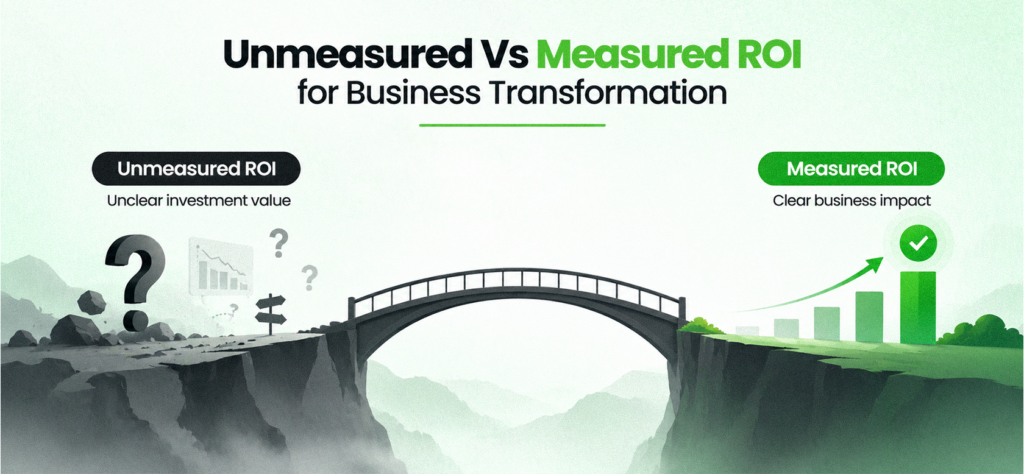
Budget pressure represents one of the most difficult startup transformation challenges.
A startup cannot simply approve a large technology program because a new platform looks more efficient. A discovery sprint can help establish the business case before funding development.
Leadership needs to connect the investment to measurable outcomes.
A practical startup transformation budget can fall into these planning ranges:
| Initiative | Typical startup investment range |
| Digital transformation discovery | $5,000–$15,000 |
| UX and process redesign | $8,000–$25,000 |
| Workflow automation | $5,000–$30,000 |
| Third-party integrations | $10,000–$40,000 |
| Data migration | $10,000–$50,000 |
| MVP modernization | $25,000–$75,000 |
| Security improvement program | $5,000–$20,000 |
| Cloud architecture improvement | $10,000–$40,000 |
| End-to-end transformation program | $50,000–$250,000+ |
These ranges represent planning estimates rather than fixed prices. Industry, team location, product complexity, compliance requirements, and hidden custom software development costs can substantially affect the final investment.
The Solution: Define ROI Before Selecting Technology
Instead of asking, How much will this platform cost? ask:
What measurable business result should this investment produce within 6–12 months?
For example:
- Reduce manual processing from 20 hours to 5 hours weekly.
- Reduce customer onboarding from two days to 20 minutes.
- Increase successful payment completion from 92% to 98%.
- Reduce support tickets by 20%.
- Cut release cycles from two weeks to two days.
- Reduce infrastructure incidents by 30%.
This creates a business case that leadership can evaluate without relying on technology trends.
3. Legacy Systems and Technical Debt
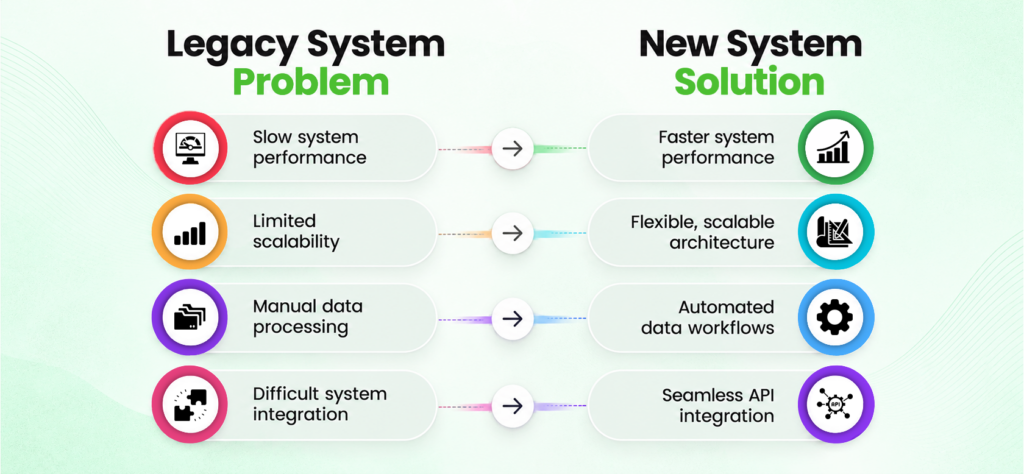
Many startups inherit technical debt because they optimized their first product for speed.
That decision often makes sense when controlling MVP development costs. However, the same architecture can become expensive as the startup reaches higher traffic or adds more integrations.
Typical warning signs include:
- Developers avoid certain parts of the codebase.
- Small changes create unexpected regressions.
- Releases require extensive manual testing.
- Database queries become increasingly slow.
- Engineers duplicate logic across services.
- API documentation remains incomplete.
- Infrastructure depends on one developer’s knowledge.
- Technical fixes repeatedly displace product work.
The solution: Modernize Selectively
Startups rarely need a complete rewrite. Targeted product rescue scaling can help address technical debt without replacing systems that still work.
A better approach starts with an architecture audit covering:
- Application architecture
- Database performance
- API structure
- Infrastructure
- Authentication and authorization
- Observability
- Automated testing
- Deployment processes
- Third-party dependencies
- Technical debt
Then classify each issue as:
Fix now → Fix during planned feature work → Monitor → Replace later
A startup should consider custom software development or rebuilding only when the existing architecture prevents critical business outcomes, such as scaling, security, or reliable delivery.
Rewrite vs. Modernization Decision
| Condition | Better choice |
| Product still validates demand | Targeted fixes |
| Architecture supports current growth | Incremental modernization |
| One subsystem blocks scaling | Replace that subsystem |
| Security vulnerabilities affect core infrastructure | Immediate remediation |
| Architecture prevents major roadmap features | Strategic rebuild |
| Code quality creates constant delivery failures | Replatform or rebuild after discovery |
A focused modernization can cost $25,000–$75,000, while a broader rebuild can exceed $100,000 depending on product scope.
Fix What’s Holding Your Startup Back
Identify costly technical bottlenecks before they slow your growth. Our experts help prioritize improvements that deliver measurable business value.
Assess My Technical Challenges4. Integrating Disconnected Digital Tools
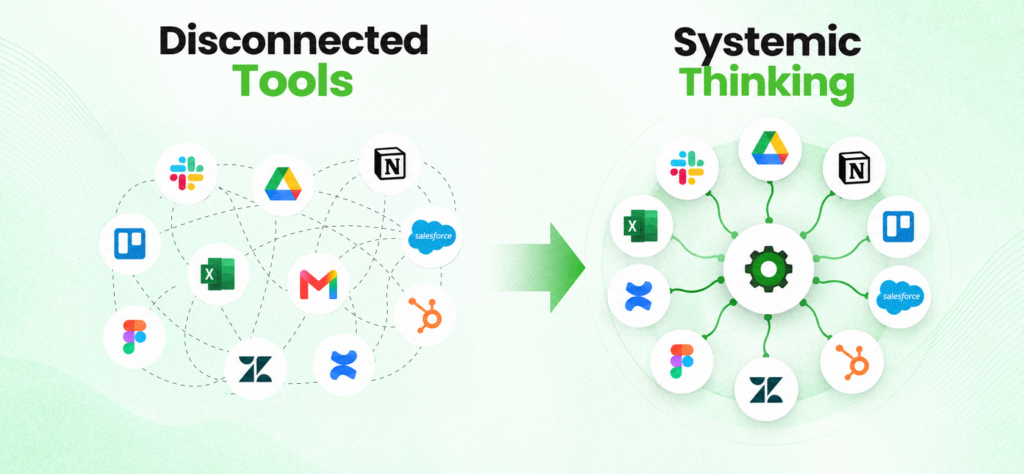
Startups often add tools one at a time.
A CRM handles sales. Stripe handles payments. Zendesk handles support. Slack handles communication. Google Analytics handles traffic. A separate platform manages email marketing.
Each system works independently, but the business lacks a connected information flow.
That fragmentation creates duplicate data entry, inconsistent customer records, reporting gaps, and manual reconciliation.
The Solution: Design an Integration Architecture
Start by mapping:
Customer → Product → Payment → Support → Analytics → Operations
Then identify where information should move automatically.
For example:
Signup → CRM record → Payment status → Product access → Support profile → Analytics event
Use system integration and API automation services to connect tools through APIs and webhooks where appropriate, without connecting every system directly to every other system.
A centralized integration layer supported by backend API development can reduce future complexity and simplify communication between systems.
Typical integration projects range from $10,000–$40,000 for a limited set of systems. More complex enterprise integrations can exceed $50,000 when they involve custom data transformation, complex workflows, or multiple legacy systems.
5. Data Silos and Poor Data Quality
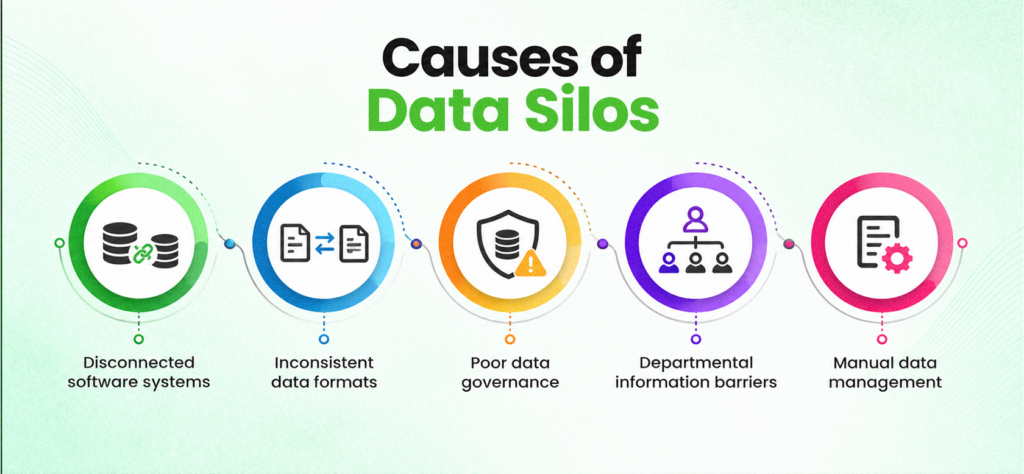
Digital transformation depends on reliable information.
However, startups often store customer and operational data across spreadsheets, databases, SaaS platforms, analytics tools, and manually maintained documents.
The problem does not simply involve data location. Persistent data inconsistencies can be among the signs startups need custom software rather than additional disconnected tools.
For example, the sales team may identify a customer by company name, billing may use an account ID, and product analytics may use an email address. Without a common identifier, teams struggle to create one reliable customer record.
The Solution: Establish Data Ownership and Governance Early
A practical startup data strategy should define:
- Source of truth for each data type
- Unique customer and account identifiers
- Data ownership
- Data retention rules
- Access permissions
- Data quality checks
- Backup procedures
- Reporting definitions
Avoid building a large data warehouse before the startup understands its reporting requirements.
For many early-stage companies, a clean operational database, reliable event tracking, and a small analytics layer provide enough capability.
Data migration projects typically cost $10,000–$50,000 for startup-scale systems, depending on data volume, quality, transformation requirements, and integration complexity.
6. Cybersecurity and Privacy Gaps
Startups often focus on product-market fit before security maturity.
That approach creates exposure when customer numbers increase, enterprise clients request security documentation, or regulations become relevant.
Security should not wait until a breach or procurement questionnaire forces the issue. Startups with customer-facing applications should establish mobile app security best practices before growth increases exposure.
National Institute of Standards and Technology recommends the Cybersecurity Framework 2.0 as a flexible approach for organizations of different sizes and maturity levels. Its small-business guidance provides a practical starting point for organizations with limited cybersecurity resources.
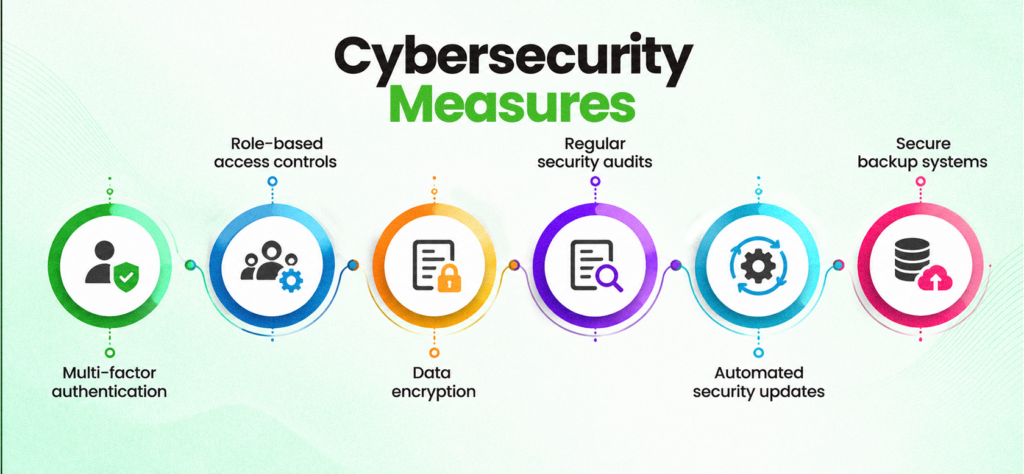
The Solution: Establish a Minimum Security Baseline
Startups should prioritize:
- Multi-factor authentication
- Role-based access control
- Secure secrets management
- Encryption in transit and at rest
- Dependency updates
- Automated backups
- Centralized logging
- Vulnerability scanning
- Secure API authorization
- Incident response procedures
For APIs, the OWASP Foundation API Security Top 10 highlights risks such as broken object-level authorization, broken authentication, unrestricted resource consumption, security misconfiguration, and unsafe API consumption.
A focused security improvement program can cost approximately $5,000–$20,000 for an early-stage product. A formal compliance program involving audits, penetration testing, legal review, and certification can cost considerably more.
7. Scaling Infrastructure Too Early or Too Late
Infrastructure creates a difficult balance.
Overbuilding infrastructure increases costs, while underbuilding creates outages and performance issues. Regular mobile app performance optimization can help growing startups identify capacity problems before they affect users.
The Solution: Scale Against Measurable Thresholds
Track:
- Monthly active users
- Requests per second
- Database CPU and memory
- Average and peak response time
- Error rate
- Storage growth
- Infrastructure cost per active user
- Queue depth
- Deployment frequency
For a small startup, cloud infrastructure may remain within $500–$5,000 per month during early growth.
More complex products with high traffic, data processing, real-time workloads, or multiple environments can exceed $10,000 monthly.
The correct target is not the cheapest infrastructure.
In mobile app development, the goal is infrastructure that provides enough capacity, resilience, observability, and security without paying for unused scale.
8. Resistance to New Processes and Tools
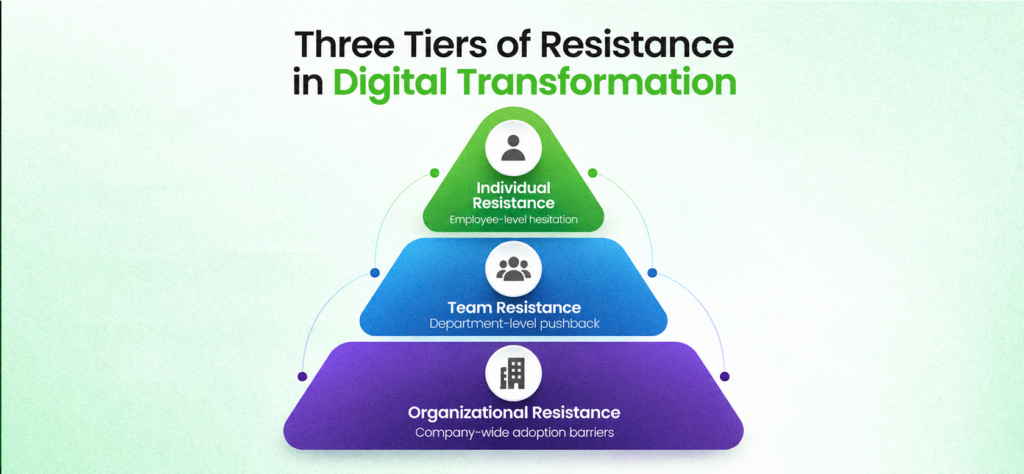
Digital transformation changes how people work.
A new CRM changes sales workflows. A new project management system changes reporting. Introducing AI automation services can also change responsibilities and how employees complete daily tasks. New analytics dashboards change decision-making.
Therefore, technical implementation alone cannot deliver transformation.
The Solution: Introduce Change in Controlled Stages
A startup can use a four-step adoption model:
Explain → Pilot → Measure → Expand
First, explain what changes and why.
Next, test the new workflow with a small team or process.
Then measure adoption, time savings, errors, and user feedback.
Finally, expand only after the pilot demonstrates value.
Training costs often fall between $2,000 and $10,000 for startup-scale transformation initiatives, depending on team size and process complexity.
The most effective training also connects the new system directly to employee responsibilities rather than presenting technology features in isolation.
9. Hiring the Right Digital Transformation Skills
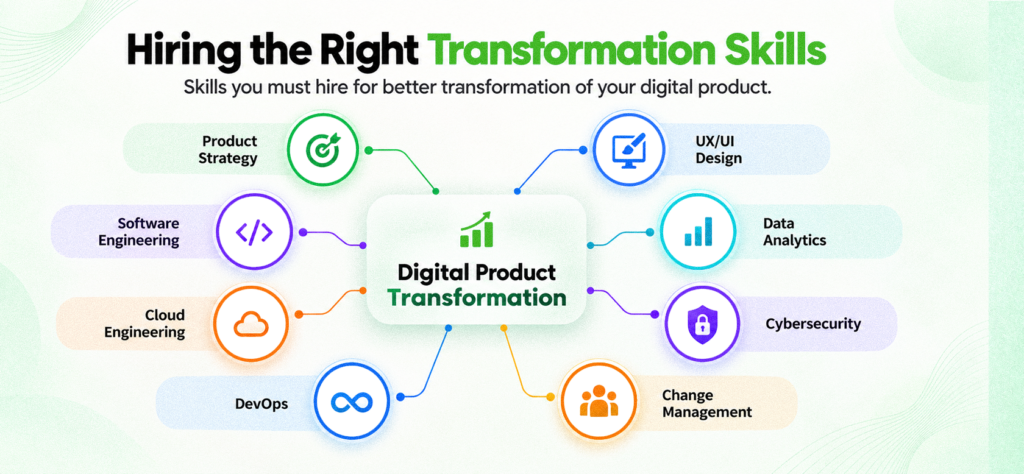
A startup may understand what it wants to transform but lack the internal expertise to execute the work.
Hiring a full transformation team may not make financial sense. Comparing in-house development and external partners helps startups determine which capabilities they should retain internally.
At the same time, relying entirely on one generalist developer can create concentration risk.
The Solution: Build a Capability Model Before Hiring
Separate required capabilities into:
| Capability | Internal ownership | External support |
| Product strategy | Usually essential | Specialist support |
| Customer research | Essential | Research specialist |
| UX design | Core product capability | Studio or contractor |
| Architecture | Technical leadership | Architect when needed |
| Engineering | Core team | Additional capacity |
| Cybersecurity | Shared responsibility | Specialist assessment |
| Cloud infrastructure | Engineering/DevOps | Cloud specialist |
| Data engineering | Depends on scale | Specialist support |
| Change management | Leadership | Consultant when required |
This model prevents startups from hiring permanent specialists for short-term requirements, including focused UI/UX design work that may only need several weeks of expertise.
10. Failing to Build for Future Product Growth
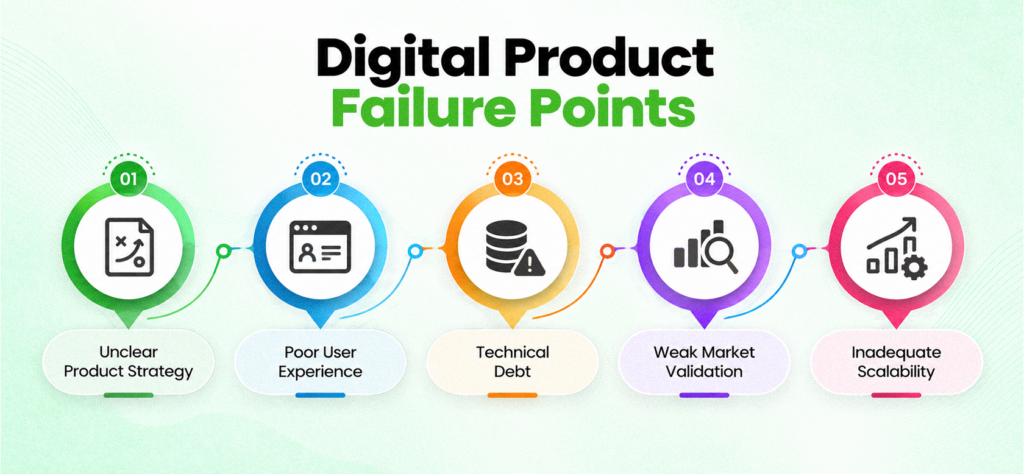
Startups should avoid overengineering while preventing growth constraints. Addressing common UI UX design mistakes early can also reduce unnecessary redesign work as the product expands.
A product built for 1,000 users may not support 100,000 users without changes.
The solution involves identifying known future requirements without building unknown features prematurely.
For example, a startup might not need a microservices architecture today. It may still need:
- Modular business logic
- Clear API boundaries
- Scalable database design
- Background job processing
- Automated testing
- Centralized logging
- Feature flags
- CI/CD
- Infrastructure-as-code where justified
This approach creates an architecture that can evolve without forcing the startup to pay enterprise-level costs too early.
How Startups Can Overcome Digital Transformation Challenges
The most effective approach does not begin with implementation.
It begins with diagnosis.
Step 1: Audit the Current Digital Environment
Document the current state across:
- Product
- Technology
- Infrastructure
- Data
- Security
- Operations
- Customer experience
- Internal workflows
- Team capabilities
For each area, identify the current problem, business impact, technical dependency, and likely investment. Startups developing customer-facing products should also consider how to validate app ideas before allocating significant resources.
A focused assessment usually takes 1–3 weeks for an early-stage startup.
A structured discovery engagement can cost approximately $5,000–$15,000, depending on stakeholder involvement and technical depth.
Step 2: Define the Transformation Business Case
Every major initiative should answer five questions:
- What problem exists?
- What does the problem cost today?
- What outcome should transformation produce?
- What will implementation cost?
- When should the investment produce measurable value?
For example:
A startup spends 30 hours per week manually reconciling orders across three systems. At an estimated internal cost of $40 per hour, the process consumes approximately $62,400 annually. A $20,000 integration project could therefore create a strong financial case if it removes most of the manual work.
This calculation creates a much stronger decision framework than simply describing the integration as “more efficient.”
Step 3: Prioritize Quick Wins and Structural Improvements
Not every transformation project requires months of work. Focused MVP development can help startups validate a new capability before committing to a larger transformation program.
Separate initiatives into three groups:
Quick Wins: 2–6 Weeks
Examples include:
- Workflow automation
- Analytics cleanup
- SaaS integrations
- Access control improvements
- Reporting automation
Strategic Improvements: 6–16 Weeks
Examples include:
- Product modernization
- Data platform improvements
- Customer portal development
- New operational workflows
- Cloud architecture improvements
Transformation Programs: 4–12+ Months
Examples include:
- Core platform replacement
- Multi-system modernization
- Enterprise-grade data transformation
- Large-scale operational redesign
- Major product and infrastructure rebuilds
This sequencing lets startups create visible value without abandoning foundational improvements.
Digital Transformation Roadmap for Startups
A practical roadmap can follow seven stages.
| Stage | Timeline | Primary output | Typical investment |
| Discovery | 1–3 weeks | Transformation assessment | $5k–$15k |
| Prioritization | 1–2 weeks | Business case and roadmap | $3k–$10k |
| Experience and process design | 2–6 weeks | Future-state workflows | $8k–$25k |
| MVP or modernization | 6–16 weeks | Working solution | $25k–$75k |
| Integration and data | 4–12 weeks | Connected systems | $10k–$50k |
| Security and reliability | 2–8 weeks | Risk controls and monitoring | $5k–$20k |
| Scale and optimization | Ongoing | Performance and iteration | $2k–$15k+/month |
These stages can overlap.
A startup might begin security improvements during discovery and introduce integration work during product modernization.
The roadmap should therefore operate as a sequence of priorities rather than a rigid waterfall process. A realistic app development timeline considers dependencies between design, engineering, integrations, and testing.
Build a Digital Transformation Roadmap That Fits Your Budget
Turn your startup’s technology challenges into a practical development plan. Get clear priorities, realistic costs, and a structured implementation roadmap.
Plan My Digital Transformation!How Much Does Digital Transformation Cost for a Startup?
There is no single startup digital transformation price because scope determines investment.
However, the following ranges provide a practical planning framework:
| Transformation scope | Cost range | Typical duration |
| Focused workflow improvement | $5k–$20k | 2–6 weeks |
| Single-system integration | $10k–$40k | 3–8 weeks |
| Product modernization | $25k–$75k | 6–16 weeks |
| Data and reporting transformation | $15k–$60k | 6–16 weeks |
| Security and infrastructure improvement | $10k–$50k | 4–12 weeks |
| Multi-system transformation | $50k–$150k | 3–8 months |
| Company-wide digital transformation | $100k–$250k+ | 6–18+ months |
These figures should support early financial planning rather than serve as fixed quotations.
The final digital product development cost depends on technical debt, integrations, data quality, product complexity, regulatory requirements, design scope, team composition, and development rates.
For startups, the strongest financial strategy usually involves sequencing investment rather than funding the entire transformation upfront.
When Should a Startup Start Digital Transformation?
Startups should not wait until technology becomes a crisis.
However, they should also avoid transforming systems before they understand their business model.
A startup should consider beginning a structured transformation program when at least three of these signals appear:
- Manual work consumes more than 20 hours each week.
- Customer growth exposes recurring operational failures.
- Engineers spend more than 20–30% of capacity maintaining fragile systems.
- Release cycles exceed one to two weeks because of technical constraints.
- Multiple teams maintain duplicate customer data.
- Support volume grows faster than headcount.
- Infrastructure incidents affect customers regularly.
- Enterprise prospects demand stronger security controls.
- The current architecture blocks important roadmap items.
- Leadership lacks reliable operational or product reporting.
These signals indicate that technology has become a business constraint rather than merely an engineering concern. Regular post-launch analytics iteration can help startups recognize these constraints through actual product usage.
A Startup Digital Transformation Checklist
Before approving a major transformation project, leadership should review its technical readiness and address common mobile app development mistakes that could undermine the investment.

Should Startups Build, Buy, Integrate, or Modernize?
This decision often determines whether transformation creates value or unnecessary complexity.
| Option | Best when | Typical cost | Main risk |
| Buy SaaS | Standard business capability | $100–$5,000+/month | Vendor dependency |
| Integrate | Existing tools work but remain disconnected | $10k–$40k | Integration complexity |
| Customize | Existing platform covers most needs | $15k–$60k | Customization debt |
| Build | Capability differentiates the business | $25k–$150k+ | Higher upfront investment |
| Modernize | Existing product has validated value | $25k–$75k+ | Scope expansion |
| Rebuild | Current architecture blocks growth | $75k–$250k+ | Lost time and feature parity |
The decision should follow the strategic value of the capability. Understanding custom software versus digital products also helps startups determine whether they need an internal system or a customer-facing product.
If a capability does not differentiate the startup, buying or integrating usually makes more sense.
If the capability directly creates competitive advantage, customer value, or proprietary operational efficiency, working with a web app development company can justify the additional investment.
Move Beyond Transformation Toward Lasting Growth
Digital transformation challenges become manageable when startups treat technology as a business investment rather than an isolated IT project.
The strongest approach starts with a clear diagnosis, connects every initiative to measurable outcomes, and sequences investment around real constraints.
Startups can then modernize selectively, strengthen security, connect fragmented systems, and improve operations. When AI supports a clear business need, AI app development services can become part of that growth strategy.
A $5,000 workflow improvement and a $150,000 platform transformation can both create significant value when they address the right problem at the right stage. The goal is not more technology.
It is a better business, supported by technology that can grow with it.
Turn Transformation Challenges Into a Clear, Scalable Product Strategy
A focused transformation strategy helps startups invest in the systems, experiences, and technology that create measurable growth without overbuilding too early.
Build My Transformation Strategy !Frequently Asked Questions About Startup Digital Transformation
Startups commonly face limited budgets, unclear ROI, technical debt, fragmented systems, poor data quality, cybersecurity gaps, scaling issues, skill shortages, employee resistance, and weak measurement. Addressing these challenges requires prioritization, measurable goals, phased implementation, technical audits, and continuous monitoring to connect transformation efforts with business outcomes.
Startup digital transformation can cost $5,000–$20,000 for focused improvements, $25,000–$75,000 for product modernization, and $50,000–$150,000 for broader multi-system programs. Company-wide transformation can reach $100,000–$250,000+, depending on integrations, technical debt, security requirements, data migration, product complexity, and team structure.
A focused workflow improvement typically takes 2–6 weeks, while product modernization can require 6–16 weeks. Multi-system transformation often takes 3–8 months, and company-wide programs may require 6–18 months or longer. Actual timelines depend on scope, technical complexity, integrations, resources, dependencies, and measurable transformation objectives.
Startups should buy software for standard business functions that do not create competitive differentiation. Custom development makes more sense for core products, proprietary workflows, unique customer experiences, or strategic capabilities. Integration offers a practical middle option when existing tools solve individual needs but cannot communicate effectively across business processes.
Startups can reduce transformation risk by conducting discovery first, defining measurable outcomes, auditing technical constraints, prioritizing high-impact initiatives, and sequencing investments. Involving business stakeholders throughout implementation also improves adoption. A phased approach allows startups to test results, identify problems early, adjust priorities, and expand successful initiatives without unnecessary spending.
Cloud platforms, APIs, SaaS systems, analytics tools, automation platforms, customer data systems, modern databases, mobile and web applications, observability tools, and cybersecurity technologies commonly support transformation. Startups should select technology according to business requirements, scalability needs, integration complexity, security expectations, and measurable outcomes rather than following technology trends.
Measure transformation through business outcomes such as reduced operating costs, faster workflows, higher customer conversion, shorter release cycles, fewer production incidents, improved data quality, greater employee productivity, and stronger retention. Technology adoption alone does not demonstrate success; startups should compare measurable performance against defined baselines and targets.
The first step involves assessing the startup’s current business processes, product, technology, data, security, and operations. A 1–3 week discovery phase can identify critical constraints, prioritize transformation opportunities, estimate investment requirements, and establish a practical roadmap before significant implementation begins or resources become committed.