
The digital product development costs typically range from $15,000 to $300,000, depending on the project’s scope.
- Minimum viable product (MVP): $15,000 to $75,000
- A mid-complexity product: $75,000 to $150,000
- An enterprise-grade platform: $150,000 to $350,000 or more.
The rest of this guide breaks that range down further, by stage, by talent model, and by the hidden expenses most estimates leave out.
Anyone unfamiliar with how the underlying process works may want to start with what digital product development actually involves before pricing it out.
Key takeaways
- Costs typically range from $15,000 to $300,000, depending on scope.
- Five stages carry the cost: discovery, design, development, testing, and launch.
- Team location shifts the price more than most founders expect.
- Post-launch maintenance and licensing rarely appear in an initial quote.
- Locking a validated scope costs more than a lower hourly rate.
The Different Tiers of Digital Products & Their Costs
The table below shows the range for each tier, from a narrow MVP through an enterprise-grade platform built to scale.
| Product Tier | What It Includes | Typical Cost | Typical Timeline |
| Narrow MVP | Core feature set only, minimal integrations | $15,000 – $75,000 | 3 – 5 months |
| Mid-complexity product | Full feature set, some integrations, polished UI | $75,000 – $150,000 | 5 – 8 months |
| Enterprise-grade platform | Complex logic, multiple integrations, built to scale | $150,000 – $350,000+ | 8 – 14 months |
The budget for a narrow MVP depends on what the first release must prove, which is why MVP development cost varies even within a limited feature set.
What Actually Drives the Price Up or Down

A handful of variables explain almost all of the difference between a $30,000 build and a $300,000 one. Each one compounds on the others rather than acting alone.
- Feature complexity drives cost more than any other factor. Each added workflow, integration, or edge case adds engineering time. A product with five core screens costs a fraction of one with role-based permissions, offline sync, or real-time collaboration built in.
- Design depth scales cost fast. A basic interface costs far less than a fully custom design system with built-in animation and accessibility features. Off-the-shelf component libraries speed this up considerably.
- Team location changes the price the most. Hourly rates run roughly $20–$50 in South Asia, $40–$90 in Eastern Europe, and $100–$200+ in the United States and the UK. The same feature set can shift by tens of thousands of dollars purely based on where the engineers sit.
- Tech stack choices affect both speed and cost. Established frameworks move faster than custom-built infrastructure, and that speed reflects directly in the invoice.
- Building separate native versions can change the estimate considerably, particularly when iOS app development cost and Android app development cost must both be accounted for.
- Post-launch scope adds a recurring cost. Ongoing maintenance, monitoring, and iteration rarely show up in a one-time build quote. This is the line item most first-time founders forget to ask about before signing.
Scope, platform, integrations, and design depth are the main factors affecting app development cost, and their effects often compound.
Where the Budget Actually Goes: Cost by Stage
Digital product development costs rarely arrive as one lump sum. It moves through five stages, and each one carries its own price tag and its own risk if it gets rushed.
Understanding this breakdown also makes it easier to spot a quote that skipped a step. A number that jumps straight from discovery to a single development total, with nothing in between, usually means important planning work got compressed or dropped.
| Stage | What Happens | Typical Cost |
| Discovery and research | Market validation, user interviews, competitive analysis | $5,000 – $25,000 |
| Design | Wireframes, prototypes, UI/UX design system | $10,000 – $80,000 |
| Development | Frontend and backend engineering, integrations | $40,000 – $200,000+ |
| Testing and QA | Functional testing, bug fixes, and performance checks | $5,000 – $30,000 |
| Launch | Server setup, app store submission, final configuration | $3,000 – $15,000 |
| Post-launch support | Maintenance, updates, hosting, and monitoring | $2,000 – $20,000 per month |
Skipping the discovery sprint to save that first $5,000 to $25,000 is one of the most common false economies in digital product development.
The cost usually resurfaces later as rework once real users reveal what the research would have caught early.
By that point, the fix costs more than the research would have, since it means reworking code and design that was already shipped.
In-House, Agency, or Studio: How the Price Changes
The same feature set can cost three or four times as much or as little, depending entirely on who builds it. None of these models is universally right, since each one fits a different budget, timeline, and risk tolerance.
| Model | Typical Rate | Best For | Trade-off |
| In-house team | Salary-based, not hourly | Long-term, continuous product work | Highest fixed cost, most control |
| US-based studio | $100 – $200+ per hour | Complex, high-stakes builds | Highest hourly rate, strong accountability |
| Eastern Europe studio | $40 – $90 per hour | Balanced cost and quality | Time zone coordination required |
| South Asia outsourcing | $20 – $50 per hour | Budget-constrained, well-scoped projects | Wider quality variance, more oversight needed |
| Freelancers | Varies widely by individual | Small, narrow-scope projects | Limited bandwidth for a larger scope |
The cheapest hourly rate on this table is rarely the cheapest total cost.
A lower rate paired with more rework, slower communication, or missed deadlines often closes the gap or reverses it entirely, which is why the total project cost matters more than the rate card.
So, make sure you understand everything about in-house vs. dedicated partners before you decide.
Fixed Price vs. Time and Materials: Which Costs More
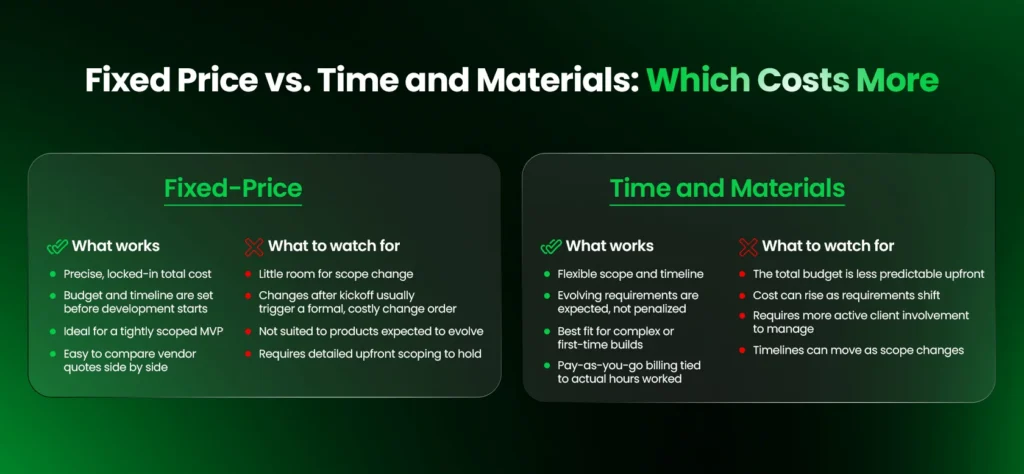
The deciding factor: how confident the scope is before development starts. A validated, well-scoped MVP development holds up well under a fixed price.
A product still finding its shape through user feedback is usually better served by time and materials, even with less budget certainty.
A Simple Build Example: A Simpler Build: A Boutique Fitness Studio Booking App
Not every first build needs marketplace complexity. Consider a founder opening a single-location fitness studio who wants class schedules, one-tap booking, and membership payments, no second user type, no marketplace logic.
Here is an example of fitness app development cost breakdown.
- Discovery: $5,000–$7,000
Maps the core booking flow, confirms what’s essential for launch
- Design: $12,000–$16,000
Wireframes and a clickable prototype built around one user journey
- Development: $35,000–$50,000
Scheduling, booking logic, and payment processing
- Testing: $4,000–$6,000
Payment flows, edge cases like double-bookings and late cancellations
- Launch: $3,000–$5,000
App store optimization, submission, server setup, final configuration
App store submission is only one part of a product launch strategy that also covers release readiness and the first users.
All in, a build like this lands around $63,000 to $80,000, near the top of the narrow-MVP tier.
The gap versus the marketplace example comes down to one user flow instead of two that also need to work together.
Note: This is just an example of the route map of Digital Product Development at Inceptives Digital. The prices may vary at consultation.
The Costs Most Quotes Leave Out
An initial estimate almost always covers the build. What happens after the product ships is usually left out entirely, and that gap catches many founders off guard.
Post-Launch Maintenance
A shipped product needs updates, bug fixes, and security patches on an ongoing basis. This generally runs $2,000 to $20,000 a month, depending on product complexity, and it starts the moment the product goes live.
Ongoing fixes, operating-system updates, and security work make mobile app maintenance cost part of the real product budget.
Scaling Infrastructure
Server costs, database capacity, and monitoring tools all scale with user growth. A product that costs almost nothing to host at 500 users can cost significantly more at 50,000, and that jump is easy to miss in a build-phase quote.
Third-Party Licensing and APIs
Payment processors, mapping services, analytics platforms, and similar tools often carry their own recurring fees. These add up quietly and get missed when a quote only accounts for development hours, especially on products that lean on several external services at once.
Ownership and IP Transfer
Some vendors retain rights to reusable code or components unless the contract states otherwise. Confirming full ownership transfer in writing avoids a costly negotiation later if the relationship ends, particularly for founders planning to raise funding or bring development in-house eventually.
The Cost of Delay
Every month a validated idea sits unbuilt is a month a competitor could close the gap first. This is harder to put a number on than a hosting bill, but it is a real cost worth weighing against a slower, cheaper build.
How to Reduce Digital Product Development Cost Without Cutting Corners
Cutting costs by cutting corners almost always costs more later, but there are legitimate ways to bring the number down without weakening the product underneath it.
- Phase the roadmap instead of building everything at once. Ship the core booking or transaction flow first. Treat messaging or advanced search as a second release.
- Reuse proven components instead of building custom ones. Authentication, payments, and notifications rarely benefit from a fully custom build. It also helps in reducing the cost of your mobile app development.
- Front-load discovery, even though it adds upfront cost. A validated scope prevents the mid-project pivots that drive most budget overruns.
How to Get a Quote You Can Actually Trust
A trustworthy estimate looks very different from a reassuring one. The difference usually comes down to how much detail sits behind the number.
- Ask for a stage-by-stage breakdown, not a single total. A vendor who can price discovery, design, and development separately has actually scoped the work.
- Confirm what the estimate excludes, not just what it includes. Maintenance, third-party fees, and scope changes should be named upfront.
- Clarify the change-request process before signing. A defined process for scope changes prevents quiet mid-project inflation.
In practice, the estimates that hold up best are the ones built around a validated scope, not a rushed one. A vendor willing to slow down and confirm the problem before pricing the build is usually the one worth trusting with the budget.
When the feature list is still uncertain, product strategy consulting can help establish priorities before a vendor prices the build.
Red Flags to Watch For in a Quote
Several warning signs show up repeatedly in estimates that end up costing more than promised. Watching them upfront is far cheaper than discovering them mid-project.

From Sticker Shock to a Number You Can Plan Around
Digital product development cost stops feeling arbitrary once it gets broken into stages, talent models, and the expenses that show up after launch. The range is wide because the inputs are genuinely different from one product to the next, not because pricing is random.
A clear scope is the single biggest lever over the final number. Talk to Inceptives Digital about sizing your scope before you request a quote.
Frequently Asked Questions
Expect to invest $15,000 to $75,000 for a narrow MVP with only core features, depending on complexity and team location. Adding integrations or a polished design layer pushes that range higher, sometimes closer to $100,000 for a more feature-rich first version.
A lean SaaS MVP generally runs $75,000 to $140,000, while a market-ready version with billing and integrations built in usually costs $140,000 to $280,000. Year-one costs, including infrastructure and iteration, often land between $120,000 and $350,000 once ongoing support is factored in.
Outsourcing to Eastern Europe or South Asia usually lowers the hourly rate significantly compared to a US-based team. The total cost advantage narrows if oversight, rework, or communication gaps add extra hours elsewhere, so the hourly rate alone is not the full picture.
Post-launch maintenance and infrastructure scaling are the most commonly missed costs, since most quotes only price the initial build and stop there. Third-party licensing fees are a close second, especially for products that rely on several external services.
Requesting a stage-by-stage breakdown and asking what the estimate excludes provides a far more accurate number than a single rounded total. A vendor willing to walk through their assumptions in detail is generally more reliable than one offering only a final figure.
Not inherently, though quality variance tends to be wider in lower-cost regions, which makes vendor vetting more important than the rate itself. A strong portfolio and clear references matter more than the country a team is based in.


