
Digital product development is the end-to-end process of transforming an idea into a digital product that delivers value to users and supports business growth.
It combines research, product strategy, design, engineering, testing, launch, and continuous improvement to build products people actually use.
This guide explains what digital product development is, how it differs from software development, the stages involved, the methodologies teams use, common challenges, typical costs, and the practices behind successful digital products.
Key takeaways
- Digital product development is the end-to-end process of turning an idea into a usable digital product, covering research, design, engineering, and post-launch iteration.
- It differs from software development because it includes strategy, market validation, and user experience work, not just coding.
- The method runs through seven stages: ideation, discovery, planning, design, development, launch, and post-launch iteration.
- Agile and Scrum are the most common methodologies, though Lean, Design Thinking, and Waterfall still fit specific situations.
- Most failures trace back to skipped validation, scope creep, or ignoring user feedback after launch.
What Is a Digital Product? Breaking Down the Category
A digital product is anything delivered through software rather than physical materials. That definition covers more ground than most people assume, and the table below lays out the range directly.
| Category | What It Includes | Example |
| Mobile and Web Apps | Native or browser-based applications that people open and use directly. | A fitness tracking app |
| SaaS Platforms | Subscription software delivered, maintained, and updated through the cloud. | A project management tool |
| Ecommerce App Development | Online storefront apps designed for product browsing, purchasing, and order management. | A direct-to-consumer clothing site |
| Digital Education Apps | Educational content delivered through an online platform or application. | A self-paced course |
| APIs and Developer Tools | Software and services that businesses integrate into their own products and systems. | A payments API |
| Digital Publications | Content-focused digital products distributed through subscriptions or downloads. | A subscription newsletter |
Digital Product Development vs. Software Development
| Digital Product Development | Software Development |
| Focuses on solving business and user problems. | Focuses on building and maintaining software. |
| Includes market research, product strategy and consulting, UI/UX design, engineering, launch, and iteration. | Primarily covers coding, testing, deployment, and maintenance. |
| Measures success through user adoption and business outcomes. | Measures success through software quality, functionality, and performance. |
| Starts by validating the problem before building. | Starts after product requirements have already been defined. |
| Involves product managers, designers, engineers, analysts, and stakeholders. | Primarily involves developers, testers, and technical teams. |
Why Digital Product Development Matters
Every industry now competes in a digital-first environment. Customers expect fast, intuitive experiences, and businesses that cannot deliver those experiences lose ground quickly to those that can.
A structured development process reduces the risk of building something nobody wants. It forces teams to validate the app idea early, rather than discovering a problem after months of engineering work and a costly launch.
The financial stakes are real, and they show up in a few consistent ways.
- Wasted budget. Poorly planned products burn through development spend before they ever reach a paying user.
- Delayed revenue. Every extra month in development pushes back the point at which the product starts generating income.
- Reputation damage. Users who try a broken or confusing product once rarely give it a second chance.
- Missed adaptability. Companies that treat development as a one-time project struggle to adjust once user needs shift.
This last point deserves attention. A limited budget makes early validation even more important, since smaller companies have little room to recover from a costly, unvalidated build.
Core Principles Behind Good Digital Product Development
Certain principles guide teams that consistently build successful products. These principles apply regardless of industry or product type.
- User-centered design. Every decision starts with the user’s problem, not the team’s assumptions about what users want.
- Iterative development. Products improve through repeated cycles of building, testing, and refining, rather than one long build phase.
- Data-informed decisions. Teams rely on user behavior and feedback data to guide priorities instead of guessing.
- Cross-functional collaboration. Product, design, engineering, and marketing teams work together throughout the process, not in isolated handoffs.
- Balanced speed and quality. Teams aim to ship quickly without sacrificing the reliability users expect.
These principles show up in every stage. Teams that skip one, especially user-centered design, tend to see the gap show up later as low adoption or poor retention.
Across every product we’ve built, one lesson has stayed consistent: lasting success comes from solving the right problem, making informed decisions, and improving continuously after launch. — CEO Hannan Shahnoor.
What Are the Stages of Digital Product Development?
Digital product development moves through seven distinct stages. Each stage builds on the last, and skipping one often causes problems that surface later at a higher cost.
The breakdown below reflects how this sequence actually plays out on real projects, not just how it looks on a slide. Each stage includes a short note on where things tend to go wrong in practice, drawn from the pattern of work seen across engagements at Inceptives Digital.

1. Ideation and Market Research
Every product starts with identifying a problem worth solving, confirmed through direct research rather than assumptions.
- Study market gaps and competitor products.
- Talk directly to potential users to confirm the problem is real.
- Run surveys, interviews, or landing page tests to gauge demand before building.
In practice: Weak or mixed signals at this stage are a stronger warning sign than any gap in technical resources.
2. Discovery and Strategy
Once a problem is validated, product managers define the product vision and set measurable goals through a structured discovery sprint.
- Build user personas and map the user journey.
- Choose success metrics such as retention, conversion rate, or daily active users.
- Set a shared strategy so priorities can be weighed consistently later.
In practice: Product managers who skip written personas tend to redefine “success” mid-project, which quietly resets the entire roadmap.
3. Planning and Roadmapping
With a validated direction, product managers prioritize which features to build first and prepare the resources behind them.
- Rank features using frameworks like RICE or MoSCoW.
- Plan timelines, budgets, and choose your tech stack.
- Map dependencies so engineering does not get blocked later.
In practice: The biggest planning delays usually come from unresolved dependencies, not from underestimating individual tasks.
4. Design
Designers translate the strategy into a testable experience before any code gets written.
- Build wireframes and interactive prototypes.
- Run usability tests to catch confusing flows early.
- Establish a design system to keep the product visually consistent as it grows.
In practice: Prototypes tested with a handful of real users tend to catch more usability issues than a full internal review does.
5. Development
Engineers build the product in structured sprints, producing working increments every one to two weeks.
- Build an MVP with only the core features first.
- Run QA testing alongside development, not after it.
- Hold sprint reviews to adjust course before too much work goes in the wrong direction.
In practice: Sprint reviews that skip a working demo tend to drift furthest from the original scope.
6. Launch
A product launch strategy covers timing, messaging, and how the product reaches its first users.
- Run a beta or soft launch before the full public release.
- Test server load and prepare customer support in advance.
- Keep a rollback plan ready in case something goes wrong.
In practice: Soft launches that skip a rollback plan lose more time recovering than they saved by launching early.
7. Post-Launch Iteration
Launch marks the start of a longer cycle, not the end of the project. This is where post-launch iteration becomes the real driver of long-term value.
- Collect user feedback and monitor analytics.
- Compare what users were expected to do against what they actually did.
- Prioritize the next round of improvements based on the gaps that surface.
In practice: The gap between expected and actual user behavior is usually where the next roadmap writes itself.
Although these stages appear sequential, most product teams revisit earlier stages as new user feedback, market conditions, or business priorities emerge.
Case Studies: Digital Product Development in Practice
DPS Airem: Workforce Management Platform
DPS Airem’s growth outpaced its ability to track guards across dozens of sites. Paper attendance and phone-call shift changes left managers unable to confirm field presence. Inceptives Digital built a geo-fenced, offline-first app and dashboard with four role-specific interfaces, backed by business process automation, so guards clock in only within approved boundaries even without signal.
Result: The platform now tracks over 1,000 field operatives in real time and cuts manual paperwork by 90 percent.
Family Entertainment Group: Automated Video Platform
Family Entertainment Group’s attractions created memorable moments, but manual video editing meant most guests left without one, costing revenue and social reach. Inceptives Digital built an automated pipeline that syncs dual GoPro cameras and renders branded highlights without human editing. A Flutter app build, a React dashboard, and a rendering engine deliver videos before guests leave.
Result: The system now runs across production venues, turning every visit into a shareable marketing asset.
Digital Product Development Methodologies
Teams choose different methodologies depending on the product, team size, and how much certainty exists about requirements. This decision matters even more for software development for startups, where the wrong process can burn through a limited runway. The table below compares the most common approaches.
| Methodology | Best For | Key Strength | Key Limitation |
| Agile | Products with evolving requirements | Adapts quickly to changing priorities and feedback. | Requires strong collaboration and consistent communication. |
| Scrum | Teams working in fixed sprint cycles | Provides clear roles, structure, and accountability. | Can feel rigid for smaller or less formal teams. |
| Lean Product Development | Early-stage startups validating ideas | Reduces waste by focusing on validated learning. | Less effective for large, highly complex projects. |
| Design Thinking | Products requiring deep user understanding | Prioritizes user needs before building solutions. | Discovery and research can extend project timelines. |
| Waterfall | Projects with a fixed, well-defined scope | Delivers predictable timelines, budgets, and documentation. | Makes changes difficult once development is underway. |
Most modern digital product teams lean toward Agile or Scrum, since user needs and market conditions rarely stay fixed for long. Larger, regulated projects sometimes still use Waterfall when requirements are locked in early and cannot shift without significant approval delays.
Some teams blend methodologies, using Lean principles for early validation and shifting to Scrum once the product direction is confirmed. The right choice depends on how much uncertainty the team is working with at each stage.
Key Roles in a Digital Product Development Team
Building a digital product requires several specialized roles working in coordination. Each role owns a specific part of the process while staying connected to the overall goal.
- Product Manager. Owns the product vision, sets priorities, and coordinates between all other roles.
- UX and UI Designers. Design the user experience and visual interface based on research and testing.
- Developers and Engineers. Build the actual product, including backend systems and frontend interfaces.
- QA Testers. Identify bugs and confirm the product works as intended before and after launch.
- Data Analysts. Track user behavior and translate it into insights the team can act on.
- Stakeholders and Founders. Set business goals and approve major direction changes.
Teams structure these roles in-house, outsource them to an agency, or use a hybrid model that mixes internal staff with external specialists. The right choice depends on budget, timeline, and how much ongoing startup product development work is expected after launch.
Smaller teams often combine roles, with one person handling both product management and design. This works for early-stage products but usually needs to expand as the product and its user base grow.
Tools Commonly Used in Digital Product Development
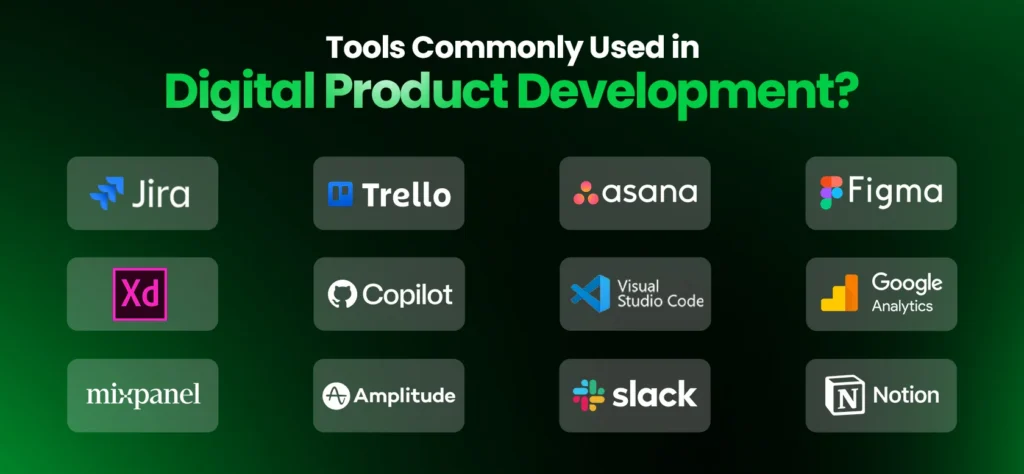
Teams rely on a set of tools to manage the workflow across research, design, and engineering. The table below covers the categories that come up most often.
| Category | Common Tools | What They Handle |
| Project Management | Jira, Trello, Asana | Task tracking, sprint planning, and project coordination. |
| Design | Figma, Adobe XD | Wireframes, interactive prototypes, and design systems. |
| Development | GitHub, VS Code | Code collaboration, version control, and software development. |
| Analytics | Google Analytics, Mixpanel, Amplitude | User behavior tracking, product performance, and usage insights. |
| Communication | Slack, Notion | Team communication, documentation, and knowledge sharing. |
Common Challenges and How to Avoid Them
Certain mistakes show up repeatedly across failed digital products, regardless of industry. Recognizing these patterns early can save significant time and budget.
Most of these challenges trace back to a breakdown in communication or a skipped validation step somewhere earlier in the process.
1. Building Without Validation
This usually happens early, right after an idea gets internal buy-in. A strong opinion inside the company gets treated as evidence, and development starts before anyone confirms the problem is real with actual users. Outside research backs up how costly that shortcut gets, and it shows up repeatedly in the list of why digital products fail: transformation initiatives that skip foundational validation waste an average of $2.4 million per failed project, and 73% fail to deliver the ROI teams expected.
Solution: Testing the problem with real users before writing any code closes this gap. Even a handful of structured interviews or a simple landing page test can reveal whether the assumption actually holds up.
2. Scope Creep
This tends to creep in mid-project, once early progress builds enough confidence to justify adding more. New features get proposed and approved without anyone revisiting the original development timeline guide or budget.
Solution: Locking a core feature set before development starts prevents this drift. Any new idea that surfaces afterward gets logged for a future phase instead of being folded into the current one.
3. Poor Communication Between Design and Engineering
This shows up when design and engineering work in separate tracks with limited overlap. A pattern that looks simple on screen turns into an unexpected technical challenge once engineering starts building it, and it often traces back to the same UI UX design mistakes that resurface project after project.
Solution: Regular cross-functional check-ins throughout the project catch these gaps early. Reviewing designs with engineers before development starts prevents rework once the code is already written.
4. Ignoring Feedback After Launch
This shows up right after release, once the pressure of shipping fades and attention shifts elsewhere. Launch gets treated as the finish line, and the feedback channels that were active during development quietly go quiet.
Solution: Building a feedback loop into the post-launch process from day one keeps that attention alive. Scheduled reviews of user feedback and analytics turn post-launch iteration into a habit instead of an afterthought.
5. Underestimating Timelines and Budgets
This usually starts at the planning stage, when a best-case timeline gets treated as the expected one. Unknowns that surface mid-project then force rushed decisions that lower the quality of what ships, often because the original mobile app development cost estimate never accounted for them.
Solution: Adding buffer time based on past project data, rather than optimistic assumptions, absorbs those unknowns. This protects both the launch date and the quality of the final release.
Real-World Examples of Digital Product Development
The pattern below shows up across almost every successful digital product, regardless of industry. Successful builds start narrow, watch real usage closely, and expand only once the core experience proves itself, a pattern closely tied to disciplined product-rescue scaling once the first version proves it works.
| Product | Started With | Expanded Into |
| Notion | Notes | Docs, AI, Wikis |
| Slack | Team messaging | Enterprise collaboration |
| Duolingo | Language lessons | AI tutoring |
| Canva | Basic design | Full creative suite |
Across all four examples, the lesson stays the same. A narrow, validated starting point beats a broad, unvalidated one almost every time.
How to Choose a Development Approach or Partner
Businesses generally choose between four paths, and each one fits a different combination of budget, timeline, and technical complexity. Before comparing vendors, it helps to review the signs you need software built for your business in the first place.
| Approach | Best For | Main Trade-off |
| In-house team | Continuous, long-term product development | Higher fixed cost, more control, a trade-off explored further in in-house vs outsourcing. |
| Digital product development company | Specialized expertise for a defined project | Less day-to-day control, faster ramp-up. See this guide on choosing a development company. |
| Freelancers | Small, well-scoped projects with limited budgets | Less bandwidth for a larger scope |
| No-code platforms | Simple products or early prototypes | Limited customization as the product grows |
How Much Does Digital Product Development Cost?
Digital product development costs vary based on product complexity, feature requirements, technology choices, integrations, and the size of the development team. A closer look at the development cost factors behind each project makes budgeting far more predictable.
Development costs increase as products require custom integrations, advanced security, AI capabilities, regulatory compliance, or support for multiple platforms.
| Product Type | Typical Cost (USD) | Estimated Timeline |
| MVP development cost | $20,000–$60,000 | 3–5 months |
| Web or Mobile App Development | $40,000–$100,000 | 4–7 months |
| SaaS Platform | $60,000–$150,000 | 5–9 months |
| Marketplace Platform | $80,000–$200,000 | 6–10 months |
| Enterprise Software | $150,000–$500,000+ | 8–15+ months |
Several factors have the greatest impact on the final investment:
- Product complexity. Advanced workflows, custom logic, and AI development services require more development time.
- Platform requirements. Building for iOS, Android app development, web, or multiple platforms increases effort.
- Third-party integrations. Payment gateways, CRMs, ERPs, analytics, and external APIs add development and testing work, often handled through dedicated system integration automation.
- Design requirements: Custom user experiences, animations, and accessibility standards increase design and engineering effort.
- Team composition. Costs vary depending on whether the product is built by an in-house team, freelancers, or an outside team, which is why hiring the right partner matters as much as the build itself.
- Ongoing maintenance. Most products require ongoing maintenance costs, security updates, infrastructure management, and feature improvements that typically cost 15% to 25% of the initial development budget.
Turning Validated Ideas Into Products People Trust
A successful digital product depends on far more than technical execution. Long-term results come from making informed decisions throughout the product lifecycle.
- Validate the problem before investing in development.
- Define a clear product strategy and roadmap.
- Design around real user needs and business goals.
- Build an MVP to gather feedback early.
- Use data and user insights to guide future releases.
- Continue improving the product after launch through regular iteration.
Following these principles helps reduce development risk, control costs, and create digital products that remain valuable as customer expectations and market demands continue to evolve.
Your Next Digital Product Deserves More Than Good Code
Whether you’re validating an idea, building an MVP, or modernizing a platform, our team creates scalable digital products with confidence.
Contact Our Team Now!Frequently Asked Questions
Software development focuses specifically on writing and maintaining code. Digital product development includes coding but also covers strategy, design, and market validation from start to finish.
Timelines vary widely based on complexity, but a basic MVP often takes three to six months, while a full-featured product can take a year or longer. Team size, technical complexity, and how much research is needed all affect the final timeline.
An MVP, or minimum viable product, is the simplest version of a product that includes only the core features needed to solve the main user problem. It allows teams to test their core assumption with real users before investing in a full build.
Digital product development typically costs $20,000 to $60,000 for an MVP, $60,000 to $150,000 for a mid-sized product, and $150,000 to $500,000+ for a complex enterprise platform. Ongoing maintenance and product improvements generally add 15–25% of the initial development cost annually.
Successful teams combine product strategy, UX and UI design, software engineering, quality assurance, and data analysis skills throughout the development.
The digital product development lifecycle covers ideation, discovery, planning, design, development, testing, launch, and continuous improvement to keep the product aligned with user and business needs.
Healthcare, finance, retail, education, logistics, manufacturing, real estate, and entertainment all benefit by improving customer experiences, streamlining operations, and creating new digital revenue opportunities.
Yes. Many products benefit from redesigning the user experience, updating features, or modernizing technology without rebuilding the entire application from scratch
Success is measured through user adoption, retention, engagement, customer satisfaction, conversion rates, revenue growth, and whether the product achieves its intended business objectives.


