
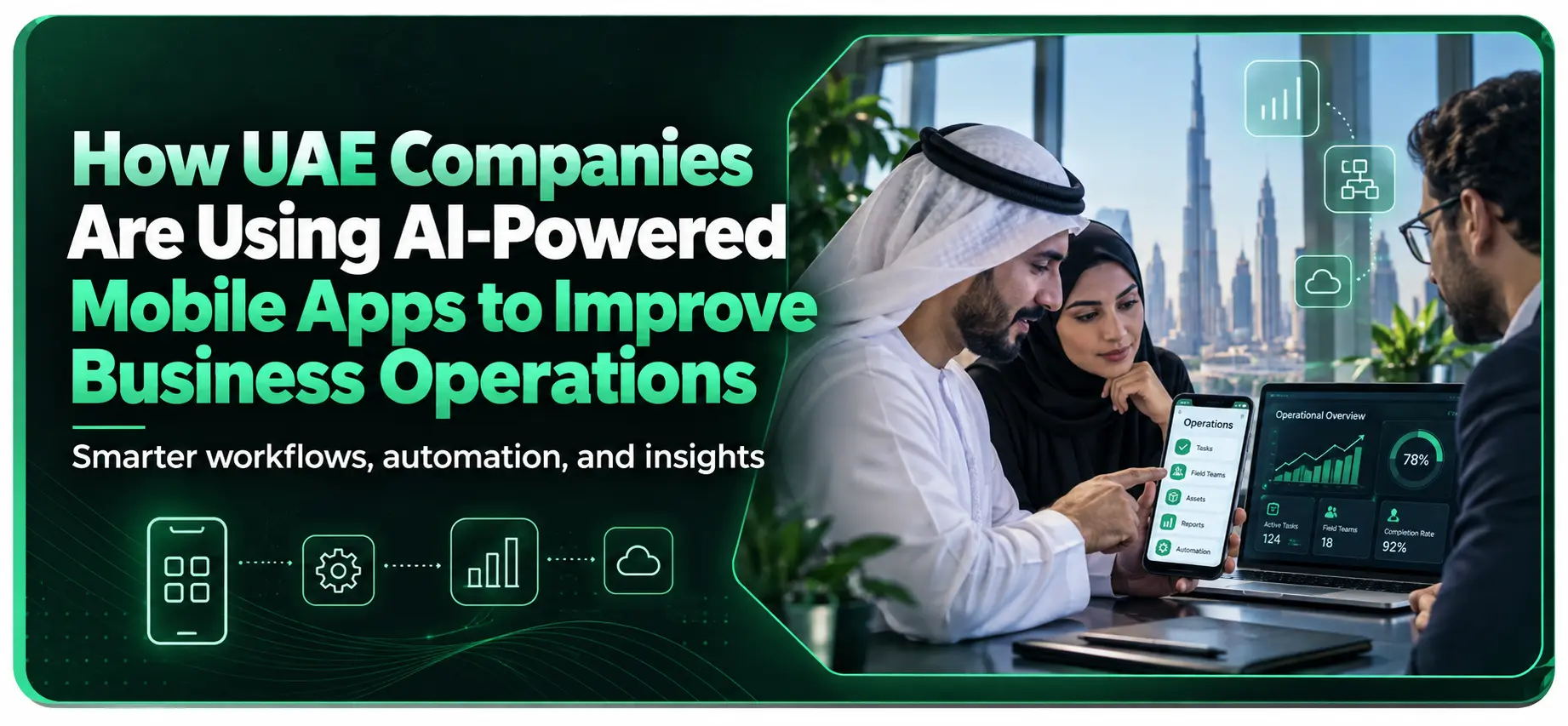
Summary: This guide breaks down how UAE companies are embedding AI into mobile apps for field operations, customer service, sales, inventory, maintenance, finance, and healthcare. It covers realistic development and operating costs, a framework for choosing the right first use case, a seven-stage build process, security requirements, and how to calculate ROI, so businesses can invest in AI that actually improves measurable operational outcomes.
Introduction
AI inside mobile apps used to mean a chatbot bolted onto a website. That phase is over. Across the UAE, companies are now building AI automation directly into daily operations, and the shift is already visible on the ground.
For businesses evaluating a mobile app development company in Dubai, the bigger question is no longer whether AI belongs in the product, but which operational workflow it should improve first
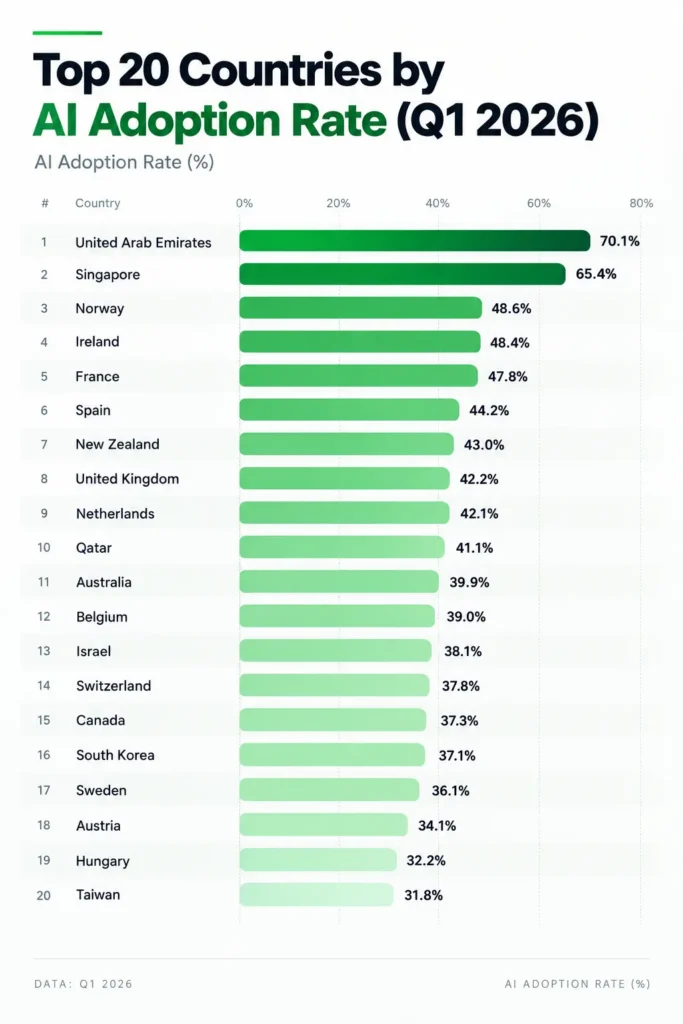
The UAE is currently leading the world in AI adoption. Microsoft’s Global AI Diffusion – Q1 2026 report ranks the country #1 globally, with an AI usage rate of 70.1% among the working-age population.
Field teams in Dubai and Abu Dhabi are getting AI-generated routes instead of static job lists. Retail chains are running location-level demand forecasts instead of one national number. Finance teams are letting AI flag suspicious transactions before an analyst ever opens the file.
Common uses already in play include:
- Forecasting demand
- Guiding field teams
- Routing service requests
- Flagging anomalies
- Helping employees make faster calls on the ground
This shift tracks with national policy. The UAE Strategy for Artificial Intelligence 2031 treats AI as core infrastructure for productivity and competitiveness. Dubai’s AI Blueprint sets explicit productivity targets tied to wider adoption.
Government direction is only part of the story, though. The harder question for any UAE business is not which AI model to use. It is which operational problem actually deserves the investment.
This guide walks through how UAE companies are applying AI inside mobile apps today, what each approach costs to build and run, and how to plan an AI project without overbuilding it.
Why This Matters Now for UAE Operations
The UAE has built a strong environment for enterprise AI adoption. But ambition and results are not the same thing.
PwC’s 2026 UAE CEO findings show 45% of UAE CEOs use AI extensively in demand generation, 45% in support services, and 38% directly within products and experiences. The same research flags a real constraint: enterprise-wide data access is a major barrier to scaling AI impact.
That gap between intent and access is exactly where mobile app development projects succeed or stall.
An AI feature does not automatically improve an operation. It needs:
- Reliable, accessible data
- A clearly defined workflow
- The right system integrations
- A KPI that proves it worked
Take a logistics company running deliveries across the UAE. Its driver app used to just answer driver questions through a chatbot, a nice-to-have at best.
Now the same app runs route optimization, delivery-time prediction, and automated dispatch recommendations. That is the shift happening across the sector: AI connected to the workflow instead of sitting beside it.
Where AI-Powered Mobile Apps Change the Numbers
| Operational area | AI-enabled capability | Business outcome |
| Field operations | Predictive scheduling, route optimization | Better workforce utilization |
| Customer service | AI assistant, automated ticket routing | Faster response times |
| Sales | Lead scoring, next-action prompts | Better pipeline prioritization |
| Inventory | Demand forecasting, replenishment alerts | Lower stock imbalance |
| Finance | Transaction anomaly detection | Earlier risk flags |
| HR | Employee assistant, workforce analytics | Faster internal support |
| Maintenance | Predictive failure alerts | Fewer surprise breakdowns |
| Healthcare | Decision-support workflows | Faster access to information |
| Hospitality | Demand prediction, personalization | Sharper resource planning |
| Manufacturing | Visual inspection, predictive analytics | Reduced production losses |
The apps that deliver real value tend to combine three things:
- Mobile access where the work actually happens
- Business intelligence that interprets data rather than just displaying it
- Workflow action that turns a recommendation into a task or alert
Miss any one of those and the app becomes a dashboard nobody checks.
Where UAE Companies Are Actually Applying AI
The right use case depends on the operating model more than the industry label. In practice:
- UAE retailers are already prioritizing demand forecasting
- Facilities companies are moving to predictive maintenance first
- Property firms are starting with lead qualification
The sections below cover the seven applications UAE businesses are running today, with realistic cost ranges for each.
1. Field Service and Workforce Management
Facilities management, construction, security, logistics, healthcare, and property services all run on distributed teams, and UAE operators in these sectors are already moving past static job lists.
A basic workforce app lets staff receive jobs and log updates. The AI-powered version now running across many of these fleets goes further. It reads:
- Technician availability and location
- Historical job duration
- Customer priority
- Travel time and traffic conditions
- Required skills
The app then recommends who should take each assignment. A practical flow looks like this:
Image 2
The employee still owns the decision. The app just cuts the manual coordination around it, and companies running this at scale report fewer missed windows and tighter dispatch times without adding headcount.
For a UAE company managing 100 to 500 field workers, budget ranges typically look like this:
| Solution level | Development cost | Timeline |
| Basic AI scheduling MVP | $45,000–$75,000 | 3–5 months |
| Workforce intelligence platform | $80,000–$140,000 | 5–8 months |
| Advanced predictive operations platform | $140,000–$250,000+ | 8–12+ months |
These figures are planning estimates, not fixed quotes. Integration count and data readiness usually move the final number more than the mobile interface does.
2. Customer Service and Internal Support
This is the most accessible entry point for most UAE businesses, and the one most companies have already adopted in some form. A mobile assistant can:
- Answer routine customer questions
- Pull account details on demand
- Summarize conversations
- Open support tickets automatically
- Hand off complex issues to a human
The catch: a useful assistant needs more than a general-purpose language model behind it. It needs a live connection to:
- System integration and API automation
- CRM and customer database
- Order management system
- Knowledge base
- Ticketing platform
- Billing system
If a customer asks “where is my order,” the app should return that specific order, not a generic reply. That single distinction is usually what separates a support assistant employees actually trust from one they route around.
| Scope | Cost | Timeline |
| AI FAQ assistant | $25,000–$45,000 | 2–4 months |
| AI support app with CRM integration | $50,000–$90,000 | 4–6 months |
| Enterprise support platform | $90,000–$160,000+ | 6–9+ months |
Budget separately for ongoing model usage, cloud infrastructure, and monitoring. Development cost and operating cost are two different line items. Treating them as one is a common planning mistake.
3. Sales and Lead Management
Sales teams across the UAE lose hours qualifying leads and updating CRM records by hand, which is exactly why lead scoring has become one of the faster-adopted AI use cases. An AI layer scores leads against:
- Customer profile and industry
- Purchase history
- Engagement activity
- Deal size
- Past conversion patterns
The salesperson receives a prioritized list rather than a raw feed. A typical flow:
Image 3
The app can also flag inactive opportunities and surface accounts showing buying signals early.
| Sales AI application | Cost |
| AI lead scoring MVP | $30,000–$55,000 |
| AI sales assistant with CRM integration | $55,000–$100,000 |
| Predictive sales platform | $100,000–$180,000+ |
One caveat worth stating plainly: a company should not build predictive lead scoring before it has enough historical sales data to make the predictions meaningful. That is as much a commercial decision as a technical one.
4. Inventory and Demand Forecasting
A standard inventory app tells a manager what stock exists right now. UAE retail and distribution businesses are increasingly leaning towards machine learning development and running the AI-enabled version instead, one that tries to answer what happens next, using:
- Historical sales and seasonality
- Product velocity
- Promotions
- Supplier lead times
- Location-level demand
For a retailer with several UAE locations, this already means separate forecasts for Dubai, Abu Dhabi, and Sharjah, instead of one blended national number. That distinction matters given how differently those markets move.
| Inventory AI solution | Cost | Timeline |
| Forecasting MVP | $40,000–$70,000 | 3–5 months |
| Multi-location inventory intelligence | $75,000–$130,000 | 5–8 months |
| Enterprise predictive supply platform | $130,000–$250,000+ | 8–12+ months |
The model rarely drives the highest cost here. Data pipelines, ERP integration, and inventory synchronization usually eat more of the budget than the forecasting logic itself.
5. Predictive Maintenance
Asset-heavy UAE businesses are shifting from reactive repairs to predictive alerts. Facilities companies running hundreds of HVAC units are a common example.
Instead of logging a breakdown after it happens, the system now in use:
- Reads equipment history from sensors or maintenance logs
- Spots abnormal patterns
- Calculates a risk score
- Notifies the responsible technician with instructions
- Feeds completion data back into the model
Companies that already collect IoT or equipment data have a noticeably stronger starting position here.
A predictive maintenance platform typically runs $100,000–$250,000+, depending on sensor volume, asset count, and how many enterprise systems it needs to touch.
6. Finance, Risk, and Transaction Monitoring
Financial operations generate large volumes of structured data, which is why UAE finance teams have moved quickly to fintech app development. A mobile app helps authorized staff monitor:
- Suspicious transactions
- Payment anomalies
- Cash-flow shifts
- Unusual account activity
AI prioritizes cases instead of forcing analysts to review everything manually.
Financial AI needs stronger governance than a general productivity assistant. The build should include:
- Role-based access and strong authentication
- Audit logs and encryption
- Human review and clear escalation rules
A financial operations application with multiple integrations and regulated workflows commonly runs $100,000–$250,000+. A simple internal financial assistant, without those controls, costs meaningfully less.
7. Healthcare Administrative and Decision Support
UAE healthcare organizations are getting the most immediate value from administrative automation, applying it to:
- Appointment prioritization
- Patient communication
- Clinical documentation support
- Staff scheduling
- Follow-up reminders
AI output should support a decision here, not replace one, unless the organization has real validation and regulatory controls behind it.
A healthcare app development for scheduling and patient support typically costs $60,000–$120,000. A platform with clinical integrations and deeper analytics can reach $150,000–$300,000+.
What’s Actually Changing on the Ground
Adoption is not even across sectors, and that unevenness tells its own story.
| Adoption pace | Sectors | Why |
| Fastest | Customer service, field operations | Data already sits in a CRM or dispatch system; workflow does not need heavy regulatory sign-off |
| Slower | Finance, healthcare, predictive maintenance | Governance, sensor coverage, and historical data depth take longer to put in place |
The gap is not about weaker technology. It comes down to readiness:
- A facilities company can start reading equipment logs today
- A bank has to clear audit and compliance requirements before an AI model touches a single transaction
The common thread across every sector that has made real progress is simple. The AI sits inside a workflow employees already use, rather than asking them to open a separate app.
That single design choice, more than any model or vendor, tends to decide whether an AI feature gets adopted or ignored after the pilot ends.
Choosing the Right Use Case Before You Build Anything
Not every workflow deserves AI. Picking the wrong first project is the fastest way to burn a budget without proving anything. Factors affecting app development cost help narrow the field.
| Factor | Low score | High score |
| Business impact | Limited operational effect | Direct revenue or cost impact |
| Data availability | Little usable history | Structured historical data |
| Automation potential | Requires human judgment | Repetitive workflow |
| Integration effort | Many legacy systems | Accessible APIs |
| Measurement | Hard to quantify | Clear KPI |
Score each candidate from 1 to 5 per factor. In practice, scores often cluster close together:
| Use case | Impact | Data | Automation | Integration | Measurement | Total |
| AI FAQ assistant | 3 | 5 | 5 | 4 | 4 | 21/25 |
| Predictive maintenance | 5 | 4 | 4 | 3 | 5 | 21/25 |
| AI route optimization | 5 | 4 | 5 | 3 | 5 | 22/25 |
| AI employee chatbot | 3 | 4 | 5 | 4 | 3 | 19/25 |
| AI demand forecasting | 5 | 5 | 4 | 3 | 5 | 22/25 |
The top score should not automatically win. Implementation risk, regulatory exposure, and time to measurable value all belong in the final call too.
What Sits Behind These Apps
Building an AI mobile app involves far more than an iOS or Android front end. A production system runs on four connected layers:
- Mobile app: the interface employees or customers actually use
- Backend: handles authentication and integrations with ERP, CRM, and IoT systems
- Data layer: feeds the AI clean, structured information
- AI layer: a predictive model, a large language model, or computer vision, depending on the job
Companies with messy or fragmented data usually feel this fastest. The AI layer rarely fails on its own. It fails because the data underneath it was never cleaned up.
Generative AI vs. Predictive AI: Picking the Right Tool
Image 4
This distinction shapes both functionality and price.
- Generative AI creates or transforms information: customer responses, report drafts, summaries
- Predictive AI estimates what happens next based on historical data: demand forecasts, churn risk, delivery delays
Many strong operational apps use both together for business process automation. A logistics app might use predictive AI to estimate a delay, then generative AI to explain that delay clearly to an operations manager.
| AI approach | Incremental development cost | Best suited for |
| API-based generative AI | $10,000–$30,000 | Assistants and content workflows |
| RAG-based enterprise assistant | $25,000–$60,000 | Internal knowledge and support |
| Predictive ML model | $30,000–$80,000 | Forecasting and scoring |
| Computer vision | $40,000–$120,000+ | Inspection and image analysis |
| Custom AI platform | $100,000–$300,000+ | Complex enterprise operations |
What It Actually Costs to Build an AI Mobile App in the UAE
Most UAE businesses can plan around four broad tiers.
| App category | Cost range | Timeline | Typical scope |
| AI MVP | $35,000–$70,000 | 3–5 months | One core workflow plus one AI capability |
| Business AI app | $70,000–$140,000 | 5–8 months | Multiple workflows and integrations |
| Advanced AI platform | $140,000–$250,000 | 8–12 months | Predictive AI, automation, enterprise backend |
| Enterprise AI ecosystem | $250,000–$500,000+ | 12–18+ months | Multiple apps, governance, cross-system integration |
Treat these as planning inputs, not quotations. Feature complexity, data cleanliness, the number of integrations, and security requirements move the price more than the mobile screens themselves.
Let’s Turn Your AI Use Case Into a Working Mobile Product
We help UAE businesses validate the right AI use case, define scope, estimate costs, and build secure mobile products faster.
Get Your AI App EstimateDevelopment Cost vs. Ongoing AI Operating Cost
Building the app is only the first bill. Recurring mobile app development costs in Dubai continue after launch, including:
- Cloud hosting
- Model or API usage
- Database services
- Monitoring
- Technical maintenance
A mid-sized business app typically runs $1,500–$5,000 per month to operate. An AI-heavy enterprise platform processing large volumes of documents or real-time data can exceed $10,000–$30,000+ per month.
AI usage deserves its own tracking line, because consumption often grows faster than the user base does. Setting cost controls before launch saves a lot of budget friction when it comes to mobile app maintenance costs.
How to Control AI App Costs Without Cutting Corners
The smartest way to reduce mobile app development cost is not stripping features. It is sequencing the investment correctly.
Image 5
- Start with one bottleneck. Prove value on one workflow before expanding with proper product strategy.
- Use existing AI models first. An API-based model paired with company data reaches production faster than a custom-trained one.
- Fix the data foundation early. PwC’s UAE findings flag data access as a top barrier to AI impact, and that risk shows up fastest in mobile projects with messy data.
- Keep the first release narrow. Login, role-based access, one workflow, one AI capability, basic analytics, and a feedback loop make a strong AI MVP scope. Everything else can wait for evidence.
A Delivery Process That Actually Works
AI projects need more upfront planning than a standard mobile build.
Image 6
In practice, the companies getting this right follow a similar sequence:
- Map the operational problem before picking a model
- Run a short feasibility check on the data
- The UI/UX design in a way that employees can see what the AI recommends and why
- Build the smallest workable version
- Pilot it with one branch or department
- Measure real business metrics
- Scale once the first workflow proves out
That sequencing is what keeps a company from spending $200,000 before finding out whether employees actually use the product.
Security and Responsible AI
AI apps handle sensitive commercial, financial, and customer data. Security has to shape the architecture from day one, not get bolted on before launch.
The UAE AI Charter emphasizes responsible use, privacy, data security, and compliance with applicable law.
A solid enterprise baseline includes:
- Multi-factor authentication
- Role-based access control
- Encryption in transit and at rest
- Secure API authentication
- Audit logging and secrets management
- AI agents with human review for high-impact decisions
The same principle of minimum necessary access should apply inside the app itself. A sales employee’s AI assistant should never have a path to payroll or executive financial data.
Governance works best when it lives inside the product, not around it:
- Permission controls
- Approval workflows for AI-recommended actions
- Output review and audit history
- Model version tracking
A system that recommends a supplier purchase, for instance, can require manager sign-off before the order goes out. That structure lets a company get the benefit of automation without handing AI unchecked authority.
Mistakes Worth Avoiding
- Building the feature before defining the workflow. AI chatbots look impressive in a demo and deliver little operational value on their own.
- Treating data preparation as optional. AI cannot fix inconsistent business data, so budget real time for it during the discovery sprint.
- Automating decisions that need accountability. AI can recommend; certain calls should stay with an authorized person, with an approval point built into the flow.
- Underestimating integrations. CRM, ERP, HR, payment, and identity systems usually determine real project complexity, not the mobile screens.
- Ignoring recurring costs. Track cost per request, user, or document so the operating budget does not creep up unnoticed.
- Measuring engagement instead of impact. A high query count does not prove the app is saving money. Measure the KPI it was built to move.
Calculating ROI Before You Build
A simple ROI model looks like this:
Annual AI benefit = labor savings + additional revenue + avoided losses + operational savings
ROI = (annual benefit − annual operating cost − annualized development cost) ÷ annualized development cost × 100
Consider a UAE service company spending $300,000 a year on administrative coordination. An AI scheduling app that cuts that workload by 20% saves roughly $60,000 a year.
If the app costs $100,000 to build and $24,000 a year to run, labor savings alone might not clear the bar in year one.
But if better scheduling also unlocks $100,000 in additional service capacity, the case changes considerably. That is why a company should model several value streams rather than lean on one efficiency number.
When an AI Mobile App Makes Financial Sense
An AI project is easier to justify when at least one of these applies:
- A high-volume, repetitive workflow
- Significant coordination overhead
- Large historical datasets already sitting somewhere
- Costly operational errors
- Distributed employees across locations
- High customer-support volume
- Predictable demand patterns
- Expensive equipment downtime
If a company cannot state how much its current process costs, proving that AI improved it becomes nearly impossible. Baseline numbers matter more than most teams expect going in.
Matching Investment to Company Size
| Stage | Budget range | Focus |
| Startups | $35,000–$80,000 | One customer or operational problem, kept narrow |
| SMBs | $60,000–$150,000 | Internal automation: CRM, scheduling, inventory, support |
| Growth-stage | $120,000–$250,000+ | Predictive models, multiple integrations, role-based dashboards |
| Enterprise | $250,000–$500,000+ | Multiple business units, governance, cross-platform data systems |
Enterprise-level projects are closer to a digital operating platform than a standalone app, and the budget and timeline should reflect that from the start.
What the UAE AI Landscape Means for Business Leaders
The national strategy identifies sectors including transport, healthcare, energy, education, technology, environment, and traffic among areas where AI can improve outcomes.
Dubai has also established an AI Blueprint connected to Dubai Economic Agenda D33, aiming to contribute AED 100 billion annually to Dubai’s economy and lift productivity by 50% through digital solutions.
Private companies do not need to mirror government initiatives directly. The useful takeaway is narrower:
- Identify where AI can genuinely improve speed, accuracy, or resource allocation inside your own operation
- Build with the same privacy and compliance discipline the UAE AI Charter calls for
Turning an AI Opportunity Into a Business-Ready Product
AI-powered mobile apps are already changing how UAE companies run day-to-day operations, without requiring a rebuild of every business system at once. The strongest results are showing up where data, mobile access, and repeatable decisions intersect: scheduling, support, sales, inventory, maintenance, or finance.
National AI policy and growing enterprise adoption are creating real momentum. But the tech stack alone does not deliver the outcome.
A focused use case, clean data, secure architecture, and a budget tied to measurable KPIs are what turn an AI mobile app into a lasting operational improvement, and what separates the UAE companies seeing real gains from those still experimenting.
Let’s Build the AI Mobile App Your UAE Operation Actually Needs
Tell us the workflow costing you the most time or money, and we’ll scope a focused AI MVP built around fixing that first.
Talk to Our AI ExpertFrequently Asked Questions
A focused MVP cost runs $35,000–$70,000. A business-grade app typically costs $70,000–$140,000; advanced platforms reach $140,000–$250,000+, and enterprise ecosystems can exceed $500,000 depending on integrations and governance needs.
A focused MVP development usually takes 3–5 months. A business app with several integrations needs 5–8 months, and enterprise platforms can take 8–18+ months.
Usually not. Established APIs and open-source models cover most cases. Custom models make sense only with proprietary data, specialized prediction needs, or strict performance and control requirements.
AI assistants, automated classification, document summarization, lead scoring, scheduling recommendations, and anomaly detection tend to show results quickest, depending on data availability.
Yes, through backend and APIs services, though older systems may need modernization or better data integration first.
Predictive apps need historical structured data. Generative AI apps need company documents, knowledge bases, or transactional records, all governed by the same security standards as the rest of the business.
Yes. A focused app for support, scheduling, sales qualification, or inventory forecasting is a practical starting point without enterprise-scale spend.
Track the operational outcome: task completion time, resolution time, forecast accuracy, utilization, conversion rate, downtime, and cost per transaction. Usage volume alone does not prove ROI.


