Skip to content
  • Services
    Services
    Application Development
    • Mobile App Development
    • Blockchain Development
    By Platform
    • iOS App
    • Android App
    • React Native App
    • Flutter
    • Kotlin Multiplatform
    By Type
    • Web App Development
    • Backend and API
    • Cross-Platform Development
    • Web Development
    • Mobile Game Development
    • AR App Development
    • VR Development
    Launch & Growth
    • App Store Optimization
    • Product Launch Strategy
    • Post Launch Analytics and Iteration
    Artificial Intelligence
    AI Services
    • AI Development
    • AI App Development
    • AI Chatbot Development
    • AI Agent Development
    • Generative AI Development
    • Machine Learning Development
    • NLP Development
    • AI MVP Development
    Automation
    • AI Automation
    • System Integration & API Automation Services
    • Business Process Automation Services
    • RPA Development
    • IoT Development
    Digital Product Development
    By Engagement
    • Digital Product Development
    • Discovery Sprint
    • MVP Development
    • Product Rescue & Scaling
    • Product Strategy & Consulting
    • Custom Software Development
    • Staff Augmentation
    By Craft
    • UI/UX Design
    • Interactive Prototyping
  • Industries
    Industries
    • Healthcare App Development
    • Fitness App Development
    • Fintech App Development
    • Education App Development
    • Real Estate App Development
    • Travel App Development
    • Food Delivery App Development
    • Dating App Development
  • Locations
    Locations
    • San Francisco
    • New York
    • Austin
    • Toronto
    • London
    • Dubai
    • Singapore
  • Case Studies
  • Company
    Company
    • About
    • Blogs
    • Press & Media
    • Partnership
    • Life At Inceptives Digital
    • Leadership
    • Founder's Letter
    • Contact Us
Inceptives Digital
  • (469) 788-8527
Get In Touch
  • Blogs
App Development
  • The Ultimate Guide to Mobile App Branding

The Ultimate Guide to Mobile App Branding

  • Last Updated: January 14, 2026
  • Picture of Amna Rashid Written By: Amna Rashid
On this page
Share
Mobile App Branding
  • Mobile app branding goes beyond logos and colors. It shapes how users recognize and experience your app.
  • A clear brand identity helps your app stand out in crowded app stores.
  • Brand strategy, visual identity, and tone of voice form the foundation of effective mobile app branding.
  • Consistent app design across iOS, Android, and marketing channels supports recognition and user trust.
  • App icons, screenshots, and descriptions can influence download decisions when combined with effective ASO.
  • User feedback and A/B testing help businesses improve their app branding over time.
  • App engagement, retention, store conversion rates, and reviews help measure branding performance.
  • Airbnb, Uber, Duolingo, and Spotify show different approaches to building recognizable mobile app brands.

First impressions shape how users perceive your app, while consistent branding and a reliable experience help build trust over time.

With millions of apps available on both the Apple App Store and Google Play Store, the competition is much more intense than ever. 

This is where mobile app branding goes beyond just logos or colors. Mobile app branding dominates the complete perception of users through your app icon, onboarding experience, tone of voice, and overall user experience. A  strong brand instantly recognizes your app, understands its purpose, and feels confident in choosing it over competitors.

This strong first impression directly influences long-term results. Effective apps build trust, recognition, and long-term loyalty. Consistent branding can improve recognition, strengthen app store conversion rates, and encourage engagement when the product delivers lasting value.

This blog breaks down mobile app branding and its importance for long-term success. It offers practical guidance for startups and businesses working with a mobile app development company to create memorable app brands.

Mobile App Branding Basics You Need to Know

Branding of a mobile app defines how users identify, comprehend, and associate with your app. It describes your app identity and what it promises, enabling users to instantly see its difference.

Mobile app branding comprises three main components:

  • Brand Strategy – Your target users, UVP (unique value proposition), and mission. Product strategy consulting can help clarify these foundations before development.
  • Visual Identity – Colors, typography, logos, and overall visuals.
  • Brand Tone – Consistent communication of your app with users.

If all these components work together, your app will become credible, memorable, and easily recognizable, and will provide a real advantage in this competitive market.

Why Your Mobile App Branding Can Make or Break Success

An effective branding strategy strengthens how users recognize and connect with an app, but it cannot compensate for poor functionality. Branding is not simply a logo or a design. It is the first impression, the promise, and overall the experience that your apps bring.

Every interaction in the app, including the app icon, the onboarding process, notifications, and micro-interactions, contributes to the perception of your app by users.

Strong branding of mobile applications results in your application being recognized in a highly saturated market. It creates a uniform identity recognized by users, creates trust, and sets the standard.

Aligning your brand across every touchpoint can improve recognition and encourage repeat engagement. This consistency can also support your mobile app monetization strategies.

This consistency generates exceptional outcomes:

  • Instant Recognition– Users identify your app easily in the app stores.
  • Trust & Credibility – A cohesive and polished brand generates trust and loyalty.
  • Higher Engagement rate and Retention – Branded experiences encourage users to come back.
  • App Store Visibility– Recognizable visuals and clear messaging can make your listing more compelling to potential users.

Understanding why branding impacts success is the first step; now it’s time to focus on how to build a strong, recognizable identity that users remember and trust.

Building a Memorable Mobile App Brand Identity

A strong identity begins with a memorable mobile app brand. All elements, including images and messages, influence how users feel and connect with your app. 

The important components that make your app branding successful are listed below:

Brand Purpose, Mission, and Values

Your brand purpose explains what the app stands for beyond its functionality. It guides product decisions and helps communicate your value to the right audience.

Make your mission and values of your brand aligned with those of your target users to connect with their needs, preferences, and expectations. This would increase trust and make your app appear relevant and reliable.

Visual Identity That Sticks

A strong visual identity recognizes your app at first glance. Start your app design with a memorable, simple app icon and a brand-personality-reflective logo.

Select typography and a color palette that support your brand values. Good UI UX design helps maintain this visual identity throughout the application. One of the benefits of the same designs across all touchpoints is a unified and professional appearance.

Consistency across platforms is critical, whether you invest in Android app development, iOS app development, or other digital channels. Similar visual styles improve recognition and credibility.

Crafting a Brand Voice That Connects

Your brand voice shows how your app will connect with users. Build your brand tone with notifications, onboarding flows, or microcopy, with a consistent and clear voice to develop the personality of your app.

Emotional connection and narration help the audience relate to your app. You can promote loyalty by providing the values and stories that are relatable to your brand and build a memorable application.

Having a strong identity of your brand ready, the second task is to bring your vision into practice by understanding the step-by-step plan for your mobile app branding.

The Ultimate Step-by-Step Plan for Mobile App Branding Success
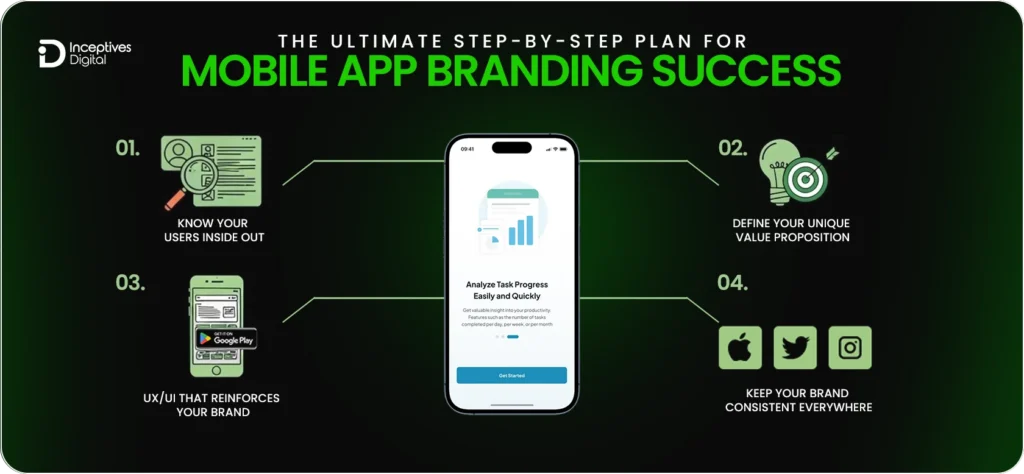
The Ultimate Step-by-Step Plan for Mobile App Branding Success

Building a strong mobile app brand takes some real effort. A highly defined, step-by-step approach below ensures that every element, from design to messaging, combines to offer an exceptional user experience. 

Step 1: Understand Your Target Audience

Begin by understanding your target audience, their actions, and their requirements. A discovery sprint can help identify user needs before defining your brand identity.

 Key Actions: 

  • Arrange interviews and feedback to know what the user likes and what they dislike.
  • Analyze your competitors and determine market gaps and opportunities to venture into the market.
  • Segment your audience to create branding messages that target each type of user.

Step 2: Define Your Unique Value Proposition (UVP)

Find the features that will make your application stand out and why people choose it. Your value proposition (UVP) must be unique, easy, and always conveyed in your branding and messages.

Key Actions: 

  • Highlight the specific benefits or features that set your app apart.
  • Create a message that interacts with the problem your app fixes. 
  • Make your UVP align with both visual and verbal branding elements.

Step 3: Design a Consistent UX/UI Experience

Every interaction should showcase your brand. Interactive prototyping can help test how your brand feels across different screens before development.

Key Actions:

  • Apply uniform visual aspects such as icons, buttons, and animations on all screens.
  • Make it user-friendly without compromising on brand aesthetics.
  • Use micro-interactions and feedback loops that support the brand character.

Step 4: Align Branding Across All Touchpoints

Your application is one part of your brand ecosystem. A clear product launch strategy helps maintain consistent visuals, tone, and messaging across your website, social media, email campaigns, and app store listings.

Key Actions:

  • Draft a brand guideline document that outlines visuals, tone, and messaging.
  • Verify that app screenshots, videos, and descriptions match the overall brand style.
  • Provide training for marketing and support teams to consistently use the brand voice in all user communications.

Step 5: Test, Measure, and Refine

Branding is a continuous process. Through post-launch analytics & iteration, businesses can collect feedback, track engagement, and assess how users respond to their brand. Applying mobile app testing strategies can also help identify usability issues that affect the brand experience.

Key Actions: 

  • Test alternative app icons, screenshots, and preview videos through Apple’s Product Page Optimization feature. On Google Play, use store listing experiments to compare graphics and text. Evaluate the results using platform-specific performance metrics before applying changes.
  • Measure retention, engagement, and brand recognition metrics. 
  • Update brand assets and messaging when testing, user feedback, or market changes justify improvements.

By maintaining these guidelines, your app brand will be strategic, consistent, and will also be remembered in this competitive market. To significantly differentiate your application, powerful branding not only covers design and communication but also includes how your application is represented and performs in the app stores.

Want Your Mobile App Brand to Stand Out in a Crowded Market?

We help you craft a powerful brand strategy, design a seamless UX/UI, and optimize every touchpoint to engage your users and boost retention.

Book Your Consultation Today!

App Store Branding & ASO

Strong mobile app branding can improve how users perceive your app, but visibility also depends on app store optimization (ASO). Apple’s search system considers factors such as app titles, subtitles, keywords, downloads, ratings, and reviews. Our guide to app store optimization and ASO explains how these elements contribute to app discoverability.

A consistent brand identity supports these efforts by helping users recognize your app and understand its value before downloading.

1. Optimize Your App Name and Description

Your app name and description should communicate value clearly. Effective ASO strategies to increase app store rankings can help you improve these elements while maintaining your brand identity.

Tips:

  • Incorporate main keywords easily in the app’s name. 
  • Emphasize the description’s unique features and benefits. 
  • Utilize brief, clear-cut sentences and bullet points for quick reading.

2. Design Branded Screenshots and Preview Videos

Create visuals from scratch to illustrate brand identity and focus on ease of use. These elements display your app’s functionalities, strengthen your brand’s personality, and attract the target audience at first glance.

Tips:

  • Maintain colors, typography, and icons that are consistent with your brand style.
  • Center each screenshot around a key feature or benefit.
  • Include a brief demo video to demonstrate your app’s functionality.

3. Focus on Ratings, Reviews, and Engagement

Ratings and reviews influence how potential users evaluate your app. Positive feedback builds credibility, while recurring complaints reveal issues that may affect adoption and retention.

Tips:

  • Encourage users to leave genuine ratings and reviews without offering rewards or attempting to influence their feedback.
  • Respond efficiently and effectively to every piece of feedback.
  • Monitor reviews to identify recurring complaints and prioritize improvements in future updates.

4. Maintain Consistency Across App Store Listings

The branding of your app should align with your social media, your website, etc to allow a consistent experience throughout the board.

Tips:

  • Sync images, graphics, and logos according to the identity of your brand.
  • Secure tone and messaging to reflect your overall brand voice.
  • Update store visuals when product improvements or new features justify a change.

Combining consistent branding with ASO can improve how users discover and evaluate your app. Avoiding common app store optimization mistakes helps prevent issues that could weaken your store listing.

Mobile App Branding Best Practices That Work

A powerful mobile app brand goes beyond visuals to create a recognizable, reliable experience. During digital product development, branding should inform decisions about how the product looks and feels. User perception is influenced by every interaction, starting from the app store to in-app use. Concentrating on best practices ensures your app is noticed, has credibility, and remains attractive to users.

Let’s explore the key practices that make your mobile app branding effective across platforms.

Maintain Brand Consistency

Writing

Consistent branding helps users recognize your app across different touchpoints. Use a brand style guide to maintain colors, typography, logos, and messaging throughout the experience. Across iOS, Android, and web, preserve your visual identity while respecting each platform’s design conventions.

Keep Branding User-Centric

Effective mobile app branding starts with understanding your users. Use research and usability testing to adapt visuals, messaging, and interactions to their preferences. Focus on communicating benefits that address real user needs.

Adapt Branding Across Platforms

Your marketing strategies for mobile apps should maintain a consistent brand message across every digital touchpoint. Align icons, screenshots, and marketing visuals consistently while adapting microcopy and notifications to platform conventions. Consistency across social media, websites, and email campaigns supports a cohesive brand experience. Businesses investing in custom software development should also maintain this identity across their digital products.

Test, Iterate, and Improve

Branding is a dynamic process that involves continual improvement. Constantly track metrics such as user interaction and retention, test minor changes to design or messaging, and consider user feedback as well. This keeps your brand not only relevant but also trusted and optimized for the long term.

Mistakes in branding might go wrong even if you have implemented the best strategies. Being aware of pitfalls is critical in establishing a strong app brand.

Avoid These Costly Mobile App Branding Mistakes

Even well-planned branding strategies can fail if common mistakes are made. For existing products struggling with usability or engagement, product rescue & scaling may help address deeper product issues alongside branding improvements.

1. Inconsistent Visuals

Using different colors, fonts, or logos across your app, website, and marketing channels confuses users and weakens brand recognition. Consistency in visuals helps users immediately identify your app and trust its quality.

2. Ignoring User Feedback

Ignoring users negatively impacts the brand’s reputation. Users’ comments uncover weaknesses to be fixed and improve the whole experience. Apps that are based on user needs prove that they value their users, which ultimately improves loyalty.

3. Weak or Confusing Brand Voice

Your app will lack a personal touch and sound like a robot with an inconsistent, unclear, or irrelevant brand voice. Clarity and consistency in messaging, notifications, microcopy, and marketing create emotion and strengthen identity.

4. Overcomplicating the Design

Cluttered screens, excessive features, and poor navigation can weaken your brand identity. Avoiding common UI UX design mistakes helps create a more consistent user experience. Minimal and user-friendly design makes everyone notice the value of your app and have a comfortable experience.

5. Neglecting Platform Adaptation

Without proper branding to align with various platforms (iOS, Android, web), your app might appear to be amateurish. Posting images, informational notifications, and microcopy to the particular platform makes the brand consistent and improves satisfaction among users.

The following mobile apps show how recognizable brands apply these principles through design, messaging, and user experience.

Also Read: Common Mistakes to Avoid in Mobile App Development

Is Your App Branding Holding Back Its Growth?

Inconsistent design and unclear messaging can affect how users perceive your app. Let our team review your branding and identify areas that need improvement.

Request a Branding Review

Real-World Mobile App Branding Examples to Inspire You

Real World Mobile App Branding Examples

Learning from these errors is essential, yet it also reflects the right use of branding techniques by the leading apps. Let’s get straight to some real-world mobile app branding cases, which, apart from being the trendsetters, also offer us valuable insights.

Airbnb 

Trust, safety, and community are the main pillars that make up Airbnb’s brand. Beginning with its clear, welcoming designs and messaging that underline guests and hosts, Airbnb develops a sense of belonging. This consistent focus allows the audience to keep up with the platform.

Uber 

Uber’s branding revolves around effortless usability and convenience. Its clean interface, straightforward app flow, and consistent visuals make it instantly recognizable. The brand’s simplicity reduces friction and keeps users returning for reliable service. 

Duolingo

Duolingo stands out with a fun, approachable, and personality-driven brand. Its playful mascot, friendly tone, and gamified learning experience create emotional engagement. By consistently reflecting this personality, Duolingo turns routine language learning into an enjoyable experience.

Spotify 

Spotify connects with users through emotion and lifestyle, not just music streaming. Its branding highlights personalization, music discovery, and cultural relevance. By aligning visuals, messaging, and user experience, Spotify builds strong emotional bonds and encourages long-term engagement.

These real-world examples show what strong mobile app branding looks like in practice. To apply these insights effectively, it’s essential to measure whether your own branding efforts are delivering the right outcomes.

How to Measure if Your App Branding is Working

Measuring your app branding is crucial to understanding its impact and guiding improvements. Tracking the right metrics ensures your efforts translate into recognition, engagement, and conversions.

Brand Awareness Metrics

Brand awareness shows how many users recognize and recall your app. Track metrics like app store impressions, search visibility, and social media mentions to gauge reach and visibility.

User Engagement and Retention Rate

Engagement and retention help measure the overall product experience, although they cannot isolate branding’s impact. Track active users, return frequency, and retention alongside brand awareness research.

App Reviews and Ratings

Reviews and ratings provide direct feedback on how your brand is perceived. Positive ratings reinforce credibility, while constructive feedback highlights areas for improvement.

Conversion and Activation Metrics

Track Google Play listing click-through rates to measure visitor actions, including Install, Open, and Pre-register. On Apple’s App Store, monitor conversion rates based on downloads and unique impressions. Compare these metrics with activation and retention to assess the full user journey.

The Future of Mobile App Branding

Mobile app branding is evolving as user expectations and technologies change. Staying ahead of emerging trends helps apps remain relevant, engaging, and competitive in a crowded market.

Personalization and AI-Driven Branding

AI-driven personalization helps apps adapt content and messaging to user preferences. Businesses exploring AI app development services can use these capabilities to create more relevant experiences that may support engagement and retention.

Micro-Interactions and Motion Branding

Subtle animations and micro-interactions play a growing role in brand perception. From button feedback to loading animations, motion branding adds personality and improves usability. These small details make interactions feel intuitive while reinforcing brand identity.

Community-Focused Brand Experiences

Brands are increasingly building communities rather than just user bases. Features like social interactions, user-generated content, and shared experiences help foster trust and loyalty. Community-driven branding encourages advocacy and turns users into long-term brand supporters.

Conclusion

Mobile app branding plays a critical role in how users perceive, trust, and engage with your app. From visual identity and brand voice to user experience and consistency across platforms, strong branding helps your app stand out, build credibility, and drive long-term retention in a highly competitive market.

To build a scalable and memorable app brand, focus on clarity, consistency, and user-centric design. Explore our development and design services to see how these elements come together throughout the product lifecycle.

Continuously test, refine, and adapt your branding based on user feedback and performance metrics to ensure your app not only gets downloaded—but remembered and trusted over time.

Ready to Turn Your App into a Memorable Brand?

Partner with us to create a cohesive brand strategy, eye-catching design, and seamless user experience that makes your app stand out and builds lasting trust.

Get Started Today

FAQs About Mobile App Branding

1. How long does it take to build a mobile app brand?

Building a mobile app brand is an ongoing process. While the initial branding elements can be developed in a few weeks, establishing strong recognition and trust typically takes months of consistent design, messaging, and user experience refinement.

2. How much does mobile app branding cost?

Mobile app branding costs depend on the scope of work, from basic identity design for startups to complete brand strategy, visual systems, and UX/UI design for established products.

3. Can branding improve app retention?

Yes, consistent mobile app branding can support user retention by building familiarity and reinforcing trust. However, branding alone cannot keep users engaged. Apps must also provide useful features, a reliable experience, and clear value to encourage repeat usage.

4. Is branding important for MVP apps?

Yes. Branding helps apps make a strong first impression, communicate value, and build trust. Even during MVP development, a consistent brand identity helps users understand what the product offers. Even when evaluating MVP cost, the simplest branding provides consistency and helps with validation, adoption, and future growth.

5. How does branding impact app store visibility?

Strong branding can improve app store conversion rates through recognizable visuals and clear messaging. Combined with effective ASO, it helps users understand your app’s value and supports organic acquisition.

Picture of Amna Rashid

Amna Rashid

Amna is a Sr. SEO content writer at Inceptives Digital, specializing in creating high-performing, search-optimized content that enhances online visibility and drives measurable business results. With a strong background in content writing, she crafts engaging blogs, articles, and web copy for mobile app development company projects and other tech-focused brands, helping them attract traffic, engage audiences, and strengthen their digital presence.
✦ Summarize with AI
ChatGPT Claude Perplexity Gemini Grok

Have a Product in Mind?

Let’s build it the right way, together
Start the Conversation
Blog / App Development / The Ultimate Guide to Mobile App Branding

The Ultimate Guide to Mobile App Branding

Amna Rashid
WRITTEN BY Amna Rashid
On This Page
Mobile App Branding Basics You Need to KnowWhy Your Mobile App Branding Can Make or Break SuccessBuilding a Memorable Mobile App Brand IdentityBrand Purpose, Mission, and ValuesVisual Identity That SticksCrafting a Brand Voice That ConnectsThe Ultimate Step-by-Step Plan for Mobile App Branding SuccessStep 1: Understand Your Target AudienceStep 2: Define Your Unique Value Proposition (UVP)Step 3: Design a Consistent UX/UI ExperienceStep 4: Align Branding Across All TouchpointsStep 5: Test, Measure, and RefineWant Your Mobile App Brand to Stand Out in a Crowded Market?App Store Branding & ASO1. Optimize Your App Name and Description2. Design Branded Screenshots and Preview Videos3. Focus on Ratings, Reviews, and Engagement4. Maintain Consistency Across App Store ListingsMobile App Branding Best Practices That WorkMaintain Brand ConsistencyKeep Branding User-CentricAdapt Branding Across PlatformsTest, Iterate, and ImproveAvoid These Costly Mobile App Branding Mistakes1. Inconsistent Visuals2. Ignoring User Feedback3. Weak or Confusing Brand Voice4. Overcomplicating the Design5. Neglecting Platform AdaptationIs Your App Branding Holding Back Its Growth?Real-World Mobile App Branding Examples to Inspire YouAirbnbUberDuolingoSpotifyHow to Measure if Your App Branding is WorkingBrand Awareness MetricsUser Engagement and Retention RateApp Reviews and RatingsConversion and Activation MetricsThe Future of Mobile App BrandingPersonalization and AI-Driven BrandingMicro-Interactions and Motion BrandingCommunity-Focused Brand ExperiencesConclusionReady to Turn Your App into a Memorable Brand?FAQs About Mobile App Branding
Share This Article
The Ultimate Guide to Mobile App Branding
  • Mobile app branding goes beyond logos and colors. It shapes how users recognize and experience your app.
  • A clear brand identity helps your app stand out in crowded app stores.
  • Brand strategy, visual identity, and tone of voice form the foundation of effective mobile app branding.
  • Consistent app design across iOS, Android, and marketing channels supports recognition and user trust.
  • App icons, screenshots, and descriptions can influence download decisions when combined with effective ASO.
  • User feedback and A/B testing help businesses improve their app branding over time.
  • App engagement, retention, store conversion rates, and reviews help measure branding performance.
  • Airbnb, Uber, Duolingo, and Spotify show different approaches to building recognizable mobile app brands.

First impressions shape how users perceive your app, while consistent branding and a reliable experience help build trust over time.

With millions of apps available on both the Apple App Store and Google Play Store, the competition is much more intense than ever. 

This is where mobile app branding goes beyond just logos or colors. Mobile app branding dominates the complete perception of users through your app icon, onboarding experience, tone of voice, and overall user experience. A  strong brand instantly recognizes your app, understands its purpose, and feels confident in choosing it over competitors.

This strong first impression directly influences long-term results. Effective apps build trust, recognition, and long-term loyalty. Consistent branding can improve recognition, strengthen app store conversion rates, and encourage engagement when the product delivers lasting value.

This blog breaks down mobile app branding and its importance for long-term success. It offers practical guidance for startups and businesses working with a mobile app development company to create memorable app brands.

Mobile App Branding Basics You Need to Know

Branding of a mobile app defines how users identify, comprehend, and associate with your app. It describes your app identity and what it promises, enabling users to instantly see its difference.

Mobile app branding comprises three main components:

  • Brand Strategy – Your target users, UVP (unique value proposition), and mission. Product strategy consulting can help clarify these foundations before development.
  • Visual Identity – Colors, typography, logos, and overall visuals.
  • Brand Tone – Consistent communication of your app with users.

If all these components work together, your app will become credible, memorable, and easily recognizable, and will provide a real advantage in this competitive market.

Why Your Mobile App Branding Can Make or Break Success

An effective branding strategy strengthens how users recognize and connect with an app, but it cannot compensate for poor functionality. Branding is not simply a logo or a design. It is the first impression, the promise, and overall the experience that your apps bring.

Every interaction in the app, including the app icon, the onboarding process, notifications, and micro-interactions, contributes to the perception of your app by users.

Strong branding of mobile applications results in your application being recognized in a highly saturated market. It creates a uniform identity recognized by users, creates trust, and sets the standard.

Aligning your brand across every touchpoint can improve recognition and encourage repeat engagement. This consistency can also support your mobile app monetization strategies.

This consistency generates exceptional outcomes:

  • Instant Recognition– Users identify your app easily in the app stores.
  • Trust & Credibility – A cohesive and polished brand generates trust and loyalty.
  • Higher Engagement rate and Retention – Branded experiences encourage users to come back.
  • App Store Visibility– Recognizable visuals and clear messaging can make your listing more compelling to potential users.

Understanding why branding impacts success is the first step; now it’s time to focus on how to build a strong, recognizable identity that users remember and trust.

Building a Memorable Mobile App Brand Identity

A strong identity begins with a memorable mobile app brand. All elements, including images and messages, influence how users feel and connect with your app. 

The important components that make your app branding successful are listed below:

Brand Purpose, Mission, and Values

Your brand purpose explains what the app stands for beyond its functionality. It guides product decisions and helps communicate your value to the right audience.

Make your mission and values of your brand aligned with those of your target users to connect with their needs, preferences, and expectations. This would increase trust and make your app appear relevant and reliable.

Visual Identity That Sticks

A strong visual identity recognizes your app at first glance. Start your app design with a memorable, simple app icon and a brand-personality-reflective logo.

Select typography and a color palette that support your brand values. Good UI UX design helps maintain this visual identity throughout the application. One of the benefits of the same designs across all touchpoints is a unified and professional appearance.

Consistency across platforms is critical, whether you invest in Android app development, iOS app development, or other digital channels. Similar visual styles improve recognition and credibility.

Crafting a Brand Voice That Connects

Your brand voice shows how your app will connect with users. Build your brand tone with notifications, onboarding flows, or microcopy, with a consistent and clear voice to develop the personality of your app.

Emotional connection and narration help the audience relate to your app. You can promote loyalty by providing the values and stories that are relatable to your brand and build a memorable application.

Having a strong identity of your brand ready, the second task is to bring your vision into practice by understanding the step-by-step plan for your mobile app branding.

The Ultimate Step-by-Step Plan for Mobile App Branding Success

The Ultimate Step-by-Step Plan for Mobile App Branding Success

Building a strong mobile app brand takes some real effort. A highly defined, step-by-step approach below ensures that every element, from design to messaging, combines to offer an exceptional user experience. 

Step 1: Understand Your Target Audience

Begin by understanding your target audience, their actions, and their requirements. A discovery sprint can help identify user needs before defining your brand identity.

 Key Actions: 

  • Arrange interviews and feedback to know what the user likes and what they dislike.
  • Analyze your competitors and determine market gaps and opportunities to venture into the market.
  • Segment your audience to create branding messages that target each type of user.

Step 2: Define Your Unique Value Proposition (UVP)

Find the features that will make your application stand out and why people choose it. Your value proposition (UVP) must be unique, easy, and always conveyed in your branding and messages.

Key Actions: 

  • Highlight the specific benefits or features that set your app apart.
  • Create a message that interacts with the problem your app fixes. 
  • Make your UVP align with both visual and verbal branding elements.

Step 3: Design a Consistent UX/UI Experience

Every interaction should showcase your brand. Interactive prototyping can help test how your brand feels across different screens before development.

Key Actions:

  • Apply uniform visual aspects such as icons, buttons, and animations on all screens.
  • Make it user-friendly without compromising on brand aesthetics.
  • Use micro-interactions and feedback loops that support the brand character.

Step 4: Align Branding Across All Touchpoints

Your application is one part of your brand ecosystem. A clear product launch strategy helps maintain consistent visuals, tone, and messaging across your website, social media, email campaigns, and app store listings.

Key Actions:

  • Draft a brand guideline document that outlines visuals, tone, and messaging.
  • Verify that app screenshots, videos, and descriptions match the overall brand style.
  • Provide training for marketing and support teams to consistently use the brand voice in all user communications.

Step 5: Test, Measure, and Refine

Branding is a continuous process. Through post-launch analytics & iteration, businesses can collect feedback, track engagement, and assess how users respond to their brand. Applying mobile app testing strategies can also help identify usability issues that affect the brand experience.

Key Actions: 

  • Test alternative app icons, screenshots, and preview videos through Apple’s Product Page Optimization feature. On Google Play, use store listing experiments to compare graphics and text. Evaluate the results using platform-specific performance metrics before applying changes.
  • Measure retention, engagement, and brand recognition metrics. 
  • Update brand assets and messaging when testing, user feedback, or market changes justify improvements.

By maintaining these guidelines, your app brand will be strategic, consistent, and will also be remembered in this competitive market. To significantly differentiate your application, powerful branding not only covers design and communication but also includes how your application is represented and performs in the app stores.

Want Your Mobile App Brand to Stand Out in a Crowded Market?

We help you craft a powerful brand strategy, design a seamless UX/UI, and optimize every touchpoint to engage your users and boost retention.

Book Your Consultation Today!

App Store Branding & ASO

Strong mobile app branding can improve how users perceive your app, but visibility also depends on app store optimization (ASO). Apple’s search system considers factors such as app titles, subtitles, keywords, downloads, ratings, and reviews. Our guide to app store optimization and ASO explains how these elements contribute to app discoverability.

A consistent brand identity supports these efforts by helping users recognize your app and understand its value before downloading.

1. Optimize Your App Name and Description

Your app name and description should communicate value clearly. Effective ASO strategies to increase app store rankings can help you improve these elements while maintaining your brand identity.

Tips:

  • Incorporate main keywords easily in the app’s name. 
  • Emphasize the description’s unique features and benefits. 
  • Utilize brief, clear-cut sentences and bullet points for quick reading.

2. Design Branded Screenshots and Preview Videos

Create visuals from scratch to illustrate brand identity and focus on ease of use. These elements display your app’s functionalities, strengthen your brand’s personality, and attract the target audience at first glance.

Tips:

  • Maintain colors, typography, and icons that are consistent with your brand style.
  • Center each screenshot around a key feature or benefit.
  • Include a brief demo video to demonstrate your app’s functionality.

3. Focus on Ratings, Reviews, and Engagement

Ratings and reviews influence how potential users evaluate your app. Positive feedback builds credibility, while recurring complaints reveal issues that may affect adoption and retention.

Tips:

  • Encourage users to leave genuine ratings and reviews without offering rewards or attempting to influence their feedback.
  • Respond efficiently and effectively to every piece of feedback.
  • Monitor reviews to identify recurring complaints and prioritize improvements in future updates.

4. Maintain Consistency Across App Store Listings

The branding of your app should align with your social media, your website, etc to allow a consistent experience throughout the board.

Tips:

  • Sync images, graphics, and logos according to the identity of your brand.
  • Secure tone and messaging to reflect your overall brand voice.
  • Update store visuals when product improvements or new features justify a change.

Combining consistent branding with ASO can improve how users discover and evaluate your app. Avoiding common app store optimization mistakes helps prevent issues that could weaken your store listing.

Mobile App Branding Best Practices That Work

A powerful mobile app brand goes beyond visuals to create a recognizable, reliable experience. During digital product development, branding should inform decisions about how the product looks and feels. User perception is influenced by every interaction, starting from the app store to in-app use. Concentrating on best practices ensures your app is noticed, has credibility, and remains attractive to users.

Let’s explore the key practices that make your mobile app branding effective across platforms.

Maintain Brand Consistency

Writing

Consistent branding helps users recognize your app across different touchpoints. Use a brand style guide to maintain colors, typography, logos, and messaging throughout the experience. Across iOS, Android, and web, preserve your visual identity while respecting each platform’s design conventions.

Keep Branding User-Centric

Effective mobile app branding starts with understanding your users. Use research and usability testing to adapt visuals, messaging, and interactions to their preferences. Focus on communicating benefits that address real user needs.

Adapt Branding Across Platforms

Your marketing strategies for mobile apps should maintain a consistent brand message across every digital touchpoint. Align icons, screenshots, and marketing visuals consistently while adapting microcopy and notifications to platform conventions. Consistency across social media, websites, and email campaigns supports a cohesive brand experience. Businesses investing in custom software development should also maintain this identity across their digital products.

Test, Iterate, and Improve

Branding is a dynamic process that involves continual improvement. Constantly track metrics such as user interaction and retention, test minor changes to design or messaging, and consider user feedback as well. This keeps your brand not only relevant but also trusted and optimized for the long term.

Mistakes in branding might go wrong even if you have implemented the best strategies. Being aware of pitfalls is critical in establishing a strong app brand.

Avoid These Costly Mobile App Branding Mistakes

Even well-planned branding strategies can fail if common mistakes are made. For existing products struggling with usability or engagement, product rescue & scaling may help address deeper product issues alongside branding improvements.

1. Inconsistent Visuals

Using different colors, fonts, or logos across your app, website, and marketing channels confuses users and weakens brand recognition. Consistency in visuals helps users immediately identify your app and trust its quality.

2. Ignoring User Feedback

Ignoring users negatively impacts the brand’s reputation. Users’ comments uncover weaknesses to be fixed and improve the whole experience. Apps that are based on user needs prove that they value their users, which ultimately improves loyalty.

3. Weak or Confusing Brand Voice

Your app will lack a personal touch and sound like a robot with an inconsistent, unclear, or irrelevant brand voice. Clarity and consistency in messaging, notifications, microcopy, and marketing create emotion and strengthen identity.

4. Overcomplicating the Design

Cluttered screens, excessive features, and poor navigation can weaken your brand identity. Avoiding common UI UX design mistakes helps create a more consistent user experience. Minimal and user-friendly design makes everyone notice the value of your app and have a comfortable experience.

5. Neglecting Platform Adaptation

Without proper branding to align with various platforms (iOS, Android, web), your app might appear to be amateurish. Posting images, informational notifications, and microcopy to the particular platform makes the brand consistent and improves satisfaction among users.

The following mobile apps show how recognizable brands apply these principles through design, messaging, and user experience.

Also Read: Common Mistakes to Avoid in Mobile App Development

Is Your App Branding Holding Back Its Growth?

Inconsistent design and unclear messaging can affect how users perceive your app. Let our team review your branding and identify areas that need improvement.

Request a Branding Review

Real-World Mobile App Branding Examples to Inspire You

Real World Mobile App Branding Examples

Learning from these errors is essential, yet it also reflects the right use of branding techniques by the leading apps. Let’s get straight to some real-world mobile app branding cases, which, apart from being the trendsetters, also offer us valuable insights.

Airbnb 

Trust, safety, and community are the main pillars that make up Airbnb’s brand. Beginning with its clear, welcoming designs and messaging that underline guests and hosts, Airbnb develops a sense of belonging. This consistent focus allows the audience to keep up with the platform.

Uber 

Uber’s branding revolves around effortless usability and convenience. Its clean interface, straightforward app flow, and consistent visuals make it instantly recognizable. The brand’s simplicity reduces friction and keeps users returning for reliable service. 

Duolingo

Duolingo stands out with a fun, approachable, and personality-driven brand. Its playful mascot, friendly tone, and gamified learning experience create emotional engagement. By consistently reflecting this personality, Duolingo turns routine language learning into an enjoyable experience.

Spotify 

Spotify connects with users through emotion and lifestyle, not just music streaming. Its branding highlights personalization, music discovery, and cultural relevance. By aligning visuals, messaging, and user experience, Spotify builds strong emotional bonds and encourages long-term engagement.

These real-world examples show what strong mobile app branding looks like in practice. To apply these insights effectively, it’s essential to measure whether your own branding efforts are delivering the right outcomes.

How to Measure if Your App Branding is Working

Measuring your app branding is crucial to understanding its impact and guiding improvements. Tracking the right metrics ensures your efforts translate into recognition, engagement, and conversions.

Brand Awareness Metrics

Brand awareness shows how many users recognize and recall your app. Track metrics like app store impressions, search visibility, and social media mentions to gauge reach and visibility.

User Engagement and Retention Rate

Engagement and retention help measure the overall product experience, although they cannot isolate branding’s impact. Track active users, return frequency, and retention alongside brand awareness research.

App Reviews and Ratings

Reviews and ratings provide direct feedback on how your brand is perceived. Positive ratings reinforce credibility, while constructive feedback highlights areas for improvement.

Conversion and Activation Metrics

Track Google Play listing click-through rates to measure visitor actions, including Install, Open, and Pre-register. On Apple’s App Store, monitor conversion rates based on downloads and unique impressions. Compare these metrics with activation and retention to assess the full user journey.

The Future of Mobile App Branding

Mobile app branding is evolving as user expectations and technologies change. Staying ahead of emerging trends helps apps remain relevant, engaging, and competitive in a crowded market.

Personalization and AI-Driven Branding

AI-driven personalization helps apps adapt content and messaging to user preferences. Businesses exploring AI app development services can use these capabilities to create more relevant experiences that may support engagement and retention.

Micro-Interactions and Motion Branding

Subtle animations and micro-interactions play a growing role in brand perception. From button feedback to loading animations, motion branding adds personality and improves usability. These small details make interactions feel intuitive while reinforcing brand identity.

Community-Focused Brand Experiences

Brands are increasingly building communities rather than just user bases. Features like social interactions, user-generated content, and shared experiences help foster trust and loyalty. Community-driven branding encourages advocacy and turns users into long-term brand supporters.

Conclusion

Mobile app branding plays a critical role in how users perceive, trust, and engage with your app. From visual identity and brand voice to user experience and consistency across platforms, strong branding helps your app stand out, build credibility, and drive long-term retention in a highly competitive market.

To build a scalable and memorable app brand, focus on clarity, consistency, and user-centric design. Explore our development and design services to see how these elements come together throughout the product lifecycle.

Continuously test, refine, and adapt your branding based on user feedback and performance metrics to ensure your app not only gets downloaded—but remembered and trusted over time.

Ready to Turn Your App into a Memorable Brand?

Partner with us to create a cohesive brand strategy, eye-catching design, and seamless user experience that makes your app stand out and builds lasting trust.

Get Started Today

FAQs About Mobile App Branding

1. How long does it take to build a mobile app brand?

Building a mobile app brand is an ongoing process. While the initial branding elements can be developed in a few weeks, establishing strong recognition and trust typically takes months of consistent design, messaging, and user experience refinement.

2. How much does mobile app branding cost?

Mobile app branding costs depend on the scope of work, from basic identity design for startups to complete brand strategy, visual systems, and UX/UI design for established products.

3. Can branding improve app retention?

Yes, consistent mobile app branding can support user retention by building familiarity and reinforcing trust. However, branding alone cannot keep users engaged. Apps must also provide useful features, a reliable experience, and clear value to encourage repeat usage.

4. Is branding important for MVP apps?

Yes. Branding helps apps make a strong first impression, communicate value, and build trust. Even during MVP development, a consistent brand identity helps users understand what the product offers. Even when evaluating MVP cost, the simplest branding provides consistency and helps with validation, adoption, and future growth.

5. How does branding impact app store visibility?

Strong branding can improve app store conversion rates through recognizable visuals and clear messaging. Combined with effective ASO, it helps users understand your app’s value and supports organic acquisition.

✦ Summarize with AI
Amna Rashid
WRITTEN BY

Amna Rashid

Amna is a Sr. SEO content writer at Inceptives Digital, specializing in creating high-performing, search-optimized content that enhances online visibility and drives measurable business results. With a strong background in content writing, she crafts engaging blogs, articles, and web copy for mobile app development company projects and other tech-focused brands, helping them attract traffic, engage audiences, and strengthen their digital presence.

✦ Summarize with AI

Have a Product in Mind?

Discuss your idea with our product development team.

Start the Conversation →
On This Page
Mobile App Branding Basics You Need to KnowWhy Your Mobile App Branding Can Make or Break SuccessBuilding a Memorable Mobile App Brand IdentityBrand Purpose, Mission, and ValuesVisual Identity That SticksCrafting a Brand Voice That ConnectsThe Ultimate Step-by-Step Plan for Mobile App Branding SuccessStep 1: Understand Your Target AudienceStep 2: Define Your Unique Value Proposition (UVP)Step 3: Design a Consistent UX/UI ExperienceStep 4: Align Branding Across All TouchpointsStep 5: Test, Measure, and RefineWant Your Mobile App Brand to Stand Out in a Crowded Market?App Store Branding & ASO1. Optimize Your App Name and Description2. Design Branded Screenshots and Preview Videos3. Focus on Ratings, Reviews, and Engagement4. Maintain Consistency Across App Store ListingsMobile App Branding Best Practices That WorkMaintain Brand ConsistencyKeep Branding User-CentricAdapt Branding Across PlatformsTest, Iterate, and ImproveAvoid These Costly Mobile App Branding Mistakes1. Inconsistent Visuals2. Ignoring User Feedback3. Weak or Confusing Brand Voice4. Overcomplicating the Design5. Neglecting Platform AdaptationIs Your App Branding Holding Back Its Growth?Real-World Mobile App Branding Examples to Inspire YouAirbnbUberDuolingoSpotifyHow to Measure if Your App Branding is WorkingBrand Awareness MetricsUser Engagement and Retention RateApp Reviews and RatingsConversion and Activation MetricsThe Future of Mobile App BrandingPersonalization and AI-Driven BrandingMicro-Interactions and Motion BrandingCommunity-Focused Brand ExperiencesConclusionReady to Turn Your App into a Memorable Brand?FAQs About Mobile App Branding
Locations

Get in touch!

Scalable solutions from teams worldwide!

  • Privacy Policy
  • |
  • Terms of Services
Inceptives Digital

We build apps, digital products, and AI-powered systems for businesses that cannot afford to get it wrong.

  • info@inceptivesdigital.com
  • (469) 788-8527
Linkedin Instagram Facebook
Services
  • Mobile App Development
  • AI Development
  • Digital Product Development
  • Mobile App Development
  • AI Development
  • Digital Product Development
Industries
  • Healthcare
  • Fitness
  • Dating
  • Education
  • Real Estate
  • Travel
  • Food Delivery
  • Healthcare
  • Fitness
  • Dating
  • Education
  • Real Estate
  • Travel
  • Food Delivery
Case Studies
  • WordSmith Pro
  • DPS Airem
  • State of the Art Chiropractic
  • Family Entertainment Group
  • StakBread
  • WordSmith Pro
  • DPS Airem
  • State of the Art Chiropractic
  • Family Entertainment Group
  • StakBread
Locations
  • San Francisco
  • Toronto
  • Austin
  • New York
  • Singapore
  • London
  • Dubai
  • San Francisco
  • Toronto
  • Austin
  • New York
  • Singapore
  • London
  • Dubai
Company
  • About
  • Blog
  • Press & Media
  • Partnership
  • Life At Inceptives Digital
  • Leadership
  • Founder’s Letter
  • Contact Us
  • About
  • Blog
  • Press & Media
  • Partnership
  • Life At Inceptives Digital
  • Leadership
  • Founder’s Letter
  • Contact Us
Recognized and Reviewed On

Independent reviews and industry recognition from established B2B platforms.

Clutch Review Badge
Bark Review Badge
Trustpilot Review Badge
Our Locations
United States
New York, USA

1178 Broadway, 3rd Floor New York, NY 10001 United States

United States
San Francisco, USA

490 Post St, Ste 500 San Francisco, CA 94102 United States

United States
Austin, USA

5900 Balcones Drive, Suite 100 Austin, Texas 78731 United States

United States
Allen, USA

450 Century Parkway, Suite 250 1005 Allen, TX 75013, USA

Canda
Toronto, Canada

2482 Yonge Street Toronto, ON M4P 2H5 Canada

united kingdom
London, UK

Office 1776, 60 Tottenham Court Road, Fitzrovia, London W1T 2EW

Dubai, UAE

IFZA Business Park Building A2, Dubai Silicon Oasis Dubai, UAE

Singapore
Singapore

No. 7 Temasek Boulevard #12-07, Suntec Tower One Singapore 038987

Pakistan
Karachi, Pakistan

Office No. 1, Najeeb Center 172-B Tariq Road, PECHS Karachi 74400, Pakistan

© 2026 IT Core Solutions LLC DBA Inceptives Digital. All Rights Reserved.

  • Privacy Policy
  • Terms of Use
DMCA.com Protection Status

Get Expert Direction for Your Next Digital Product

Inceptives Digital has helped businesses across regions bring their visions to life. See what their experience says about working with us. We don’t do magic. We build with expertise.

“
Inceptives Digital has been professional, responsive, and genuinely committed to understanding our vision for Evoltion Enterprise. The team communicated clearly, explained technical details patiently, and made payments hassle-free. Special thanks to Aaron Francis for his clarity and support throughout. Highly recommend them as a transparent, easy-to-work-with technology partner
Tyrrell Gibson CEO, Evoltion Enterprise
When I came to these guys, it was just me in an idea. I’ve had ideas before that. I thought were good and sat on them only to watch others take the initiative and reap the rewards because I lacked confidence. When I had the idea for my app I figured, “Not this time.
Edward Eller, GoRyde
I absolutely recommend this company. This team is absolutely Amazing!
I can't say enough good things about them. I had tried 3 other app makers before finding them. All of them fell short in the end. The Inceptive team was the literal answer of my prayers.
DC & Owner, State of the Art Chiropractic
AWARDS & RECOGNITION
Inceptives Digital award badge 1
Top Mobile App Developers 2025
Inceptives Digital award badge 3
RightFirms company badge
Inceptives Digital award badge 5
FEATURED ON MEDIA & REVIEW PLATFORMS
Associated Press
Trustpilot
Google
The New York Times
The Globe and Mail
USA Today

Let us help you build the next innovative digital product with precision and expertise. Share your idea and get a customized roadmap to your app within 24 hours.

Fully NDA-Protected
  • Privacy Policy
  • |
  • Terms of Services

Schedule a Meeting

Loading calendar...
Calendar is taking longer than expected

Please try again, or open Calendly directly to book your meeting.

Open Calendly