


- Custom software development in the UK can cost between $13,500 and $675,000+, depending on project requirements.
- Most custom business applications fall within an estimated budget of 54,000–202,000.
- A basic internal business tool may cost 13,500–40,500, while enterprise projects can exceed $1 million.
- UK software development agencies typically charge 110–250 per hour, depending on expertise and location.
- App complexity, user roles, integrations, and security requirements have a major impact on development costs.
- Flutter and React Native can reduce costs when building applications for both iOS and Android.
- AI integrations may add 6,800–27,000 for simpler implementations, with advanced AI systems costing considerably more.
- Annual software maintenance generally requires a planning allowance of 15–25% of the initial development budget.
- Development costs vary between freelancers, in-house teams, UK agencies, and offshore providers.
- Starting with an MVP and a discovery phase can help businesses avoid unnecessary development expenses.
- Comparing the full scope of vendor proposals matters more than choosing the lowest hourly rate.
Software development in the UK typically costs between $13,500 and $675,000+, and the gap comes down to three things: what you’re building, how complex it gets, and who builds it.
- A narrow internal tool can stay under $40,500.
- A customer-facing SaaS product usually needs $67,500 to $202,000.
- Enterprise platforms, regulated systems, and AI-heavy products often push past $338,000.
The hard part isn’t finding a number. It’s turning a rough idea into a budget you can actually plan around.
A proper quote by any mobile application development company in UK covers discovery, UX design, engineering, integrations, QA, security, deployment, and support after launch.
Rates also shift depending on whether you hire a freelancer, a regional agency, a London consultancy, or an offshore team, and rising software development costs in 2027 widen those gaps.
This guide breaks down UK custom software development costs for 2027, shows what different budget levels actually deliver, and walks through how to plan spend without overpaying for complexity you don’t need yet.
It also covers the hidden software development costs most quotes leave out until later: maintenance, infrastructure, data migration, and the true cost of choosing the wrong delivery model.
Treat the numbers here as planning ranges rather than fixed prices.
Every product is different, and a proper estimate still needs a real discovery conversation with a delivery team.
Quick Overview of Software Development Cost in UK
Most custom software projects land between $34,000 and $338,000. Enterprise programmes can exceed $675,000.
A few reference points from digital product development cost benchmarks are worth knowing before you dig in:
- Internal tools: roughly $10,800–$40,500
- Web applications: roughly $34,000–$202,000
- Mobile apps: roughly $54,000–$202,000 for a baseline build
- Enterprise platforms: roughly $202,000–$675,000+
- Typical UK agency rates: $110–$250 per hour, depending on location and team model
These figures describe custom development, not website design or off-the-shelf software configuration. The rest of this guide explains what pushes a project toward the lower or upper end of each range.
What Does $34,000, $101,000, or $270,000 Actually Buy?
Budget makes more sense once you connect it to real product capability rather than an abstract number.
| Budget | What it typically covers | Best suited for |
| $34,000 | Authentication, basic profiles, one core workflow, admin dashboard, responsive interface, simple API, essential QA | Internal tools, booking workflows, early validation products |
| $101,000 | Multiple user roles, custom UX, payment integration, notifications, search and filtering, reporting, automated testing, monitored cloud infrastructure | SME SaaS MVPs, customer platforms, mobile-first business apps |
| $270,000 | Complex role-based workflows, combined mobile and web apps, multiple integrations, real-time functionality, advanced analytics, strong security controls | Growth-stage SaaS, complex marketplaces, FinTech, healthcare and logistics platforms |
At $34,000, don’t expect multiple user journeys, complex integrations, and native mobile apps together; keep scope narrow and validate the core workflow first through MVP development.
At $101,000, spend on the workflows that move acquisition, conversion, or retention rather than secondary features.
At $270,000, lock in the architecture and governance model early, since those decisions shape years of operating cost.
UK Software Development Cost by Project Type
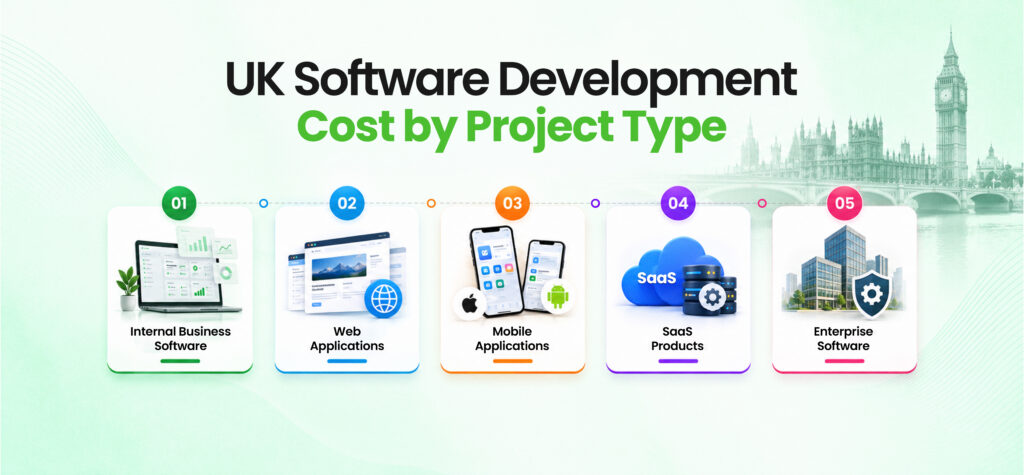
The type of software you’re building tells you more about likely cost than almost anything else, even before you factor in individual features.
Internal Business Software
$13,500–$67,500
Internal tools serve employees, not the public, which usually means tighter, better-understood requirements.
- Common examples: employee portals, inventory systems, staff scheduling, approval workflows, reporting dashboards
- Straightforward build: $13,500–$40,500
- Multi-department platform with integrations: $40,500–$67,500+
The smart approach is to start with your highest-volume workflow: login, task allocation, status updates, manager approval, and basic reporting. Add payroll integrations and automation once people are actually using it.
Web Applications
$34,000–$202,000+
Web app costs vary enormously depending on what “application” actually means in your case.
- Basic customer portal: $27,000–$54,000
- Interactive business application: $47,000–$94,500
- E-commerce platform: $54,000–$135,000
- SaaS MVP: $54,000–$122,000
- Advanced SaaS platform: $122,000–$270,000+
- Enterprise web platform: $202,000–$540,000+
Working with a web app development company makes financial sense when users mainly work from a browser and don’t need deep device-level functionality.
A responsive build can serve desktop, tablet, and mobile users from one codebase, and a Progressive Web App can add mobile capability without funding two native builds.
Mobile Applications
$54,000–$202,000+
Mobile app development adds its own layer of design, testing, deployment, and ongoing maintenance work on top of core development.
A simple utility app, in line with typical mobile app development cost, runs around 54,000–81,000.
Complex apps with real-time features, payments, and AI can reach $202,000–$405,000+.
| Approach | Typical cost | Best when |
| Native iOS or Android | $54,000–$122,000 each | You need advanced device functionality or maximum performance |
| Flutter or React Native | $67,500–$148,000 for both platforms | The experience can stay broadly consistent across iOS and Android |
| Progressive Web App | $34,000–$94,500 | Browser access covers most of your users |
Cross-platform frameworks, weighed in native vs hybrid vs cross-platform comparisons, can deliver both major platforms for roughly 60–75% of the cost of separate native builds, though the real saving depends on the product.
SaaS Products
$54,000–$338,000+
SaaS is rarely just a polished front end. The backend usually needs subscription management, multi-tenancy, billing, role permissions, and usage tracking layered underneath.
A lean MVP costs 54,000–122,000, in line with typical MVP development cost ranges. A growth-ready platform runs $122,000–$243,000. A complex multi-tenant system can reach $243,000–$473,000+.
A realistic $101,000 SaaS MVP splits roughly as follows.
The point isn’t the exact figures; it’s that engineering shouldn’t eat the entire budget, because design, testing, and infrastructure protect that investment.
| Workstream | Allocation |
| Discovery | $6,800 |
| UX/UI design | $10,800 |
| Frontend development | $20,000 |
| Backend development | $27,000 |
| Integrations | $9,400 |
| QA | $9,400 |
| DevOps | $6,800 |
| Product management | $6,800 |
| Contingency | $4,100 |
Enterprise Software
$202,000–$675,000+
Enterprise builds combine multiple departments, large datasets, heavy integration work, and demanding uptime requirements. ERP systems, enterprise CRM, supply chain platforms, and healthcare or financial systems all sit here.
- Single-department platform: $135,000–$243,000
- Multi-department system: $243,000–$405,000
- Enterprise SaaS: $338,000–$675,000
- ERP replacement: $405,000–$1m+
- Large digital transformation: $675,000–$1.4m+
At this scale, don’t pick a vendor on the lowest proposal alone.
A $243,000 quote can look better than a $378,000 quote right up until you discover it excludes data migration, security review, or post-launch support.
What Drives the Price Up or Down
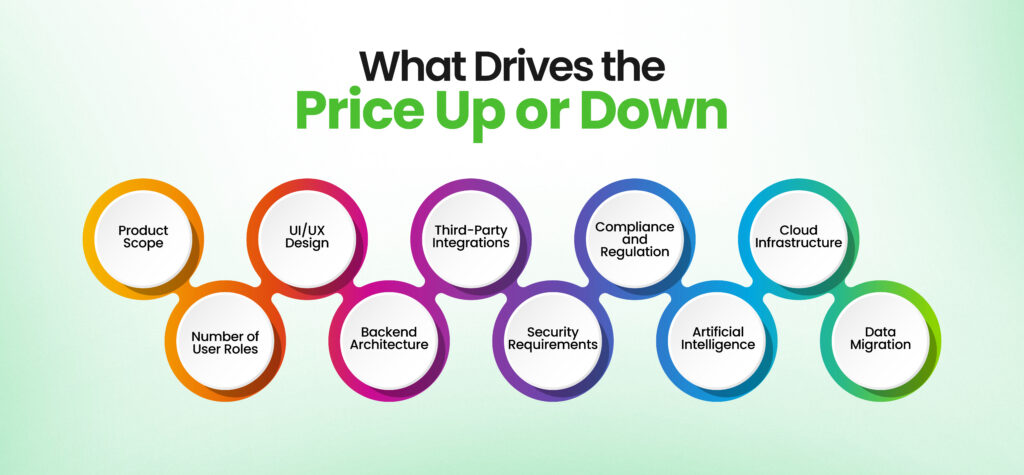
Project type sets the starting point. These factors determine where you actually land within that range.
Product Scope
Every feature adds cost across design, engineering, testing, and documentation, so product strategy consulting pays off early. Basic authentication is cheap; adding MFA, SSO, social login, and audit logs multiplies that cost several times over.
Sorting features into must-have, should-have, and later keeps the initial price tag tied to real launch requirements.
Number of User Roles
Cost scales with roles, not just features. One or two roles add little overhead.
Five to seven roles typically add 15–25% to the budget, and eight or more can add 25–40%, since each role needs its own workflows and permissions priced separately.
UI/UX Design
UI UX design cost tracks the complexity of the user journey, not the screen count. A basic application needs $6,800–$16,200.
Customer-facing products need $16,200–$40,500. Enterprise design systems can cost more than $81,000. Skipping design early just shifts that cost into pricier development work later.
Backend Architecture
A simple backend, built through backend api development, costs 13,500–40,500.
Real-time processing, high transaction volume, multi-tenancy, and event-driven architecture push that price to $67,500–$202,000+.
A modular monolith keeps early costs down; pay for service separation only once scale justifies it.
Third-Party Integrations
A simple API integration, delivered through system integration api automation, costs 2,700–8,100.
Complex integrations involving bidirectional sync, webhooks, and reconciliation run $10,800–$34,000+.
Unclear documentation or rate limits are common sources of unbudgeted costs, so confirming API terms before signing protects the estimate you were quoted.
Security Requirements
Standard application security costs $4,100–$10,800.
A security review and hardening pass runs $10,800–$27,000, and complex FinTech or healthcare compliance work can reach $67,500+.
Pricing security into the architecture from day one, using app security best practices, costs less than retrofitting it after launch.
Compliance and Regulation
Compliance doesn’t map to a fixed price tag.
UK GDPR, PCI DSS, FCA rules, and healthcare requirements, especially in fintech app development, can add 20–50%+ to total project cost, depending on the data and assurance involved.
Pricing this during discovery turns an open-ended risk into a defined budget line.
Artificial Intelligence
A simple AI API integration from AI app development services adds 6,800–27,000.
RAG-based assistants and custom workflows add $27,000–$81,000, and a fully custom AI platform can add $101,000–$338,000+.
A managed model keeps costs down, as the AI development cost guide shows, until proprietary data justifies custom development.
Cloud Infrastructure
Setup and ongoing hosting are separate cost lines.
A small app runs $135–$700 a month at first; a growing SaaS product often reaches $700–$6,800; high-traffic enterprise systems can exceed $13,500 monthly.
Budget both a setup cost and a recurring operating cost from the start.
Data Migration
A small migration costs $6,800–$20,000. A complex enterprise migration can reach $202,000+.
Auditing the source data before development starts prices migration as its own workstream, rather than letting it surface later as an unbudgeted addition to the final invoice.
Have a Software Project in Mind but No Clear Budget?
Share your requirements with Inceptives Digital. We’ll assess the technical scope and help you understand what development could cost before you commit.
Get a Software Cost Estimate!Cost by Project Complexity and Team Size
Complexity is a useful lens on its own, separate from project type, because two “web apps” can sit at completely different cost levels depending on what they actually do underneath.
- Low complexity ($20,000–$54,000, 6–12 weeks): basic workflows, limited integrations, a handful of screens.
- Moderate complexity ($54,000–$135,000, 3–6 months): multiple user roles, several APIs, and working dashboards.
- High complexity ($135,000–$338,000, 6–12 months): complex workflows, extensive integrations, and a backend built to scale.
- Enterprise complexity ($338,000–$675,000+, 9–18+ months): multiple connected systems, compliance requirements, and high transaction volume.
Feature count alone doesn’t decide complexity. A single feature can create major technical work if it needs real-time processing, external systems, or strict regulatory controls, even inside an otherwise simple product.
Team size follows a similar pattern.
- A lean team (one product manager, one designer, two developers, one QA engineer) suits a focused MVP and typically costs $54,000–$122,000.
- A standard product team, adding a technical lead and DevOps engineer, commonly supports $108,000–$243,000 projects.
- Enterprise programmes bring in solution architects, security specialists, and data engineers, often pushing budgets past $338,000.
The goal isn’t to hire the biggest team you can justify.
It’s to hire the smallest team capable of meeting the product’s actual technical and delivery requirements, then scale up only when the roadmap demands it.
UK Developer Rates in 2027
Hourly rates are a useful benchmark, but they shouldn’t be the only thing driving your decision.
| Role | Hourly range | Day rate |
| Junior developer | $40–$60 | $350–$450 |
| Mid-level developer | $70–$95 | $550–$750 |
| Senior developer | $95–$130 | $750–$1,000 |
| Technical architect | $100–$155 | $800–$1,200 |
| UI/UX designer | $60–$95 | $450–$750 |
| Project manager | $90–$110 | $700–$800 |
| DevOps engineer | $90–$120 | $700–$950 |
| AI/ML engineer | $135–$200 | $1,100–$1,600 |
Agency rates sit higher, typically $110–$250 per hour, because you’re paying for a full delivery team and its overhead rather than one person’s time.
Location matters too. London commands a premium ($120–$250+/hour) thanks to demand and specialist talent density.
Regional hubs like Manchester, Bristol, and Birmingham often run $90–$200/hour, while Scotland, Wales, and Northern Ireland tend to sit lower still.
None of these figures are official tariffs; treat them as planning benchmarks.
Freelancer vs In-House vs Agency
Your delivery model, compared in in-house vs development partner guides, changes the underlying economics more than almost any other decision.
| Model | Typical cost | Best for | Weaker fit for |
| Freelancer | $40–$110/hour | Small websites, prototypes, isolated features, short-term API work | Complex SaaS, enterprise platforms, anything needing dedicated QA/DevOps |
| In-house team | Salary plus overhead (NI, pension, benefits, equipment, recruitment) | Long-term strategic capability, continuous development over years | One-off projects or short-term needs |
| Agency | $110–$250/hour, team-based | Fixed launch windows, limited internal capacity, multiple disciplines from day one | Very small, narrowly scoped tasks |
Coordinating several freelancers yourself often erases the hourly savings on anything beyond a narrow task.
Agency rates don’t compare directly to a freelancer’s rate, because you’re buying a delivery system, not just coding hours.
How Agencies Structure Pricing
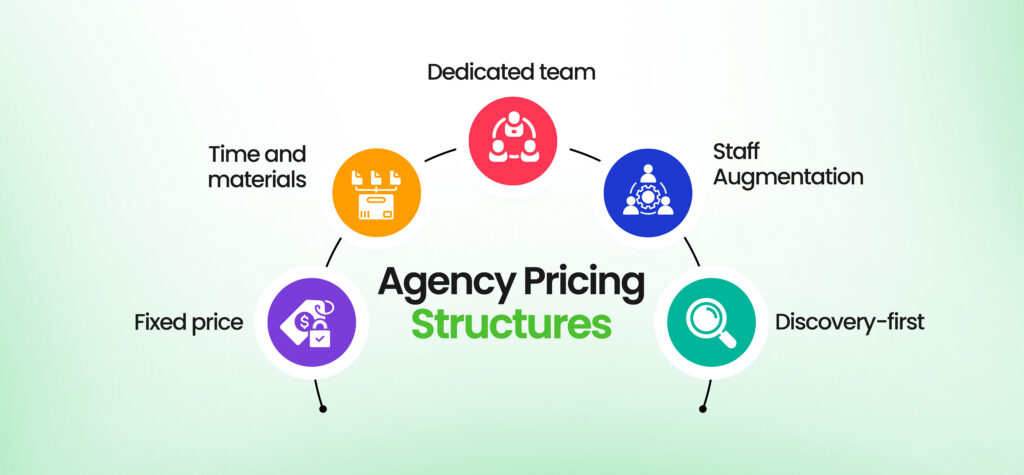
Different commercial models suit different levels of certainty about scope.
- Fixed price works when requirements, designs, and acceptance criteria are already locked. It’s ideal for a well-defined discovery phase or MVP, but scope changes usually trigger a formal change request.
- Time and materials gives you flexibility to reprioritise as you learn from users. It suits SaaS products and evolving builds, but needs monthly spending caps and sprint-level budgets to avoid uncontrolled spend.
- Dedicated team funds a stable, ongoing team rather than a single project. A five-person team (product manager, designer, two developers, QA) typically runs $40,500–$74,000 per month, and this model fits companies with a long product roadmap.
- Staff augmentation adds specialist capacity to an existing in-house team on an hourly or day-rate basis.
- Discovery-first starts with a fixed-fee discovery sprint, then prices the MVP once requirements are clear. This is often the safest starting point when requirements are still fuzzy.
Hidden Costs Beyond the Quote
The headline number in a proposal rarely represents the full investment. These workstreams deserve their own line items.
- Discovery: $4,100–$20,000 for a small or medium product, $27,000–$81,000+ for enterprise. It should produce requirements, user journeys, architecture decisions, and a cost estimate, not just a kickoff meeting.
- QA: roughly 10–20% of the development budget for most custom products, sometimes more for complex builds. Cutting QA doesn’t remove defects; it just shifts discovery of them onto your customers.
- DevOps: roughly 5–15% of development effort, covering CI/CD, monitoring, backups, and infrastructure as code. Complex enterprise systems need considerably more.
- Maintenance: a useful planning figure, in line with mobile app maintenance cost benchmarks, is 15–25% of the initial development cost per year. A $135,000 build typically needs $20,000–$34,000 annually just for patches, dependency updates, and minor fixes, before any new features.
- Third-party software: hosting, payments, email, SMS, analytics, and AI APIs add recurring monthly fees, often in the hundreds to low thousands of dollars.
A Sample $135,000 SaaS Budget
For a customer-facing SaaS platform, a realistic allocation looks something like this:
- Product discovery: $10,100
- UX/UI design: $16,900
- Frontend development: $27,000
- Backend development: $34,000
- Integrations: $13,500
- QA and automation: $13,500
- DevOps and cloud setup: $6,800
- Project management: $6,800
- Security and contingency: $6,800
This is illustrative, not a template. If your product needs heavy AI work, data migration, or regulated payment infrastructure, the split will shift accordingly.
Building Your Own Planning Estimate
Before you talk to vendors, it helps to have a rough number of your own. Start with a base project cost of $54,000, then adjust for the specifics of what you’re building.
- Additional user roles: +$2,700–$10,800 each
- Complex integration: +$6,800–$27,000
- Native mobile platform: +$40,500–$94,500
- Advanced analytics: +$6,800–$27,000
- AI capability: +$13,500–$108,000+
- Complex compliance: +$20,000–$67,500+
- Data migration: +$6,800–$135,000+
- Advanced security: +$10,800–$54,000
- Real-time functionality: +$13,500–$54,000
For example, a base application at $54,000, plus two complex integrations ($27,000), advanced analytics ($13,500), a mobile app ($54,000), and security work ($13,500), lands at roughly $162,000. This won’t replace a proper technical estimate, but it gives you a defensible starting point for vendor conversations.
When Is Custom Software Actually Worth It?
Custom development makes financial sense when off-the-shelf tools can’t support something important to the business, or when the software itself creates a real competitive advantage, which is where software versus product development decisions begin.
- Worth building when the product removes expensive manual work, opens a new revenue channel, connects fragmented systems, or gives you data capabilities competitors don’t have
- Rarely worth building when a cheaper answer already exists, since rebuilding a $700-a-month SaaS tool for $135,000 needs a genuinely strong strategic reason
Before deciding you need custom software, apply one test: does the business value outweigh the total cost of ownership, including maintenance, infrastructure, and future improvements, not just the initial build?
Ways to Cut Costs Without Cutting Quality
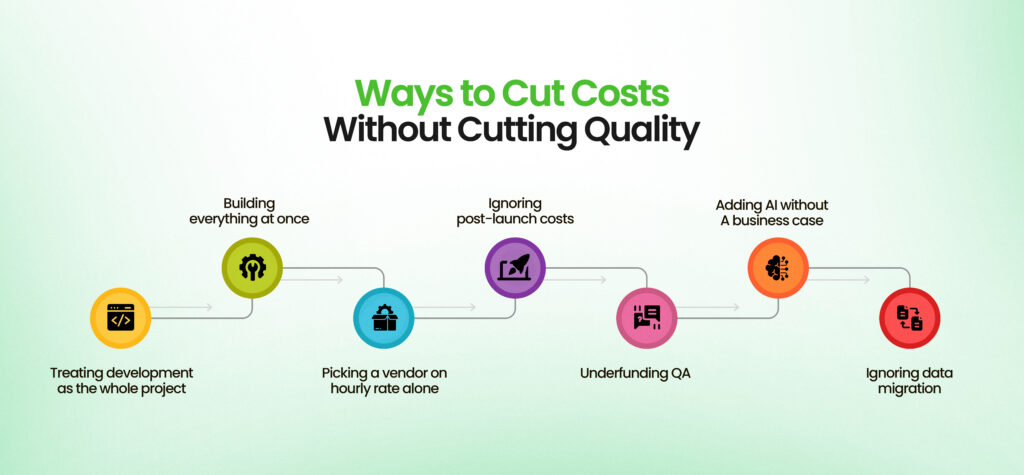
Cost optimisation should mean removing unnecessary work, not lowering engineering standards, as these tips to reduce app development cost show.
- Start with discovery. Spending $6,800 upfront can expose redundant features, integration constraints, and compliance gaps before they turn into expensive rework.
- Build an MVP around one outcome. Don’t scope 25 features across five user types and three platforms. Scope the smallest product that proves one business hypothesis: one workflow, two user types, one payment provider, one platform.
- Reuse proven components. Authentication providers, payment platforms, and analytics tools already exist. Spending $27,000 to rebuild functionality a proven service already offers rarely pays off.
- Choose cross-platform app development where it fits. Flutter or React Native can deliver both platforms for a fraction of dual native development, when the product doesn’t need deep native functionality.
- Delay automation. Launch with a manual process, measure how people actually use it through post-launch analytics iteration, then automate the steps that create real operational value.
- Use managed infrastructure. Managed databases, authentication, and monitoring reduce early-stage engineering work. Move to custom infrastructure once scale genuinely justifies it.
Need to Build Software Without Stretching Your Budget?
Not every feature needs to launch on day one. Our team can help you define an MVP with a practical scope and realistic development budget.
Discuss Your MVP Budget!UK Agency vs Offshore Development
Location affects pricing, but it shouldn’t be the only factor in the decision.
| Scenario | Rate | Hours | Total |
| UK agency | $150/hour | 1,000 | $150,000 |
| Offshore team (as quoted) | $60/hour | 1,000 | $60,000 |
| Offshore team (with rework from unclear requirements) | $60/hour | 2,000 | $120,000 |
The offshore quote looks like an easy win until communication gaps push effort up.
This doesn’t mean offshore development always creates rework; it means the comparison that matters is total delivery cost, not the advertised hourly rate.
UK agencies tend to offer easier communication and stronger regulatory collaboration, while offshore and nearshore teams tend to offer lower base rates.
Weigh both against your project’s complexity and how much management time you can realistically spend.
Getting an Accurate Quote
A quote is only as good as the information behind it. Before you approach vendors, work through these steps:
- State the objective in one sentence. For example: “The platform lets field-service companies schedule jobs, assign technicians, and invoice customers.”
- List every user group and what each one needs to see, do, and access.
- Map the core workflows, from signup through to the final action a user takes.
- Split features into MVP and future, so estimators aren’t pricing your entire roadmap as day-one scope.
- List every integration, including payment, CRM, accounting, and identity systems.
- Define your platforms: web, iOS, Android, PWA, admin portal, APIs.
- Ask for a work breakdown structure showing discovery, design, development, QA, DevOps, and project management as separate line items. Be wary of any proposal that gives you one unexplained total.
When you compare quotes, don’t default to the cheapest one.
Ask what’s actually included:
- QA automation
- Security testing
- Post-launch support,
- Documentation
- Who owns the source code once the project ends?
A $40,500 gap between two proposals can shrink fast once you account for what’s missing from the cheaper one.
Say three agencies quote $74,000, $115,000, and $169,000 for the same brief, with timelines of five, six, and seven months.
The middle quote isn’t automatically the safe choice, and the cheapest isn’t automatically the risky one.
Check what each proposal actually covers before ranking them:
- Feature scope and number of developers assigned
- Design coverage and QA allocation
- Security work and deployment support
- Documentation and post-launch support
- Change-request terms if scope shifts
If the cheapest agency excludes QA automation and support while the mid-tier one includes both, the apparent $40,500 gap often narrows to almost nothing once you price in what’s missing.
Fixed Budget or Flexible Roadmap?
Choose fixed pricing when requirements, user journeys, and designs are already settled. A well-defined internal portal, for instance, suits a fixed $34,000 engagement.
Avoid locking in a rigid fixed price when the product needs real experimentation.
A new SaaS concept often changes shape after customer interviews and prototype testing.
In that case, a discovery phase followed by a fixed MVP scope and a flexible growth roadmap gives you both financial control and room to adapt.
Timeline Expectations
Cost and app development timeline move together, and most projects fall into predictable bands:
- Internal tool: 6–12 weeks
- Basic portal: 8–16 weeks
- SaaS MVP: 12–24 weeks
- Standard mobile app: 16–32 weeks
- Marketplace: 20–36 weeks
- Complex SaaS: 24–48 weeks
- Enterprise platform: 36–72+ weeks
Adding developers doesn’t shorten these timelines proportionally, since architecture decisions and QA both depend on earlier work being finished first.
A realistic plan accounts for these dependencies rather than dividing total effort evenly across the team.
Total Cost of Ownership
Initial development is only one part of the financial picture. A $135,000 SaaS product, viewed over five years, might look like this:
- Initial development: $135,000
- Maintenance: $101,000–$169,000
- Cloud and infrastructure: $40,500–$135,000
- Third-party services: $20,000–$81,000
- Security and compliance: $20,000–$67,500
- Product improvements: $101,000–$270,000
That puts a realistic five-year total somewhere between $418,000 and $857,000.
A $94,500 application that needs constant rebuilding or product rescue scaling can easily cost more over time than a $135,000 build with a stronger architecture from the start.
Common Budgeting Mistakes
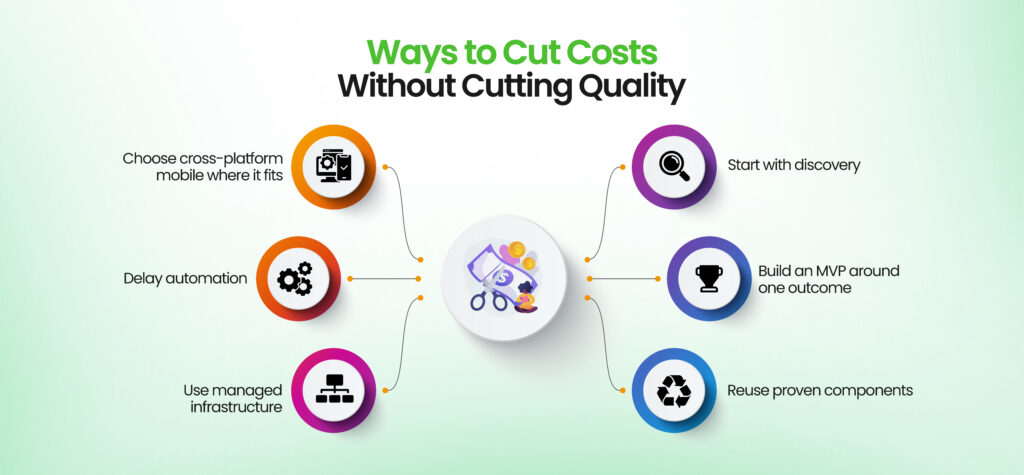
- Treating development as the whole project. Coding often represents only 40–60% of total delivery effort. Design, QA, DevOps, and project management all need their own budget lines.
- Building everything at once. A broad first release raises both cost and delivery risk. Scope the smallest version that proves your commercial hypothesis instead.
- Picking a vendor on hourly rate alone. Compare total cost of ownership, not just the number on the invoice.
- Ignoring post-launch costs. Hosting, maintenance, and support continue well after launch, so build a three-year operating budget before development starts.
- Underfunding QA. Defects don’t disappear when you skip testing; they just show up in production instead.
- Adding AI without a business case. Define the outcome first, then decide whether AI is genuinely the most economical way to get there.
- Ignoring data migration. Legacy data almost always creates more technical work than expected. Audit it before finalising the estimate.
Building in Contingency
Set aside 10–20% contingency for projects with moderate uncertainty, and 20–30% for genuinely complex ones, guided by app development risk management principles. Pair that with clear change-control rules: every scope change should show its added effort, cost, and timeline impact before it gets approved.
Review progress every sprint rather than waiting until the budget runs low. Tracking planned work against completed work and burn rate gives you time to trim lower-priority features before costs run past what’s approved.
This matters more for time-and-materials engagements than fixed-price ones, since flexibility only stays useful if someone is actively watching the burn rate. A five-minute sprint review is far cheaper than discovering a budget shortfall three months before launch.
What a Strong Proposal Should Cover
A credible UK software proposal answers six questions clearly:
- What you’re building
- How the team plans to build it
- Who’s doing the work
- What it costs (broken down, not a single total)
- When it launches, and what support looks like afterward.
That last point should cover warranty, maintenance, hosting, documentation, and source-code ownership. If a proposal is vague on any of these, treat it as a signal to ask more questions before signing.
Final Recommended Budget Bands for 2027
| Requirement | Planning budget |
| Simple internal tool | $13,500–$40,500 |
| Customer portal | $27,000–$67,500 |
| MVP | $40,500–$108,000 |
| SaaS MVP | $54,000–$122,000 |
| Standard mobile app | $67,500–$162,000 |
| Marketplace | $88,000–$202,000 |
| Growth-stage SaaS | $135,000–$338,000 |
| FinTech or regulated platform | $135,000–$405,000+ |
| Enterprise platform | $202,000–$675,000+ |
| Large transformation programme | $675,000–$1.4m+ |
These bands reflect broadly consistent UK market data, even though published estimates vary in scope. The variation usually comes down to how each source defines a project, not a genuine disagreement about pricing.
Final Thoughts
UK software development ranges from $13,500 for a focused internal tool to $675,000+ for enterprise systems, with most business applications landing between $54,000 and $202,000.
The right number for your project depends on scope, architecture, integrations, security, compliance, and how long you expect to operate the product.
Rather than chasing the cheapest quote, define the outcome you actually need, prioritise the workflows that matter, and price the full digital product development lifecycle rather than just the coding hours.
A discovery-first approach consistently produces clearer estimates and fewer surprises down the line.
The right budget isn’t the smallest one available; it’s the one that funds the product you actually need, without paying for complexity you don’t.
Get a Costed Plan for Your Software Idea
Discovery-first quotes remove the guesswork. Share your requirements and Inceptives Digital will scope a costed, phase-by-phase development plan within days.
Get Expert Help Now!Frequently Asked Questions
Most small to medium projects cost $34,000–$338,000, while enterprise systems can reach $675,000+. A focused MVP typically runs $40,500–$108,000.
There’s no reliable single average, since projects vary too widely. For planning purposes, $67,500–$202,000 is a reasonable range for many custom business applications.
A custom MVP generally costs $40,500–$108,000. A more complex SaaS or marketplace MVP with multiple roles and payments can reach $108,000–$162,000.
Enterprise software typically costs $202,000–$675,000+. Large ERP replacements and regulated, multi-system programs can exceed $1.4 million.
Roughly $40–$60 for junior developers, $70–$95 for mid-level, and $95–$130 for senior developers, with specialist architects and AI engineers charging more.
Usually, though, specialist expertise can command premium pricing anywhere in the UK. Compare total project cost and delivery quality, not just the hourly rate.
Freelancers often cost less per hour and suit simple projects well. Agencies tend to deliver better value on complex builds because one team manages the entire lifecycle.
Plan for 15–25% of the original development cost each year. A $135,000 product typically needs $20,000–$34,000 annually, excluding major new features.
Choose a fixed price when requirements are stable and well-documented. Choose time and materials when the product needs ongoing experimentation. A discovery-first engagement followed by a fixed MVP scope often works best.
As a starting point: $13,500–$40,500 for a focused internal tool, $40,500–$108,000 for an MVP, $67,500–$162,000 for a standard app, and $135,000–$338,000 for a growth-stage SaaS product. Refine the figure through discovery and technical scoping.
A simple AI API integration adds $6,800–$27,000. More advanced work, including RAG assistants, recommendation engines, or computer vision, can add $27,000–$338,000+, depending on the data and infrastructure involved.
Cut unnecessary scope, validate the idea before building it out fully, reuse proven third-party services, and pick the right platform strategy from the start. Cutting QA or security to shrink the quote tends to raise total cost later, not lower it.















CEO Insight:
“Most budget overruns start before development begins, when nobody challenges the brief. A discovery-first estimate protects the number you actually commit to.”
— Hannan Shahnoor, CEO, Inceptives Digital