- AI development costs vary by complexity: A proof of concept may cost $5,000–$25,000, while enterprise AI platforms can exceed $500,000.
- Project scope drives pricing: Features, data readiness, AI models, integrations, and security requirements significantly affect the budget.
- Choose the right development stage: Start with a proof of concept or MVP to validate your idea before investing in a full-scale product.
- Data quality matters: Clean, structured, and accessible data helps reduce development costs and improve AI performance.
- Plan for ongoing expenses: Infrastructure, API usage, monitoring, maintenance, and updates contribute to long-term AI costs.
- Prioritize essential features: Focus on one high-value use case first and expand based on user feedback and measurable results.
- Measure ROI before investing: Define clear business outcomes, such as reduced operational costs, improved efficiency, or increased revenue.
- Choose the right development partner: An experienced AI development company can help you make informed technical decisions, manage risks, and avoid unnecessary expenses.
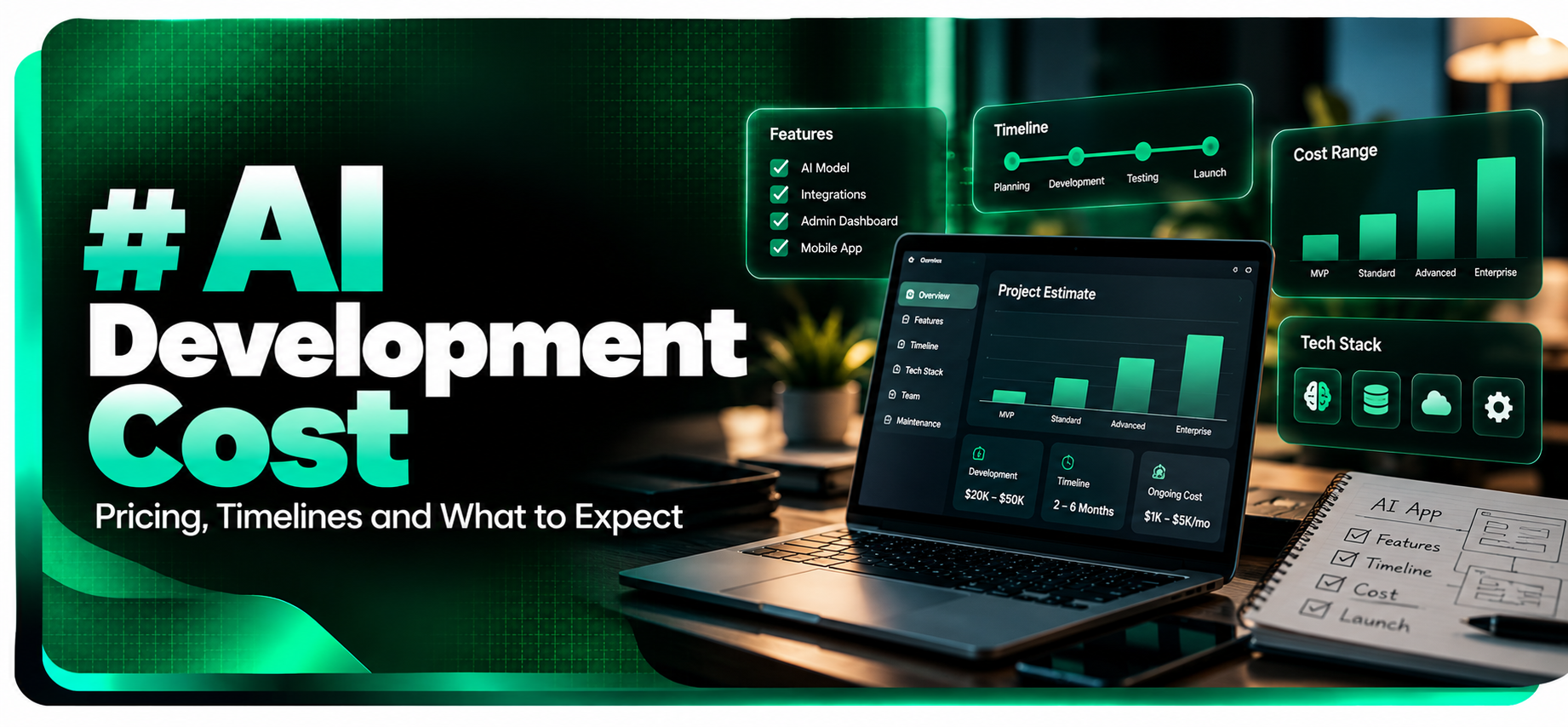
AI development costs usually range from $5,000 to $25,000 for a focused proof of concept, $25,000 to $80,000+ for an AI MVP, and $100,000 to $500,000+ for a custom AI product or enterprise AI platform.
That cost matters more now because AI budgets are expanding. Deloitte found that 78% of organizations expected to increase their overall AI spending in the next fiscal year, which means more teams are moving from AI experiments into serious budget planning.
The final cost depends on what the AI system needs to do. A simple AI chatbot development project using a prebuilt model will not cost the same as a RAG-based knowledge assistant, AI agent workflow, machine learning prediction system, or full AI-powered SaaS platform.
Most AI budgets increase because of the work behind the visible features: data preparation, model selection, prompt architecture, integrations, infrastructure, security, testing, and post-launch monitoring.
That is why working with an experienced AI development company is critical. Instead of estimating based only on features, a reliable partner evaluates the use case, available data, system complexity, and required production reliability to provide a more accurate and scalable cost estimate.
Why AI Development Cost Varies So Much
AI development cost varies because the word “AI” can describe very different levels of work. A basic chatbot, a document search assistant, a machine learning prediction model, and an AI agent that takes actions across business systems may all be called AI solutions. But they do not require the same planning, data work, engineering, testing, or infrastructure.
The biggest cost differences usually come from five areas:
| Cost Factor | Why It Affects the Budget |
| Product scope | More user roles, workflows, dashboards, and permissions increase design and development effort |
| Data readiness | Messy, incomplete, or scattered data requires cleaning, labeling, structuring, and preparation |
| AI model approach | Prebuilt APIs cost less to start, while fine-tuning, RAG systems, AI agents, or custom models need more engineering |
| Integrations | Connecting with CRMs, ERPs, databases, internal tools, or third-party APIs adds backend complexity |
| Production requirements | Security, compliance, monitoring, scalability, latency, and reliability increase the cost beyond a simple demo |
This is why two AI projects with similar screens can have completely different budgets. The visible interface may look simple, but the hidden costs often sit behind the product: data pipelines, model behavior, workflow logic, API connections, cloud infrastructure, output testing, and post-launch monitoring.
A useful AI cost estimate should explain what is being priced. Is the business testing feasibility, starting MVP development, launching a customer-facing product, or creating a production AI system that needs to support real users and real decisions?
Without that context, the price range is only a guess.
AI Development Cost by Project Type
AI development cost becomes easier to understand when the project type is clear. A small internal AI tool, an AI chatbot, a generative AI feature, and a full enterprise AI platform do not sit in the same budget range.
Use these ranges as planning estimates, not fixed quotes.
| AI Project Type | Typical Cost Range | What It Usually Includes |
| AI proof of concept | $5,000 to $25,000 | Validates one use case, tests a model approach, and works with limited data |
| AI prototype | $10,000 to $40,000 | Shows how the AI solution could work through a demo, sample data, or limited workflow |
| AI MVP | $25,000 to $80,000+ | Includes a usable first version with core AI functionality, backend logic, interface, and limited integrations |
| Custom AI app | $50,000 to $150,000+ | Covers a mobile or web product with AI features, user accounts, backend, integrations, and testing |
| Generative AI solution | $40,000 to $200,000+ | Includes LLM integration, prompt architecture, RAG, content generation, evaluation, and guardrails |
| AI agent system | $50,000 to $180,000+ | Supports multi-step tasks, tool use, workflow logic, permissions, integrations, and monitoring |
| Enterprise AI platform | $150,000 to $500,000+ | Includes multi-role access, advanced integrations, compliance, analytics, infrastructure, and long-term scale planning |
The main difference between these ranges is not the label attached to the project. It is the level of responsibility the AI system carries.
A proof of concept only needs to show whether the idea can work. An AI MVP needs to prove that users can get value from the first usable version. A production AI product needs to be reliable, secure, scalable, and maintainable under real usage.
That is why the cost to build an AI solution should always be tied to the outcome expected from that version.
AI App Development Cost vs AI Software Development Cost
AI app development cost and AI software development cost are related, but they are not the same.
AI app development cost usually refers to the cost of mobile app development, or of building a web app or SaaS product, with AI features inside the experience. This includes the interface, user flows, backend, accounts, AI features, integrations, testing, and launch support.
AI software development cost is broader. It can include internal systems, AI automation tools, predictive models, document processing systems, AI agents, data pipelines, dashboards, and backend AI workflows that may not look like a traditional app.
| Cost Category | AI App Development | AI Software Development |
| Main focus | User-facing product experience | System, workflow, model, or automation logic |
| Common outputs | Mobile apps, web apps, SaaS products, AI assistants | Internal tools, analytics engines, AI workflows, AI platforms |
| Main cost drivers | UX, frontend, backend, AI features, accounts, subscriptions, integrations | Data pipelines, models, APIs, automation, infrastructure, monitoring |
| Typical users | Customers, consumers, product users, teams | Operations teams, analysts, support teams, internal departments |
| Example | AI writing app, AI fitness coach, AI chatbot app | Document intelligence system, fraud model, predictive analytics engine |
The cost of AI app development depends heavily on the product experience. Users need a clear interface, fast responses, helpful AI output, account access, and a workflow that feels reliable.
The cost to build AI software depends more on what happens behind the scenes: data quality, model behavior, integrations, permissions, automation, monitoring, and operational reliability.
For many businesses, the final product includes both. A customer may see a simple AI feature on the screen, while the system behind it includes retrieval logic, model evaluation, backend APIs, data pipelines, security controls, and infrastructure planning.
AI Development Cost by Build Stage
AI development cost also depends on how mature the project needs to be. Testing an idea, launching a first usable version, and building a full AI product are three different investments.
A proof of concept is built to answer, “Can this work?”
An MVP is built to answer, “Will users get value from this?”
A production AI product is built to answer, “Can this operate reliably at scale?”
| Build Stage | Typical Cost Range | Main Purpose |
| AI proof of concept | $5,000 to $25,000+ | Test feasibility and reduce technical uncertainty |
| AI MVP | $25,000 to $80,000+ | Validate user value through a usable first version |
| Production AI product | $80,000 to $500,000+ | Build a secure, scalable, maintainable AI system |
AI Proof of Concept Cost
An AI proof of concept is the lowest-risk way to test whether an AI idea is technically possible before committing to a larger build.
It usually focuses on one use case, one model approach, and a limited data sample. The goal is not to create a polished product. The goal is to understand whether the AI can produce useful results.
An AI proof of concept may include:
- sample data testing
- model selection
- prompt or retrieval testing
- basic accuracy review
- limited workflow demo
- feasibility findings
- technical recommendation for the next stage
This stage is useful when the business is unsure about data quality, model performance, or whether it is ready for AI at all.
AI MVP Cost
AI MVP development costs more because it needs to become usable, not just technically possible.
A strong AI MVP usually includes one clear user group, one or two core workflows, a functional interface, backend logic, limited integrations, basic security, model evaluation, and a controlled launch environment.
An AI MVP may include:
- user-facing interface
- AI feature connected to real or limited production data
- backend APIs
- database setup
- authentication
- basic admin controls
- model testing
- limited integrations
- user feedback loop
The purpose of an AI MVP is to prove whether users will trust, use, and benefit from the AI solution. It should not try to include every feature from the long-term product strategy.
Production AI Product Cost
A production AI product is built for real users, real data, and real operating conditions.
This stage costs more because the system needs stronger security, scalability, monitoring, error handling, analytics, infrastructure, and maintenance planning, in line with app security best practices. It may also need compliance controls, audit logs, role-based permissions, advanced integrations, and ongoing model monitoring.
A production AI product may include:
- polished product experience
- secure backend architecture
- role-based access
- production data pipelines
- AI model monitoring
- performance optimization
- cloud infrastructure
- advanced integrations
- analytics dashboard
- security testing
- maintenance and support planning
The cost increases because production AI carries responsibility. It cannot only work in a demo. It has to keep working when users depend on it.
Why the Right Build Stage Can Save Thousands in AI Development Costs
One of the biggest factors influencing AI development cost isn’t the technology itself. It’s deciding how much product you need to build first. Projects that validate a focused workflow before expanding typically avoid unnecessary engineering, reduce development risk, and accelerate digital product development.
Real Project Example: WordSmith Pro
| Project | WordSmith Pro |
| Challenge | Create an AI writing platform that helps users improve their writing instead of simply correcting grammar. |
| Initial Vision | A comprehensive AI product with writing analysis, OCR, progress tracking, enterprise features, and multiple AI capabilities. |
| Product Decision | The first release prioritized the core writing experience, real-time AI feedback, and measurable progress tracking before expanding into broader workflows. |
| Business Outcome | A production-ready AI platform with a validated product foundation, three revenue models, and a roadmap built on real user feedback instead of assumptions. |
Key takeaway: The biggest cost savings didn’t come from choosing a cheaper AI model. They came from narrowing the first release to the features that delivered immediate value, then expanding the product based on validated user needs.
AI Development Cost by Solution Type
AI development cost also changes based on the type of AI solution being built. A generative AI assistant, machine learning model, AI agent, and RAG-based knowledge assistant may all use AI, but they do not require the same data work, architecture, testing, or infrastructure.
This is where many AI cost estimates become misleading. The project name may sound simple, but the solution type determines how much work sits behind the interface.
| AI Solution Type | Typical Cost Range | Main Cost Drivers |
| Generative AI solution | $40,000 to $200,000+ | LLM integration, prompt architecture, RAG, guardrails, evaluation, API usage |
| Machine learning system | $30,000 to $250,000+ | Data quality, training, validation, prediction accuracy, monitoring |
| AI agent system | $50,000 to $180,000+ | Multi-step workflows, tool access, permissions, integrations, human review |
| RAG knowledge assistant | $25,000 to $150,000+ | Document ingestion, embeddings, vector database, retrieval quality, source grounding |
1. Generative AI Development Cost
Generative AI development usually involves large language models, prompt design, retrieval logic, output testing, moderation, and integration into a product or workflow.
The cost depends on how controlled and reliable the output needs to be. A simple content generation feature costs less than a generative AI assistant that needs company data, source citations, user permissions, and response guardrails.
Generative AI development cost is usually shaped by:
- LLM provider selection
- prompt architecture
- RAG pipeline
- vector database
- document ingestion
- output guardrails
- hallucination control
- model evaluation
- token and API usage
- user feedback loops
Examples include AI writing tools, internal knowledge assistants, support copilots, legal document assistants, policy search tools, and AI features inside SaaS products.
2. Machine Learning Development Cost
Machine learning projects rarely fail because the algorithm is weak. They struggle when historical data is incomplete, biased, or doesn’t reflect the decisions the business actually wants the model to make.
Traditional machine learning development often produces systems that classify, recommend, forecast, score, detect, or predict something based on historical data. The model may be less visible to users than a chatbot, but the work behind it can be more data-intensive.
Machine learning development cost is usually shaped by:
- historical data volume
- data cleaning
- data labeling
- feature engineering
- model selection
- model training
- validation
- deployment
- retraining
- monitoring
Common examples include recommendation engines, fraud detection models, churn prediction, demand forecasting, credit scoring, predictive maintenance, and risk analysis.
3. AI Agent Development Cost
Most businesses underestimate AI agent development because they compare agents to chatbots. The expensive part isn’t generating responses. It enables the agent to make reliable decisions across multiple systems while handling permissions, failures, approvals, and business rules without disrupting existing workflows.
AI agent development cost is usually shaped by:
- task complexity
- tool and API access
- reasoning workflow
- memory and context management
- permissions
- integrations
- fallback logic
- human review
- monitoring
- safety controls
Examples include sales assistant agents, support agents, research agents, operations agents, data analysis agents, and internal workflow automation agents.
4. RAG and Knowledge Assistant Development Cost
Many businesses assume adding company documents to an LLM is enough to build a reliable knowledge assistant, without real NLP development work. In practice, the challenge isn’t giving the model more information. It’s retrieving the right information consistently, keeping it up to date, and grounding every answer in trusted sources.
The cost depends on how much content needs to be processed, how accurate retrieval must be, and whether users need permissions, citations, source visibility, or frequent updates.
RAG and knowledge assistant development cost is usually shaped by:
- document volume
- document formats
- ingestion pipeline
- chunking strategy
- embeddings
- vector database
- permission handling
- source citation
- retrieval evaluation
- update frequency
A RAG system is not just a chatbot connected to files. The real cost comes from making answers accurate, secure, source-grounded, and useful inside the workflow.
What Drives Custom AI Development Cost?
Custom AI development needs more planning because the system has to fit a specific business process, user experience, data environment, and operating model.
A simple AI feature can often use an existing model or API. A custom AI solution needs more planning because the system has to fit a specific business process, user experience, data environment, and operating model.
The main cost drivers usually fall into seven areas.
1. Product Scope and User Experience
Businesses often focus on the AI feature itself, but users judge the entire product experience by its UI/UX design. Authentication, onboarding, permissions, dashboards, and feedback loops all contribute to whether the AI becomes useful or frustrating.
Cost increases when the product includes:
- multiple user roles
- mobile, web, or dashboard interfaces
- admin panels
- onboarding flows
- permissions
- notifications
- analytics
- subscriptions or payment logic
- user feedback loops
A narrow internal AI tool built through custom software development may cost less than a customer-facing AI product because the user experience, reliability expectations, and support requirements are usually different.
2. AI Model Approach
The model approach has a direct impact on AI development pricing.
Using an existing AI API is usually faster and less expensive than training a custom model. But API-based development still requires prompt architecture, output testing, integration work, monitoring, and usage planning.
Cost increases when the solution needs:
- model selection
- prompt engineering
- fine-tuning
- open-source model setup
- custom model training
- multi-model routing
- evaluation datasets
- model monitoring
The right model approach should match the use case. Training a custom model too early is one of the common mistakes when building apps with AI, because it can increase cost without improving the product.
3. Data Readiness
Most AI projects don’t become expensive because the model is difficult to build. They become expensive because the information the model depends on isn’t ready to use.
Businesses often discover their documents are inconsistent, customer records live in multiple systems, permissions are unclear, or critical information exists only in spreadsheets and PDFs. Preparing that data frequently requires more engineering effort than integrating the AI model itself.
Data-related costs may include:
- data cleaning
- data labeling
- data structuring
- document processing
- deduplication
- data privacy review
- embeddings
- data pipelines
- access rules
AI quality depends on the quality and availability of the information behind it. Weak data usually creates extra cost later through poor output, rework, or manual review.
4. AI Architecture
Tech stack and architecture decisions often create unnecessary cost when they’re made too early. Teams sometimes assume they need fine-tuning, multi-agent orchestration, or complex retrieval pipelines before validating whether users actually benefit from the AI workflow.
Architecture-related cost may include:
- RAG pipeline
- vector database
- prompt orchestration
- caching
- guardrails
- fallback logic
- source citations
- model evaluation
- model monitoring
This is where many AI estimates become too optimistic. The model may be available, but the system around the model still needs to be designed.
5. Integrations
AI system integration cost depends on how many systems the AI solution needs to work with and how reliable those connections need to be.
Common integrations include:
- CRM
- ERP
- CMS
- helpdesk software
- payment systems
- data warehouses
- internal databases
- cloud storage
- third-party APIs
- mobile or web applications
A simple integration may only retrieve data. A more complex integration may need permissions, data mapping, workflow updates, real-time actions, error handling, and audit logs.
6. Security and Compliance
Security and compliance requirements can increase custom AI development cost, especially when the system handles sensitive or business-critical data that needs HIPAA compliant app development or similar controls.
Cost may increase when the AI solution needs:
- authentication
- role-based access control
- encryption
- audit logs
- data retention rules
- secure API design
- HIPAA, SOC 2, GDPR, or internal compliance alignment
- security testing
- human review workflows
Security should not be treated as a final layer. It affects architecture, permissions, logging, deployment, and how the AI system handles data from the beginning.
7. Scale and Usage
The cost to build an AI solution also depends on expected usage.
A tool used by a small internal team has different cost requirements than a customer-facing AI product, where web app development has to handle thousands of daily requests. Higher usage can increase infrastructure needs, API costs, latency planning, caching, monitoring, and support requirements.
Scale-related costs may include:
- expected user volume
- frequency of AI calls
- inference cost
- token usage
- latency requirements
- uptime needs
- cloud hosting
- monitoring and logging
- performance optimization
AI systems need cost visibility after launch. Without usage monitoring, a product that looks affordable during testing can become expensive as adoption grows.
Custom AI development cost is highest when the system needs to be accurate, secure, integrated, scalable, and reliable under real usage. It is lowest when the first version stays focused on one clear workflow and avoids unnecessary complexity.
AI Development Cost by Development Phase
AI development cost is not spent in one place. The budget moves through several phases, and each phase answers a different question about the product, data, model, and system.
1. Discovery and AI Feasibility (5% to 15%)
A discovery sprint defines what the AI solution should do, what data it needs, which model approach makes sense, and what risks need to be handled before development begins.
This phase usually includes use case definition, workflow review, data assessment, technical feasibility, risk review, and success metrics.
2. Product Design and UX (10% to 20%)
Product design turns the AI idea into a usable experience, often validated through interactive prototyping.
This includes UI/UX design, user flows, dashboards, review states, permissions, error handling, source visibility, and the points where human review may be needed.
3. Data Preparation (10% to 25%)
Data preparation is often the phase teams underestimate.
If documents are messy, databases are incomplete, or business knowledge is scattered across tools, the project needs more work before the AI can return useful output.
4. AI Model Setup (15% to 30%)
Model setup covers the AI layer itself.
Depending on the solution, this may include LLM integration, RAG, fine-tuning, embeddings, prompt orchestration, model routing, evaluation datasets, or prediction model configuration.
5. Backend and Frontend Development (20% to 35%)
Development connects the AI system into a working product.
This includes frontend screens, backend API development, databases, authentication, admin tools, business logic, integrations, and the product workflows around the AI feature.
6. Testing and Security Review (10% to 20%)
Testing for AI products goes beyond normal QA and standard app testing strategies.
The team needs to review functionality, output quality, incorrect responses, edge cases, permissions, latency, security, and failure behavior.
7. Deployment and Monitoring (5% to 15%)
Deployment and product launch strategy prepare the AI solution for real use.
Once users start interacting with the product, the team needs visibility into performance, usage cost, model behavior, errors, and feedback.
| Development Phase | Typical Share of Cost | What Happens |
| Discovery and AI feasibility | 5% to 15% | Define the use case, user flow, data needs, risks, model approach, and success metrics |
| Product design and UX | 10% to 20% | Design workflows, interface, dashboard, review steps, permissions, and feedback loops |
| Data preparation | 10% to 25% | Clean, label, structure, connect, or prepare business data for AI use |
| AI model setup | 15% to 30% | Set up APIs, RAG, fine-tuning, embeddings, prompt logic, evaluation, or model workflows |
| Backend and frontend development | 20% to 35% | Build the app, APIs, database, admin tools, business logic, and integrations |
| Testing and security review | 10% to 20% | Test functionality, AI output, model behavior, edge cases, permissions, and security |
| Deployment and monitoring | 5% to 15% | Set up cloud infrastructure, logging, analytics, model monitoring, and performance checks |
A complete AI cost estimate should show how much effort goes into each phase. Otherwise, the estimate may look cheaper at the start but miss the work required to make the AI system reliable after launch.
Costs That Continue After the First Build
AI development costs do not stop when the first version launches. The first build creates the product foundation, but integrations, infrastructure, monitoring, and maintenance shape the long-term cost of ownership.
These costs matter because AI systems are not static. Models change, data changes, user behavior changes, and usage volume can grow faster than expected.
1. AI Integration Cost
Integration is often treated as a technical task, but it’s one of the most common reasons AI budgets grow after development begins. Connecting AI to existing business systems is rarely just about moving data. The challenge is making those systems exchange information reliably without disrupting existing workflows.
A simple integration may only pull information from one source. A more complex integration may need real-time data access, permissions, workflow updates, error handling, and audit logs.
Common AI integrations include:
- CRM systems
- ERP platforms
- CMS platforms
- helpdesk software
- payment systems
- internal databases
- data warehouses
- cloud storage
- mobile apps
- web apps
- third-party APIs
AI integration cost usually increases when systems are old, APIs are poorly documented, data is spread across multiple sources, or the workflow requires custom business logic.
2. AI Infrastructure Cost
Many teams budget for building the AI product but overlook what it takes to keep it running. Once users start interacting with the system, every request, document, and model response relies on infrastructure that needs to remain reliable, secure, and cost-efficient.
This may include hosting, model API usage, vector databases, storage, monitoring, logging, analytics, security tools, backup systems, and DevOps or MLOps support.
| Infrastructure Choice | Cost Profile | Best For |
| AI API | Lower setup cost, usage-based billing | MVPs, pilots, and products that do not need full infrastructure ownership |
| Managed cloud AI service | Medium setup, scalable pricing | Teams that need cloud support, governance, and easier scaling |
| Self-hosted open-source model | Higher setup and maintenance | Businesses that need more control, privacy, or high-volume optimization |
| Custom-trained model | Highest infrastructure and talent cost | Specialized AI products with strong data, budget, and business case |
Infrastructure cost can also increase through inference usage, token volume, GPU needs, latency requirements, uptime expectations, and monitoring requirements.
3. AI Maintenance Cost After Launch
Unlike traditional software, AI products don’t remain static after launch. Business data changes, models evolve, user behavior shifts, and new edge cases emerge. Without ongoing maintenance, the quality of AI responses can gradually decline even if the application itself continues to function normally.
A common planning range is 15% to 30% of the initial development cost annually, depending on the system’s complexity and usage.
AI maintenance may include:
- model monitoring
- output quality review
- prompt updates
- retrieval tuning
- data refreshes
- bug fixes
- security updates
- cloud cost optimization
- model provider updates
- usage analytics
- user feedback review
- retraining or fine-tuning
- compliance updates
AI maintenance cost is different from regular app maintenance cost because the system’s quality can change over time. Documents become outdated. User behavior shifts. Models update. Workflows evolve. A response that worked well during launch may need adjustment later.
A realistic AI development estimate should include these post-launch costs, such as post-launch analytics and iteration, from the beginning. Otherwise, the first build may look affordable while the true operating cost remains unclear.
Hidden AI Development Costs Businesses Ignore
The biggest AI expenses are rarely the ones listed in the initial proposal. They usually appear after development begins, when assumptions about users, data, workflows, or integrations prove incorrect.
1. Unclear Product Scope
AI projects become expensive when the team starts with a broad idea instead of a defined workflow.
A vague request like “we need an AI assistant” can turn into weeks of rework if the team has not answered the right questions before starting an AI project:
- who the assistant is for
- what task it should support
- what data it can access
- what output it should produce
- what should happen when the AI is wrong
- how success will be measured
Clear scope reduces cost because the first build has a defined job.
2. Poor Data Quality
Data problems are one of the most common hidden costs in AI development.
The project may assume that business data is ready, but the actual data may be incomplete, duplicated, outdated, inconsistent, poorly labeled, or spread across different systems.
This creates extra work around:
- data cleaning
- data labeling
- document formatting
- deduplication
- data mapping
- permission rules
- source validation
- data pipeline setup
Weak data usually creates weak output. Fixing that after development starts costs more than reviewing data readiness early.
3. Integration Rework
AI systems often need to connect with existing products, databases, CRMs, ERPs, helpdesk tools, payment systems, or internal APIs.
Integration cost increases when those systems are poorly documented, outdated, inconsistent, or missing the data the AI needs.
The hidden cost is not only connecting the systems. It is making the AI workflow work correctly across those systems.
4. Model Evaluation and Output Testing
AI output needs to be tested differently from normal software behavior.
The system may technically work but still produce answers that are inaccurate, incomplete, unsupported, inconsistent, or unsafe for the workflow.
This creates cost around:
- evaluation datasets
- human review
- prompt testing
- hallucination checks
- retrieval testing
- edge case testing
- output quality scoring
- model comparison
Skipping model evaluation early can make the AI product look complete while the actual output is not reliable enough for users.
5. Security, Compliance, and Risk Review
Security and compliance can become expensive when they are treated as late-stage checks instead of part of app development risk management.
If the AI solution supports healthcare app development or handles sensitive data, customer information, financial data, legal content, employee records, or proprietary business knowledge, the system may need stronger controls from the beginning.
Hidden costs can appear through:
- access control changes
- audit log requirements
- encryption updates
- data retention rules
- vendor risk review
- compliance documentation
- security testing
- human approval workflows
These items are harder to add after the architecture is already built.
6. Usage and Cloud Cost Surprises
An AI product may look affordable during testing because only a few people are using it.
Once usage grows, costs can rise through:
- model API calls
- token usage
- vector database queries
- storage
- logging
- monitoring
- GPU or compute needs
- frequent document processing
- high-volume user requests
This is why usage monitoring, model routing, caching, and infrastructure planning matter before launch.
7. Post-Launch Ownership
AI systems need someone responsible after launch.
Without clear ownership, small issues can grow into expensive problems that call for product rescue and scaling: outdated data, poor answers, rising token cost, broken integrations, user complaints, model changes, or security updates.
Post-launch ownership should cover:
- who reviews AI output quality
- who updates data sources
- who monitors usage cost
- who handles user feedback
- who manages model or provider changes
- who decides what improves next
Hidden AI costs are rarely caused by one big mistake. They usually come from small assumptions that were not tested early enough.
A better AI development plan makes those assumptions visible before they become expensive.
How Team Structure Affects AI Development Pricing
AI development pricing depends on the team behind the estimate, not only the hourly rate.
A small AI feature may need a designer, backend developer, and AI engineer. A production AI product may also need data engineering, cloud architecture, QA, security review, and product strategy.
| Role | Why It Matters |
| Product strategist | Defines the use case, product direction, and success metrics |
| AI engineer | Handles models, prompts, RAG workflows, agents, or AI APIs |
| Data engineer | Prepares data, pipelines, ingestion, and retrieval logic |
| Backend developer | Builds APIs, databases, authentication, and integrations |
| UX designer | Designs flows, review states, feedback loops, and user experience |
| Cloud or DevOps engineer | Manages hosting, deployment, monitoring, and scaling |
| QA and security team | Tests functionality, AI output, edge cases, access, and vulnerabilities |
Not every project needs every role at full capacity. But missing the right expertise early, whether in-house or with a development partner, can make the project cheaper on paper and more expensive later.
Common AI Development Pricing Models
| Pricing Model | Best For | Risk |
| Fixed price | Clear scope and stable requirements | Change requests can increase cost |
| Time and material | Discovery-heavy or evolving AI products | Needs strong budget control |
| Dedicated team | Long-term AI product development | Higher monthly commitment |
| Product studio model | Strategy, design, AI engineering, launch, and iteration | Needs clear decision ownership |
The lowest quote is not always the lowest cost. A weak team can miss data problems, underestimate integrations, or build an AI feature users do not trust, which is why choosing the right development company matters.
The better question is not only, “What is the hourly rate?” It is, “Can this team make the right product and technical decisions before expensive work begins?”
Cost by AI Development Team Location
AI development cost also changes based on where the team is located and how the work is managed.
For a U.S. business, the hourly rate is only one part of the decision. Time zone overlap, communication quality, AI experience, product judgment, and delivery structure can affect the final cost just as much as the rate itself.
| Team Location | Typical Hourly Range | What to Consider |
| U.S. AI development team | $100 to $250+/hour | Higher rates, closer market familiarity, easier collaboration |
| Nearshore team | $50 to $120/hour | Good time zone overlap, moderate cost, easier communication |
| Offshore team | $25 to $80/hour | Lower hourly cost, but requires stronger management and clearer documentation |
| AI product studio | Varies by scope | Combines strategy, design, AI engineering, product build, and iteration |
Lower hourly rates do not always mean lower AI development cost. A cheaper team can become expensive if they misunderstand the use case, skip data review, underestimate integrations, or build a first version that needs major rework.
For AI projects, the best cost decision is usually not the cheapest team. It is the team that can reduce uncertainty before development becomes expensive.
How to Estimate AI Development Cost Before You Build
A useful AI cost estimate needs more than a feature list. It needs enough context to understand the product, data, workflow, technical approach, and operating requirements.
Before asking an AI development company for a quote, define these inputs:
| Estimation Input | Why It Matters |
| Use case | Defines what the AI solution needs to do |
| User type | Affects UX, permissions, workflows, and support needs |
| Build stage | Clarifies whether this is a PoC, MVP, or production product |
| Data source | Affects preparation, access, security, and architecture |
| Model approach | Shapes cost around APIs, RAG, fine-tuning, agents, or ML models |
| Integrations | Adds backend complexity and workflow dependencies |
| Compliance needs | Affects security, audit logs, data handling, and testing |
| Usage volume | Impacts infrastructure, inference cost, latency, and scaling |
| Maintenance plan | Defines post-launch monitoring, updates, and support cost |
The estimate becomes stronger when the business can answer a few practical questions:
- What problem should AI solve?
- Who will use the AI solution?
- What data will the AI need?
- What systems must it connect with?
- What happens when the AI is wrong?
- What level of security or compliance is required?
- Who will monitor and improve the system after launch?
The more precise these answers are, the easier it becomes to estimate AI development cost without guessing.
How to Reduce AI Development Cost Without Weakening the Product
The best way to reduce development cost for AI is not to cut engineering quality. It is to reduce uncertainty before the expensive work begins.
Start with the smallest AI workflow that can prove value. A focused first version is easier to design, test, launch, and improve than a broad AI platform, and it keeps MVP development cost in check.
Practical ways to control cost include:
- Validate one workflow first
Build around one clear use case instead of trying to automate everything at once. - Use existing models where they fit
AI APIs, foundation models, open-source models, and managed cloud services can reduce early development cost. - Avoid custom model training too early
Custom training can increase cost quickly. Many products should test RAG, prompt architecture, or fine-tuning before training a model from scratch. - Prepare data before development
Clean documents, structured datasets, clear permissions, and approved data sources reduce rework. - Limit unnecessary integrations
Connect only the systems needed for the first useful version. Add deeper integrations after the workflow is proven. - Monitor usage cost early
Token usage, API calls, inference cost, storage, and cloud resources should be tracked from the start. - Build only what the product needs to prove
Avoid extra dashboards, advanced admin controls, cross-platform app development, or automation features before they are needed.
Lower cost should not mean weaker architecture or rushed testing. A lean AI build still needs clear scope, reliable output, secure data handling, and a plan for improvement after launch.
How AI Development Cost Turns Into Business Value
AI development cost only makes sense when it is tied to a measurable outcome, like building a profitable app using AI. A polished AI feature is not valuable because it uses AI. It is valuable when it reduces cost, saves time, improves decisions, increases revenue, or makes a product more useful.
Before and After AI Development
| Use Case | Before AI | After AI | ROI Signal |
| Customer support | Support teams answer the same questions manually | AI handles common questions and routes complex issues | Lower ticket volume and faster response time |
| Document processing | Teams review forms, PDFs, invoices, or records by hand | AI extracts, checks, and organizes key information | Fewer manual hours and lower error rates |
| Sales operations | Reps spend time researching leads and writing follow-ups | AI summarizes accounts, drafts responses, and suggests next steps | Faster follow-up and better conversion opportunities |
| Predictive analytics | Teams make decisions from delayed reports or guesswork | AI forecasts demand, churn, risk, or operational patterns | Better planning and fewer avoidable losses |
| Internal knowledge search | Employees search across documents, chats, and tools manually | AI retrieves answers from approved company knowledge | Faster decisions and fewer repeated questions |
| AI product feature | Users complete tasks manually inside the product | AI helps users generate, summarize, recommend, or automate | Higher engagement, retention, or paid feature adoption |
What ROI Should Prove
Before investing in AI development, define what should change after launch.
Ask:
- What manual work should decrease?
- What process should become faster?
- What decision should improve?
- What error or risk should become smaller?
- What revenue opportunity should the AI support?
- What user behavior should change?
- How will success be measured?
AI ROI depends on whether the system changes a real workflow through business process automation. If the AI solution does not improve speed, cost, accuracy, revenue, or user behavior, the development cost is hard to justify.
AI Development Cost Examples by Use Case
AI development cost becomes easier to understand when it is tied to real scenarios. A feature name alone is not enough to estimate the budget because the same AI solution can be simple, moderate, or complex depending on the workflow behind it.
AI Customer Support Assistant
Estimated cost: $25,000 to $120,000+
An AI customer support assistant may answer common questions, search a knowledge base, summarize tickets, or support agents during live conversations.
The cost usually depends on the quality of the knowledge base, whether the system needs RAG, how deeply it connects with helpdesk tools, and whether it includes escalation logic, analytics, multilingual support, or human review.
Main cost risk: poor source content and unclear escalation workflows.
AI Document Processing System
Estimated cost: $40,000 to $180,000+
An AI document processing system may use computer vision to extract information from PDFs, forms, invoices, contracts, medical records, applications, or business documents.
The cost usually depends on OCR quality, document variation, extraction rules, validation requirements, review workflows, and integrations with internal systems.
Main cost risk: inconsistent document formats and low tolerance for extraction errors.
AI SaaS Product Feature
Estimated cost: $30,000 to $150,000+
An AI SaaS product feature may include smart recommendations, AI writing support, automated summaries, workflow suggestions, customer insights, or a product-specific copilot.
The cost usually depends on the user experience, API usage, product-specific data, subscription logic, analytics, feedback loops, and how tightly the AI feature fits the existing product.
Main cost risk: building a generic AI feature users do not actually need.
Predictive Analytics Platform
Estimated cost: $50,000 to $250,000+
A predictive analytics platform may forecast demand, score leads, predict churn, identify risk, optimize pricing, or support operational planning.
The cost usually depends on historical data quality, model training, data pipelines, dashboards, reporting needs, prediction accuracy, and ongoing model monitoring.
Main cost risk: insufficient or unreliable historical data.
AI Agent Workflow
Estimated cost: $50,000 to $180,000+
An AI agent workflow may handle multi-step tasks such as research, support triage, sales follow-up, internal operations, data analysis, or workflow automation using RPA development services.
The cost usually depends on tool access, permissions, business rules, integrations, human review, fallback logic, and monitoring.
Main cost risk: giving the agent too much autonomy before the workflow is proven.
These examples show why AI development cost cannot be estimated from a feature name alone. The same AI chatbot can be a simple support assistant or a complex workflow system connected to company data, user accounts, approvals, analytics, and escalation rules.
When AI Development Is Worth the Cost
AI development is worth the cost when the system improves a real workflow, supports a measurable outcome, and gives the business something that existing tools cannot solve well enough.
It may be worth the investment when:
- the current workflow is slow, expensive, or error-prone
- users clearly need the AI capability
- the business has data the AI can use
- the solution can reduce manual work or improve decision quality
- the first version can be launched with a focused scope
- the system supports revenue, retention, efficiency, or risk reduction
- someone will own monitoring and improvement after launch
AI development may not be worth the cost yet when:
- the problem is still vague
- the workflow has not been validated
- the data is missing, messy, or unusable
- users do not trust the output
- an off-the-shelf AI tool already solves the need
- the business cannot measure success
- no one is responsible for maintaining the system after launch
The strongest signal is not whether the idea sounds advanced. It is whether the AI solution can change a specific workflow in a way the business can measure.
AI development becomes a smart investment when the product path is clear. It becomes an expensive waste when the team starts building before the problem, data, users, and success metrics are understood.
How a Digital Product Studio Helps Control AI Development Cost
A digital product studio helps control AI development cost by making the right product decisions before engineering becomes expensive.
The goal is not to add more AI. The goal is to decide what should be proven first, what should be simplified, and what is worth building.
A strong AI product plan should clarify:
- the use case AI should support
- the workflow users actually need
- the data the system can use safely
- the model approach that fits the problem
- the integrations needed for the first version
- the features that can wait
- the risks that should be handled before launch
- the maintenance plan after users start using the system
This matters because many AI budgets grow when teams start with a broad idea instead of a focused product path. The work becomes more expensive when the team discovers too late that the data is not ready, the workflow is unclear, the model approach is wrong, or the first version includes features users do not need.
At Inceptives Digital, AI development cost is treated as a product decision before it becomes a development estimate. We help teams decide what to test, what to connect, what to avoid, and what to build only when the value is clear.
A better AI roadmap does not make every project cheaper. It prevents the more expensive mistake of building the wrong version first.
Final Recommendation on AI Development Cost
AI development cost is not determined by the idea alone. It depends on what the system needs to do, how ready the data is, which model approach fits, what integrations are required, and how much reliability the product needs after launch. A focused proof of concept, AI MVP, and production AI platform all carry different costs because they answer different business questions.
The better starting point is a clear product path. Before investing heavily, define the use case, test the riskiest assumptions, and understand what needs to be built now versus later. The right AI development services should help you control cost by shaping the first version around real value, not unnecessary complexity.
Ready to Build Your AI Solution? Let’s Plan the Right Investment
The right AI investment starts with clear goals, a realistic budget, and a focused development plan. At Inceptives Digital, we help businesses build scalable AI solutions while minimizing unnecessary costs.
Talk to Our AI Development Team!Frequently Asked Questions About AI Development Cost
AI development costs can range from $5,000 to $25,000 for a focused proof of concept, $25,000 to $80,000+ for an AI MVP, and $100,000 to $500,000+ for complex custom AI platforms. The final cost depends on scope, data, model approach, integrations, security, and maintenance.
The biggest cost drivers are product scope, data readiness, AI model approach, integrations, infrastructure, security requirements, usage volume, and post-launch maintenance.
AI app development cost usually starts around $50,000 for a focused product and can exceed $150,000 to $500,000+ for complex AI apps with multiple user roles, integrations, custom AI workflows, and production infrastructure.
An AI MVP usually costs $25,000 to $80,000+, depending on the workflow, user experience, data connection, AI model, backend, and integrations.
Yes, custom AI development usually costs more upfront than using AI APIs alone. However, APIs are often only one part of the system. A production AI product also needs UX, backend logic, data handling, integrations, testing, monitoring, and maintenance.
AI maintenance often costs 15% to 30% of the initial development cost annually, depending on model monitoring, data updates, infrastructure, retraining, bug fixes, security, and optimization needs.
AI development is expensive because it often requires specialized product strategy, AI engineering, data preparation, model evaluation, cloud infrastructure, integrations, security, and ongoing monitoring.
Yes. AI development cost can be reduced by starting with a focused AI MVP, using existing models where appropriate, avoiding custom training too early, preparing data before development, limiting scope, and monitoring usage cost after launch.
AI development is worth the investment when the solution improves a measurable workflow, reduces manual effort, increases revenue, improves decisions, or creates a product advantage. It is less likely to be worth it when the use case is unclear or already solved by existing tools.