

- Off-the-shelf AI works best for standard tasks that need little customization.
- Custom AI development makes more sense when exisWhere Off-the-Shelf AI Solutions Start to Break Down ting tools cannot support specific business workflows.
- A hybrid approach combines existing AI models with custom features and integrations.
- Ready-made AI tools cost less upfront, but expenses can increase as usage grows.
- Custom AI gives businesses greater control over their data and product development.
- Off-the-shelf tools can launch faster because the core technology already exists.
- Complex workflows may require custom development to handle business rules and approvals.
- Start with an AI MVP when the product idea still needs validation.
- The right choice depends on what the business needs AI to accomplish.
Most businesses are no longer asking whether AI is worth exploring. They are asking which path will actually hold up once real users, real data, and real workflows are involved.
That is where the decision between custom AI development vs. off-the-shelf AI solutions becomes important.
A ready-made AI tool can be the fastest way to test an idea, automate a simple task, or give a team immediate productivity support. But when AI needs to work with proprietary data, follow specific business logic, integrate with existing systems, or become part of the product experience, an off-the-shelf tool can start to feel limiting.
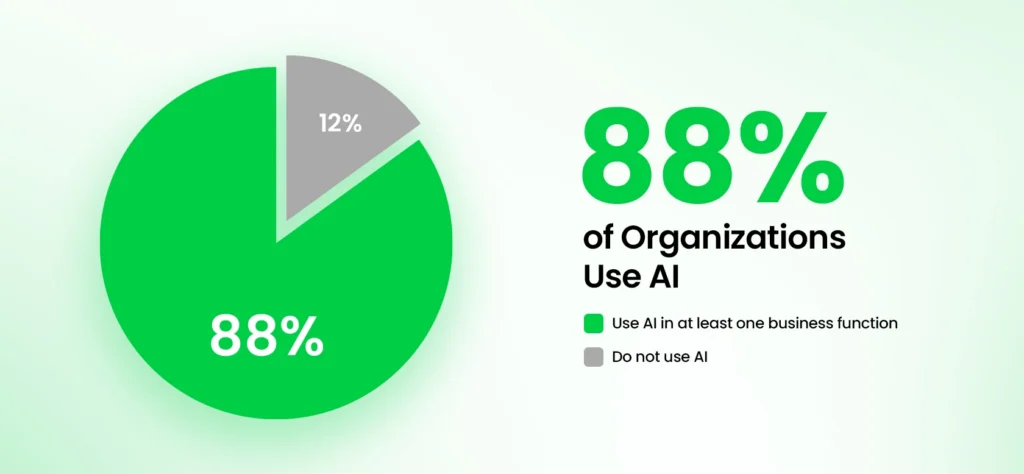
The stakes are rising because AI adoption is already widespread. McKinsey’s latest State of AI research reports that 88% of organizations use AI in at least one business function, but many are still working through the harder problem of moving from pilots to scaled business impact. That gap is exactly why the build-or-buy decision matters. Choosing the wrong path can leave a business with a tool that is fast but shallow, or a custom build that is powerful but premature.
The better question is not, “Should we build AI or buy AI?”
It is: What does this AI solution need to prove, connect with, protect, and improve?
In this guide, we will compare custom AI development and off-the-shelf AI solutions across cost, speed, scalability, data privacy, workflow fit, integrations, ownership, and long-term product value. We will also look at when a hybrid approach makes more sense, especially for teams working with an AI development company to turn an unclear AI idea into a practical product roadmap.
Custom AI Development vs Off-the-Shelf AI Solutions: What Is the Difference?
Custom AI development means creating an AI solution around a specific product, workflow, dataset, user experience, or business process. It may involve generative AI development, machine learning models, RAG systems, fine-tuning, open-source models, APIs, data pipelines, AI agents, or custom software layers.
Off-the-shelf AI solutions are ready-made AI tools, platforms, APIs, or SaaS products built for common use cases. They usually come with a predefined interface, standard features, vendor-managed infrastructure, subscription pricing, documentation, updates, and support.
The difference is not only whether the technology is custom or prebuilt. It is how much control the business has over the AI system’s behavior, data access, workflow logic, user experience, integrations, and long-term direction.
| Factor | Custom AI Development | Off-the-Shelf AI Solutions |
| Product fit | Designed around a specific product or workflow | Designed for broad use cases |
| AI components | Models, APIs, RAG, fine-tuning, agents, data pipelines, custom logic | Prebuilt AI features, templates, APIs, and platform tools |
| User experience | Custom interface and product flow | Vendor-defined interface or limited configuration |
| Data use | Structured around selected business data sources | Limited to supported uploads, connectors, or vendor settings |
| Workflow logic | Built around business-specific rules and steps | Based on standard platform behavior |
| Technical control | Higher control over architecture and implementation | Lower control over platform behavior |
| Setup model | Planned, designed, developed, tested, and deployed | Configured, connected, and adopted |
| Ownership | Business controls more of the system and roadmap | Vendor controls more of the product and roadmap |
The distinction between custom software and digital products also applies here. Custom AI development builds around specific requirements, while off-the-shelf AI involves configuring an existing capability for use.
The Better Question Is Build, Buy, or Hybrid AI?
The choice is not always limited to custom AI development or off-the-shelf AI solutions. For many businesses, the better decision is to choose how much of the AI system to buy, configure, integrate, or build.
A business can buy a ready-made AI tool when the need is standard. It can build a custom AI solution when the product, workflow, or data requires more control. It can also take a hybrid AI approach by using existing models, APIs, or AI platforms while adding custom workflows, proprietary data, integrations, and product design around them.
| Approach | What It Means | Best Fit |
| Buy | Use an existing AI tool or platform with standard configuration | Common use cases, quick setup, early adoption |
| Hybrid | Combine existing AI models or platforms with custom data, workflows, interfaces, or integrations | Teams that need speed but also need business-specific control |
| Build | Create a custom AI solution or AI-powered product around specific users, data, logic, and product goals | Strategic workflows, differentiated products, or complex AI requirements |
This matters because many AI projects do not need a full custom build on day one. A team may start with a hybrid approach or AI MVP development to validate the workflow, test user trust, and understand the data before investing in a larger AI product.
The right path depends on what the AI solution needs to prove, particularly when deciding between an AI MVP and full product. If the goal is basic productivity, buying may be enough. If the goal is a product feature, internal system, or workflow that depends on proprietary data and specific user behavior, hybrid or custom development may be the stronger path.
The decision should not start with the model. Comparing AI app builders and human developers can help businesses determine how much technical control their product needs and which development approach makes sense.
When Off-the-Shelf AI Solutions Make Sense
Off-the-shelf AI solutions make sense when the problem is common, the workflow is simple, and the business needs a faster way to test or adopt AI without starting a full custom AI development project.
These tools are useful for standard tasks where the product experience does not need to be deeply tailored.
| Use Case | Why Off-the-Shelf AI Works |
| Meeting summaries | Standard workflow with quick review |
| Basic content drafting | Faster first drafts without custom logic |
| Simple support chatbot | Handles common questions and routing |
| Sales email assistance | Repeatable communication task |
| Internal brainstorming | Low-risk output users can easily judge |
| Basic document summarization | Useful when documents are not highly sensitive |
| AI features inside SaaS tools | Convenient because teams already work there |
Off-the-shelf AI is often a practical starting point. It helps teams determine whether their business is AI-ready, how users respond, and whether the workflow is worth improving further before investing in a more tailored solution.
Where Off-the-Shelf AI Solutions Start to Break Down
Off-the-shelf AI solutions are useful when the task is standard. They start to feel limited when the business needs the AI to follow specific workflows, understand internal context, or support decisions that depend on company data.
1. The Tool Does Not Match the Workflow
Ready-made AI tools are built for broad use cases. They may not fit unique approvals, user roles, exceptions, business rules, or operational steps. When that happens, teams often adjust their process around the software instead of the software supporting the process.
2. The AI Does Not Understand Your Business Data
Generic AI tools may not fully understand internal documents, product details, customer history, policies, or domain-specific language. Without the right access to proprietary data, the output can stay too general to be useful in real work.
3. Integrations Are Too Shallow
Many off-the-shelf AI solutions offer connectors, but a connector is not the same as a working process. The tool may move information between systems, but still fail to support business logic, approval paths, or real-time operational decisions without proper system integration and API automation services
4. Vendor Lock-In Becomes a Risk
The vendor controls pricing, features, model changes, usage limits, platform availability, and the product roadmap. A tool that works well during early adoption can become restrictive when the business needs more control.
5. Data Privacy and Compliance Become Limiting
Sensitive workflows may require stronger control over where data is stored, how it is processed, who can access it, and what gets logged. For U.S. businesses in healthcare, finance, legal, insurance, education, or government-adjacent sectors, vendor limitations can become a serious concern.
6. Costs Increase as Usage Grows
Off-the-shelf AI can look affordable at the beginning. As more users, API calls, premium features, and add-ons are introduced, hidden custom software development costs and recurring vendor expenses can make the long-term budget harder to control.
7. Product Differentiation Is Limited
If competitors can use the same AI tool in the same way, the advantage is limited. The business may improve productivity, but it is less likely to create a distinct product experience or long-term moat.
Off-the-shelf AI is a good starting point until the business needs deeper workflow fit, stronger data control, better integrations, or product differentiation.
Not Sure Whether to Build or Buy AI?
Avoid investing in the wrong solution. Let our experts assess your workflows and recommend an approach that fits your business.
Find My AI Development Approach!When Custom AI Development Makes Sense
Custom AI development makes sense when the AI solution needs to reflect how the business actually works. Businesses often require AI app development services when ready-made tools cannot support their specific product requirements.
This usually happens when the product depends on specific workflows, proprietary data, user roles, business rules, or a customer experience that requires a web app development company to build beyond ready-made tools.
Choose custom AI development when:
- AI is part of the core product experience
- the workflow is unique or operationally complex
- the system needs to use proprietary data
- users need different roles, permissions, or approval paths
- the AI output supports important business or customer decisions
- the solution needs a custom interface or branded product experience
- The business needs more control over how the AI behaves
- the AI system must evolve with the product roadmap
| Business Situation | Why Custom AI Development Fits |
| Building an AI-powered SaaS product | The AI capability is part of the product’s value, not a bolt-on feature |
| Using private business data | The system can be designed around selected documents, databases, permissions, and retrieval rules |
| Supporting complex workflows | Custom logic can match real approvals, exceptions, handoffs, and user roles |
| Creating a customer-facing AI experience | The interface, tone, output format, and user journey can be shaped around the product |
| Building for long-term differentiation | The system can evolve around your own users, data, and operating model |
Custom AI development is not about building the most complex AI system possible. Understanding what digital product development involves helps businesses build around the workflow and the value AI needs to create.
Technical Factors That Shape the Custom AI vs Off-the-Shelf AI Decision
Once the use case is clear, the next question is whether the AI solution can work inside the real conditions of the business. Data privacy, integrations, scalability, and ownership often decide whether an off-the-shelf AI tool is enough or whether a custom AI solution is needed.
1. Data Privacy and AI Compliance
AI systems often touch sensitive information: customer records, internal documents, financial data, healthcare information, legal content, operational policies, or proprietary business knowledge.
When AI operates within mobile products, following mobile app security best practices becomes important for protecting user information.
Before choosing a tool or custom build, ask:
- What data will the AI process?
- Where will that data be stored?
- Who can access the AI output?
- Will the vendor use business data for model training?
- Are audit logs, retention rules, or role-based permissions required?
- Do HIPAA, SOC 2, GDPR, or internal compliance policies apply?
| Security Factor | Off-the-Shelf AI Solutions | Custom AI Development |
| Data storage | Controlled by vendor policy | Designed around business requirements |
| Access control | Limited to platform settings | Custom role-based permissions |
| Audit logs | Depends on vendor plan | Built around operational and compliance needs |
| Data retention | Based on vendor rules | Defined by the business |
| Sensitive data handling | Requires vendor review | Planned from the start |
| Deployment model | Vendor-defined | Cloud, private cloud, or on-premises options |
2. AI Integration and Workflow Fit
AI integration is not only about connecting tools. Effective AI automation services must account for how information moves through the workflow, not just between connected systems.
The real question is whether the AI can work with the systems and decisions users already rely on, such as:
- CRM
- ERP
- CMS
- helpdesk software
- internal databases
- data warehouses
- document repositories
- payment systems
- scheduling tools
- mobile apps
- web apps
- internal APIs
Custom AI development gives more control when the system needs workflow-specific automation, approval flows, role-based access, source-grounded outputs, custom dashboards, real-time data use, or backend API development for deeper integrations.
3. Scalability and Long-Term Ownership
Off-the-shelf AI solutions can scale quickly because the vendor manages the infrastructure. The tradeoff is that the vendor also controls pricing, usage limits, model changes, feature updates, and the product roadmap.
Custom AI development requires more ownership, but it gives the business more control over how the AI system evolves.
| Ownership Question | Why It Matters |
| Who controls the AI roadmap? | Determines how quickly the solution can evolve |
| Who owns the user experience? | Affects adoption and product differentiation |
| Who monitors AI output quality? | Helps prevent accuracy issues over time |
| Who controls usage cost? | Reduces surprise spending as adoption grows |
| Who manages model or workflow updates? | Keeps the product aligned with business needs |
| Who handles failures or escalation? | Critical for customer-facing or operational AI |
A useful AI solution does not end at launch. Poor ownership is among the common reasons digital products fail, making ongoing monitoring and product iteration essential as the business changes.
Custom AI Development vs Off-the-Shelf AI Solutions Cost Comparison
Cost is one of the clearest differences between custom AI development and off-the-shelf AI solutions, but the first price is not the full story. Off-the-shelf AI is usually easier to start because the product already exists.
Custom AI development requires more upfront planning and engineering. Understanding AI-native digital product development costs helps businesses evaluate that investment against the control they gain over the system.
| Cost Area | Off-the-Shelf AI Solutions | Custom AI Development |
| Typical starting cost | $20 to $500+ per user/month | $5,000 to $25,000+ for a focused proof of concept |
| MVP or early product cost | Subscription-based, depending on seats and usage | $25,000 to $80,000+ depending on scope |
| Larger platform cost | Higher-tier plans, add-ons, API usage, and enterprise pricing | $100,000 to $500,000+ for complex AI platforms |
| Setup cost | Configuration, onboarding, and supported integrations | Discovery, UX, architecture, engineering, AI setup, testing, and deployment |
| Usage cost | Based on vendor pricing, seats, credits, or API calls | Based on model choice, infrastructure, caching, and usage planning |
| Maintenance | Usually handled by the vendor | Managed by the business, internal team, or development partner |
| Scaling cost | Can rise as users, usage, or features increase | Can be optimized around actual system usage |
Off-the-shelf AI solutions are cheaper to start, but costs can grow as adoption increases. Custom AI development costs more upfront, but understanding digital product development cost factors helps businesses plan for greater control over architecture and long-term operations.
Timeline Comparison: Which AI Solution Launches Faster?
Off-the-shelf AI solutions usually launch faster because the core product is already built. Teams mainly need to configure the tool, connect supported systems, train users, and adjust the workflow around what the platform allows.
Custom AI development takes longer because the product has to be shaped before it is built, often starting with a discovery sprint to clarify requirements and reduce uncertainty. A realistic app development timeline includes discovery, UX decisions, AI architecture, data preparation, development, testing, deployment, and iteration.
| Stage | Off-the-Shelf AI Solutions | Custom AI Development |
| Initial setup | Days to weeks | Weeks to months |
| Product planning | Limited to tool selection and configuration | Requires product discovery, scope, and workflow definition |
| Data setup | Uploads, imports, or supported connectors | Data preparation, pipelines, permissions, and retrieval logic |
| Integration | Based on available connectors | Custom APIs and system-level integration |
| Testing | User acceptance and vendor settings | Functional, model, security, workflow, and output testing |
| Launch | Usually faster | Usually phased |
| Iteration | Limited by vendor settings and roadmap | Controlled through the product roadmap |
Speed matters, but it should not be the only measure. Off-the-shelf AI wins when the business needs immediate utility. Custom AI development takes longer because the team is building around a specific product, workflow, and operating model.
Know What Your AI Solution Will Cost Before You Build
Get a realistic development estimate based on your product requirements, integrations, technical complexity, and the features your business actually needs.
Get My AI Project Estimate!Custom AI, Off-the-Shelf AI, or Hybrid AI: Use Case Examples
The same use case can require different AI approaches depending on the workflow, data, users, and level of control involved. A basic task may only need an off-the-shelf AI tool. A business-specific workflow may need a hybrid AI approach. A product or operational system may require custom AI development.
1. Customer Support
Use off-the-shelf AI when:
The goal is to answer common questions, reduce repetitive support tickets, or add a simple chatbot to a website without requiring custom NLP development for more complex language processing.
Use a hybrid AI approach when:
The chatbot needs to answer from approved company documents, help center content, policies, or product information through RAG. This may require AI chatbot development that connects responses to business-approved sources.
Use custom AI development when:
Support depends on account context, ticket history, escalation rules, customer segments, analytics, and custom workflows across multiple systems.
2. Healthcare
Use off-the-shelf AI when:
The need is limited to admin productivity, note-taking, summarization, or low-risk internal assistance.
Use a hybrid AI approach when:
The AI assistant needs controlled access to approved knowledge resources, internal documents, or defined staff workflows.
Use custom AI development when:
The system supports patient or staff workflows that require HIPAA-aware design, access control, audit logs, human review, and compliance-specific safeguards.
3. SaaS Product
Use off-the-shelf AI when:
The product only needs a generic AI writing, chat, search, or summarization feature.
Use a hybrid AI approach when:
The AI feature needs a branded experience, foundation model APIs, product-specific data, and controlled responses inside the existing SaaS platform. Some products also require mobile app development to deliver that experience across devices.
Use custom AI development when:
The core product value depends on proprietary workflows, user behavior, custom product logic, AI-driven recommendations, or differentiated user experiences.
Business Operations
Use off-the-shelf AI when:
The task is simple, repeatable, and does not require deep integration with internal systems.
Use a hybrid AI approach when:
The AI assistant needs to connect with CRM, ERP, documents, databases, or internal tools. Similar requirements arise when AI-powered mobile apps improve operations using existing models and business-specific integrations.
Use custom AI development when:
The workflow includes multiple steps, approvals, exceptions, reporting, system updates, and role-based actions that may require business process automation services to maintain accountability across departments.
The pattern is clear: off-the-shelf AI works when the task is simple and standard. Hybrid AI works when the business needs context without a full custom build. Custom AI development works when the solution must become part of the product, workflow, or operating model.
Decision Framework for Choosing the Right AI Development Solution
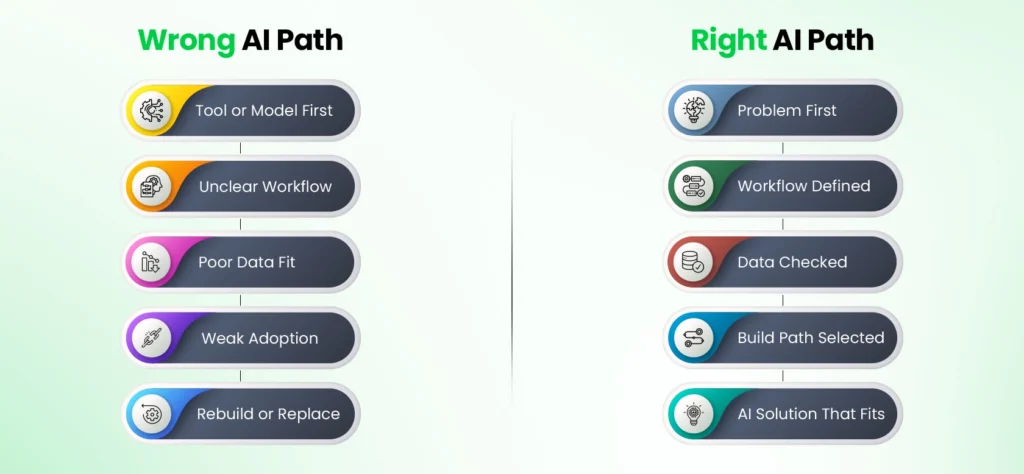
Choosing the right AI development solution is not just a build-or-buy decision. It depends on how much control your business needs over the workflow, data, user experience, security, integrations, and long-term product direction.
Before choosing custom AI development, off-the-shelf AI solutions, or a hybrid AI approach, use this framework to narrow the decision.
1. Define the AI Use Case
Start with the problem before comparing tools or development options.
Ask:
- What problem should the AI solution solve?
- Is the workflow simple, repeatable, or unique?
- Is this an internal productivity need or a customer-facing product capability?
- What measurable improvement should AI create?
2. Review the Data Behind the AI Solution
AI quality depends heavily on the information the system can access and use. For predictive applications, machine learning development also depends on having sufficient historical data to support reliable results.
Ask:
- Does the AI need proprietary business data?
- Is the data structured, unstructured, or spread across multiple systems?
- Is the data sensitive, regulated, or difficult to prepare?
- Will the solution need RAG, fine-tuning, data pipelines, or custom permissions?
3. Map the Workflow and User Experience
The right AI development path depends on where AI fits inside the actual user journey.
Ask:
- Will users rely on the AI output for important decisions?
- Does the process include approvals, exceptions, or role-based actions?
- Does the AI need to work inside an existing product, dashboard, CRM, ERP, or mobile app?
- What happens if the AI produces the wrong answer?
4. Choose the Build Path
Once the use case, data, and workflow are clear, the build path becomes easier to evaluate.
Ask:
- Can an existing AI platform handle the first version?
- Would a hybrid AI approach help validate the idea faster?
- Do we need a custom user experience or deeper system integration?
- Who will monitor, maintain, and improve the AI solution after launch?
| If This Is True | Lean Toward |
| You need something live quickly | Off-the-shelf AI solutions |
| The workflow is simple, common, and low-risk | Off-the-shelf AI solutions |
| You need some customization but not a full custom build | Hybrid AI approach |
| You need proprietary data inside the AI system | Hybrid AI or custom AI development |
| The AI affects customer experience | Custom AI development |
| The workflow includes approvals, exceptions, or role-based actions | Custom AI development |
| Security or compliance requirements are strict | Custom AI development or controlled hybrid AI |
| You need to prove value before investing heavily | AI MVP or hybrid AI approach |
| The product must create differentiation | Custom AI development |
Businesses can follow a structured AI MVP development process to test a critical workflow before committing to a larger custom build.
The best AI implementation strategy is the one that proves value with the least unnecessary complexity. Start with the use case, understand the data, map the workflow, then choose whether to buy, customize, or build.
Common Mistakes in the Custom AI vs Off-the-Shelf AI Decision
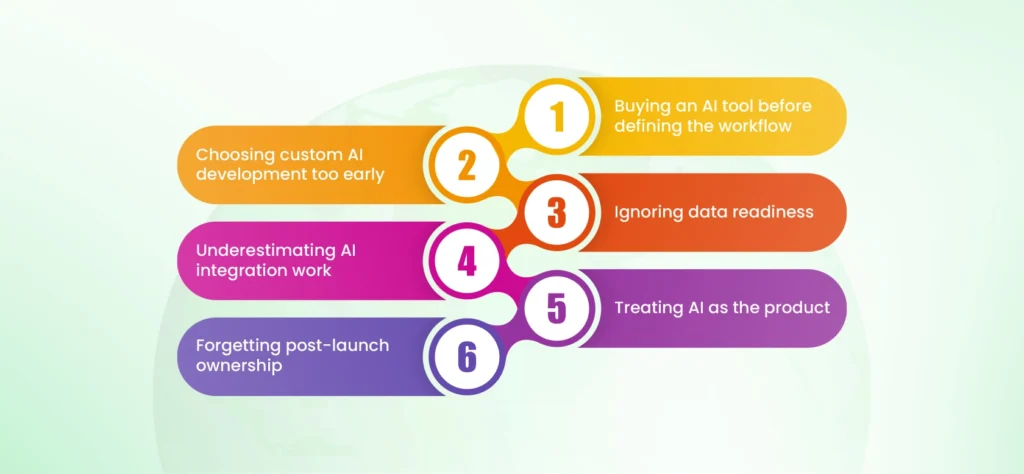
The wrong AI path is usually chosen when teams rush into tools, models, or development before understanding the product and workflow behind the AI solution. These common mistakes when building AI apps create wasted budgets, weak adoption, and systems that look useful in demos but fail in real use.
Common mistakes include:
- Buying an AI tool before defining the workflow
The tool looks useful, but the team has not decided where it fits or what process it should improve. - Choosing custom AI development too early
The business invests in a custom build before validating the problem, users, data, or success metric. - Ignoring data readiness
The AI plan assumes clean and useful data, but the actual documents, databases, and internal knowledge are incomplete or disconnected. - Underestimating AI integration work
The model works, but the solution does not connect properly with systems, permissions, user flows, or business rules. - Treating AI as the product
The team focuses on the AI feature instead of the workflow, interface, decision process, and user outcome around it. - Forgetting post-launch ownership
No one is clearly responsible for monitoring output quality, usage cost, user feedback, model behavior, and improvement priorities.
The safest decision is not always to buy or build. It is to choose the path that proves the AI solution can create value before the business commits more time, cost, and complexity.
How a Digital Product Studio Makes the AI Decision Clearer
A digital product studio does not start by asking whether you should build custom AI. It starts by separating the AI idea into four decisions:
1. Use Case
What problem is worth solving?
2. Workflow
Where should AI fit into the user journey?
3. Data
What information does the AI need to produce useful output?
4. Build Path
Should the solution be bought, integrated, customized, or built from scratch?
This is where the custom AI vs. off-the-shelf AI decision becomes clearer. If the need is standard, buying may be enough. If the workflow needs business context, a hybrid approach may be smarter. If the product depends on proprietary logic, user experience, or deeper control, custom AI development may be the right path. For complex processes involving autonomous decisions, AI agent development may also become necessary.
At Inceptives Digital, we help teams turn broad AI ideas into product decisions: what to test first, what to avoid, what to connect, and what to build only when the value is clear. For existing products facing technical limitations, product rescue scaling can help address those constraints before expanding AI capabilities.
Final Recommendation on Custom AI Development vs Off-the-Shelf AI Solutions
The right choice depends on what the AI solution needs to become.
Choose off-the-shelf AI solutions when the task is standard, the risk is low, and the business needs speed more than control.
Choose a hybrid AI approach when existing models or platforms can support the first version, but the workflow still needs proprietary data, product-specific context, or custom integration.
Choose custom AI development when AI is central to the product experience, the workflow is unique, the data is business-specific, or the solution needs to create long-term differentiation.
The smartest AI decision is not to build the most advanced system. Businesses planning to build a profitable AI app should choose an approach that fits their users and delivers measurable product value.
Frequently Asked Questions About Custom AI Development vs Off-the-Shelf AI Solutions
Custom AI is better when you need control, differentiation, proprietary data, or deep integrations. Off-the-shelf AI is better when the use case is common, low-risk, and speed matters most.
A business should choose off-the-shelf AI solutions when it needs quick deployment, lower upfront cost, vendor-managed maintenance, and support for a standard workflow such as drafting, summarization, basic support, or productivity.
A business should choose custom AI development when AI is part of the core product, the workflow is unique, the data is proprietary, or the solution needs stronger control over security, integrations, and user experience.
A hybrid AI approach combines existing AI models or platforms with custom workflows, proprietary data, integrations, and product experience. It is often useful when businesses need both speed and control.
Custom AI development usually costs more upfront because it requires discovery, design, engineering, integration, testing, and maintenance. It can create stronger long-term value when the AI solution supports a core workflow or replaces multiple tools.
Yes, but usually within vendor-defined limits. Many ready-made AI tools allow prompts, templates, connectors, knowledge bases, and configuration, but may not support deeper workflow logic or architecture control.
Validate the problem, target users, workflow, available data, success metrics, security needs, and whether AI creates a meaningful improvement over existing tools or automation.
Many startups should start with the smallest version that proves user value. That may be an off-the-shelf AI tool, a hybrid prototype, or a focused AI MVP before investing in full custom AI development.
Custom AI development creates an AI system around your specific workflows, data, users, and business rules. Off-the-shelf AI solutions are prebuilt tools designed for common use cases with limited setup.