
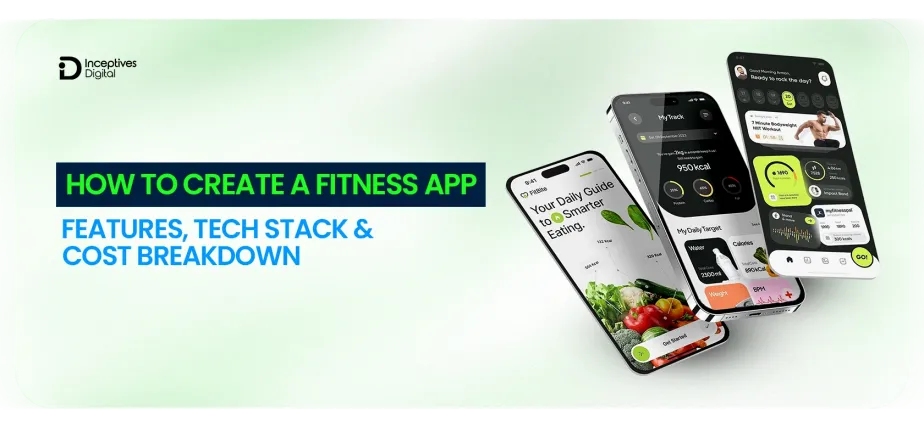

The way people practice fitness and wellness has undergone remarkable changes, with mobile apps being the main players in daily health routines. The current fitness applications guide the users in logging their workouts, suggesting meal plans, monitoring progress, and personalizing workout schedules through their smart phones. As the fitness app market is predicted to surpass $23.98 billions in 2026, indicates massive opportunities for fitness entrepreneurs, startups, and established businesses as well. Building a fitness app for your business helps you capture a wider audience and caters to the modern tech-savvy user’s requirements.
However, building a successful fitness app is not as simple as it may seem. Success depends on understanding the latest trends, core features, the right tech stack, and accurate cost planning, which are fundamental aspects most apps fail to address.
To help you navigate this, we’ll break down this blog into what it takes to build a fitness app that users adopt and continue to use, from key features to monetization strategies, and everything in between. You can also get help from a reliable fitness app development company to make the process easier and more effective.
Stay connected to discover how to create a fitness app, its characteristics, cost estimate, and tech stack that will attract users and generate a profit for your business.
Have a Fitness App Idea? Let’s Shape It Into Something People Use Daily
Ready to turn your fitness app idea into reality? Partner with Inceptives Digital for seamless development, cutting-edge features, and rapid deployment.
Get Started TodayWhy Fitness Apps Are in High Demand Today?
Fitness apps have facilitated the entire process of attaining health and wellness goals for users. Today’s users enjoy the luxury of managing their exercise, diet planning, and monitoring success through their smartphones anytime and anywhere. The future will witness the extension of fitness apps further due to the rapid emergence of wearables, AI integration, and greater health consciousness. According to a recent survey, almost 58% of mobile app users keep apps related to fitness and health installed on their devices.
Sustained demand mainly gives an advantage to users, as fitness apps have extended their usefulness beyond only tracking. They provide a means for users to remain inspired, form a habit of exercising regularly, and motivate users to manage their health in a personalized manner with insights and guidance based on data. Hence, fitness apps have transformed from being non-obligatory tools to being essential partners for the people who care about long-term health.
Top Trending Fitness App Ideas for Your Next Big Launch
The fitness and wellness market is evolving rapidly, due to technology that is transforming how individuals tackle the issue of health. Nowadays, digital tools are making workouts more personalized and interactive as users are turning to these apps for their constant motivation and guidance. These shifting user behaviors are providing opportunities for businesses. Below, we have listed some of the best fitness mobile app ideas that can skyrocket your revenues.
AI-powered Home Workout Apps
AI-powered home workout apps are one of the top trending fitness app ideas, offering workout plans based on users’ goals, fitness level, and the available equipment at home. For example, Freeletics and Fitbod. These applications enhance flexibility and provide behavioural support through progress tracking and timely reminders, keeping users well-motivated throughout their fitness journey.
Meditation and Mindfulness Apps
Meditation and mindfulness applications highlight mental wellness as a central element of absolute fitness. These apps not only reduce stress but also enhance concentration and foster the adoption of healthier daily practices as users increasingly realize the mental-physical health connection. By offering various features like guided meditation sessions, breathing exercises, sleep support, and mindfulness reminders, apps like Headspace and Calm have turned into essential tools for creating balance, consistency, and enduring mental wellness.
Nutrition & diet planner apps
Nutrition and diet planner applications support individuals in managing their dietary habits and adjusting their food intake to particular health objectives. The widely used applications MyFitnessPal and Cronometer enable users to log calories, keep an eye on nutrients, and be on a custom meal plan according to their way of life. These apps help to justify daily food selections into practical information, which, in turn, leads to improved diet, stronger adherence, and gradual milestones in achieving fitness and health goals.
Gamified Fitness Apps
Gamified fitness applications utilize game mechanics to transmute workouts into fun experiences. Applications like Strava and Zombies keep users motivated with the help of challenges, rewards, leaderboards, and social sharing features. These apps, by fostering competition, progress tracking, and a sense of achievement, make fitness enjoyable and rewarding instead of making it a monotonous exercise, and thus, help the user to sustain the habit over a long period.
Gym Workout Apps
The organized gym workout apps, like Nike Training Club and JEFIT, are preferred by users who need guided fitness training. These apps allow users a variety of workout plans, videos to correct the postures, personalized training, and progress tracking for users to achieve goals and measurable results.
Voice-Enabled Personal Training Apps
Voice-assisted personal training applications, like the Vi Trainer, are expected to rank among the top ideas due to their non-contact and interactive features. These workouts offer the user a specialized coach who customizes the user’s training depending on their capabilities, keeps an eye on their growth, and allows them to continue training during the fitness session without any disruption.
Not Sure Which Fitness App Idea to Build? Let’s Figure It Out
Not sure which fitness app idea to pursue? We help you pick the one with the most potential and turn it into a user-loved app.
Let’s Pick Your Fitness App IdeaStep-by-Step Process to Build a Fitness App
The development of an ideal fitness application is way more than just writing code, but an opportunity to provide users with the opportunity to constantly monitor their health in a fun and convenient way. Having a good knowledge of fitness app development makes it easy to understand what kind of application suits your business requirements, target audience, and development budget. Choosing the right application results in higher user satisfaction and beating your competitors, thus results in generating millions for you.
Let’s see what the steps are to develop a successful fitness application that stands out in the market.
1. Ideation & market research
Each fitness app starts with a strong concept. To begin with, conduct extensive research on the fitness app market, your potential competitors, and the target audience. This process will clarify the design requirements, core features, budget, and a well-defined plan for your entire fitness app development process.
2. Wireframing & prototyping
Before you begin designing your app, make some wireframes and prototypes first to clarify the structure of the app. This step helps you to ensure that the important features like workout tracking, diet charts, and feedback systems are placed logically, hence providing a good experience for users while also giving you the chance to modify the functionalities early on.
3. Design & UX implementation
The success of a fitness app highly relies on its user-friendly and entertaining interface. With the use of tools like Figma, Adobe XD, UXPin, Xcode, MockFlow, or Uizard, the design of user-friendly navigation and interaction is made easy. These help you to design features that allow users to track their workouts, log their meals or monitor their meditation practices without any difficulty.
4. Backend development & API integration
The backend is the heart of your fitness app that takes care of the main functions like storing data, managing users, keeping track of progress, and connecting to different health and fitness services. By selecting the proper technology, you can guarantee that your app will not only operate without any issues but also provide support for individualized features and give the users a trustworthy experience.
5. Testing & QA
QA makes it possible for your fitness application to function properly and reliably so that users do not notice any disruptions. This process includes finding bugs and fixing them, carrying out performance testing, and checking that all the features work as they were designed to. Testing in great detail not only prevents bugs but also increases stability and keeps users satisfied.
6. Deployment to App Store & Google Play
After you have finished testing your app, launch your app on the App Store and Google Play. Make sure to improve your store listing with understandable descriptions, pictures, and important keywords to get to your desired users, for instance, fitness fans, and promote downloads.
7. Post-launch support & updates
The process of your app development doesn’t end at launch. Update your app regularly, enhance features, and fix bugs to keep your fitness app engaging, relevant, and aligned with user needs. Continuous support and updates also help in improving retention, maintaining motivation, and building a loyal user base.
Key Features to Include in a Fitness App

A fitness app’s effectiveness depends on features that guide users throughout their fitness journey. A proper mix of essential and advanced fitness app features makes the app user-friendly, promotes user interactions, and improves user retention. The following features are basic requirements for every modern fitness app development:
Core Features
The following core features are the essential parts to develop your fitness application as they provide user-friendly, high-performing, and engaging solutions that are consumed by users every day.
- User Registration & Profile Management
This feature allows users to safely sign up, handle their personal information, list down fitness aims, and pick their preferences for the ultra-personalized experience.
- Workout Tracking & Progress Monitoring
Users can keep a log of their workouts, track their daily activity, view their performance growth using graphs, and also assess their exercise.
- Nutrition Tracking & Meal Planning
Users can track their nutrition, control their calories, and stick to personalized meal programs with their fitness objectives.
- Goal Setting & Reminders
The user can set realistic health goals and receive notifications to keep them consistent in the long term.
Advanced Features
The following advanced features elevate a fitness app by providing smarter, more interactive functionality that keeps users engaged and motivated.
- AI-Powered Personal Workout Plans
AI functionalities in fitness applications can be responsible for building exercises, which are personalized according to the user’s daily routine, physical condition, and aims.
- Gamification & Social Aspects
Create challenges, leaderboards, rewards, and sharing of users’ socials to make workouts community-driven and fun.
- Wearable Gadget Compatibility
The connection with Apple Watch, Fitbit, and other wearables is so smooth that real-time fitness data synchronization is possible.
- Push Notifications & User Engagement Tools
Constantly keeps the users active and engaged by sending notifications, encouraging messages, and reminding them about workouts at the right times.
In addition, features like offline mode, geo-location, and analytics & tracking significantly improve the app’s performance by ensuring accessibility, providing location-based experiences, and offering data-driven insights for continuous improvement.
The next most critical thing you should consider while creating a fitness app is choosing the right tech-stack for a fast and scalable app.
The Tech Stack Blueprint for a Top-Notch Fitness App Development
Selecting the right tech stack is the foundation for building a fitness application with a performance that is fast, scalable, and easy to maintain. The following points outline the essential components of the development of a perfect fitness application:
Frontend Development
The frontend is what users interact with, and selecting the right framework is key. Popular options include:
- React Native: It facilitates cross platform app development that uses a single codebase, hence reducing both time and cost for development.
- Flutter: The app runs very smoothly with no lags or stops during the animations, which makes the app attractive.
- Native (iOS/Android): Outstanding performance and incorporation of device features for targeted applications.
Backend Development & Database
Backend development is the primary layer on which your fitness app will be built, thus operating the data capture, user control, and execution of server-side logic functions. The related technologies used are:
- Node.js or Python for highly effective server-side development.
- MongoDB or PostgreSQL for database management that is safe, trustworthy, and adaptable.
API Integrations
APIs increase app features and seamless connections with external services. In these fitness apps, Google Fit and Apple Health are the common integration examples that monitor workouts and sync data with the user’s device. Moreover, the payment gateways are also used to manage subscription plans and in-app purchases. Together, these features impact performance and scalability, that lead to another critical aspect, which is understanding fitness app development cost.
Cost Breakdown of Fitness App Development
- Basic Fitness Apps: Such apps are typically seen as MVPs or early products priced from $30,000 to $80,000 with basic features like workout tracking, food intake logging, and goal setting.
- Advanced Fitness Apps: The price of those apps that have AI workouts, gamification, wearable integration, and push notifications are up to $100,000-$250,000+.
- Ongoing Maintenance: The annual expense for continuous updating, server hosting, and performance improvement is around $5,000 to $50,000+ (which is about 15–20% of the initial production cost).
- Monetization Costs: The cost for setting up subscriptions, in-app purchases, or ads is between $3,000 and $15,000+, but such an operation will have a positive impact on the company’s revenues in the long term.
| Category | Description | Estimated Cost |
| Basic Fitness Apps | MVP or early-stage apps with core features like workout tracking, food logging, and goal setting. | $30,000 – $80,000 |
| Advanced Fitness Apps | Apps with AI workouts, gamification, push notifications, and wearable integration. | $100,000 – $250,000+ |
| Ongoing Maintenance | Annual expenses for updates, server hosting, and performance improvements (approx. 15–20% of initial cost). | $5,000 – $50,000+ |
| Monetization Costs | Setting up subscriptions, in-app purchases, or ads to generate revenue long-term. | $3,000 – $15,000+ |
After comprehending the development and maintenance costs correctly, the next task is to devise monetization strategies that will make your fitness application a revenue generator.
8. Monetization Strategies for Fitness Apps
Choosing the right revenue model for apps is key to deciding the fate of your fitness app as a money-making business or not. Choosing the wrong revenue model can make your app development cost very high and badly affect your ROI.
- Subscription Plans: Grant users the option to subscribe to premium features and content on a monthly or yearly basis.
- Freemium Model & In-App Purchases: Provide users with free access to basic functionalities, while charging for advanced features or content.
- Ads & Sponsorships: Generate revenue through targeted ads or brand partnerships.
- Premium Features & Personalized Coaching: Offer one-on-one coaching, exclusive workouts, or advanced tracking tools for paying users.
Once we have our monetization strategy, it’s time to plan a strategy for user engagement and customer loyalty.
Tips to Ensure User Engagement & Retention
The users’ retention and the long-term success of fitness apps depend heavily on user engagement as a major factor.
- Gamification & Challenges: The app will be more lively through users receiving rewards in the form of badges, challenges, getting their names on the leaderboard, and more.
- Push Notifications & Reminders: Users would be informed about taking workouts, meals, or meditation sessions less effectively through the reminders.
- Personalized Workout Plans: Users will get different workouts tailored according to fitness levels and goals.
- Social Sharing & Community Building: The users can not only share their accomplishments but also invite others to be supported and motivated in the community.
Consideration of all these user engagement tactics during the app development and launch period of your fitness app, so that the users can enjoy the benefits of loyalty and a successful launch.
Wrapping Up
The development of a demanding fitness application does not only involve programming. It is a matter of integrating the suitable features, a user-friendly UI/UX design, powerful technology, and good monetization to provide actual value to the consumers. If you conduct a meticulous plan for each phase from ideation and market study through development, launch, and continuous engagement, you will have an app that draws users, retains their motivation, and creates revenue that is sustainable over time.
Partnering with an experienced mobile app development company ensures your app not only meets modern user expectations but also stands out in a competitive market. With the right strategy and execution, your fitness app can become an indispensable tool for users while driving growth for your business.
Maximize Engagement & Retention With Your Fitness App
Ensure your fitness app keeps users motivated and coming back. Work with Inceptives Digital to implement advanced features and engagement strategies.
Build Your App NowFrequently Asked Questions (FAQs)
The fitness app development cost usually ranges between $30,000 to $250,000+, based on the app features, platform selection, complexity, and personalization level.
The following are the key factors that might affect your fitness app development cost:
UI/UX design complexity
App features
Platform selection
Backend infrastructure
Security requirements
Ongoing maintenance needs
For fitness applications, the development timeline is up to 3-4 months, and apps with advanced features like AI integrations and customization typically need 6-9 months or may be more.
Absolutely, if you are going to launch your app on a single platform, such as iOS OR Android, it can significantly lower the starting cost and timeline of development. These apps can be ideal for early market validation and MVPs.
You can ensure your app budget and timeline by specifying your app requirements, using an agile method for development, and partnering with an experienced development team that focuses on performance as well as scalability.
