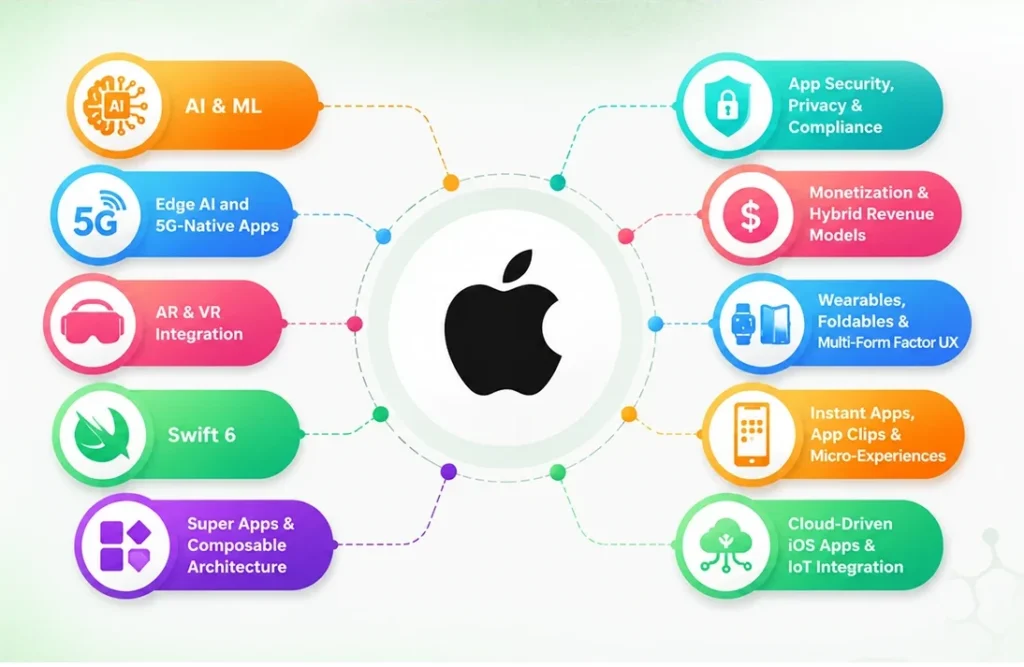
- AI and on-device machine learning are making iOS apps faster, more personalized, and less dependent on cloud processing.
- Edge AI and 5G help reduce delays in gaming, streaming, and real-time applications.
- AR and VR are creating new opportunities for interactive shopping, education, and immersive experiences.
- Swift 6.4 helps developers build more reliable iOS apps and manage complex workloads.
- Super apps combine multiple services, while modular architecture makes future updates easier.
- Security, user privacy, and data protection remain essential for iOS app development in 2027.
- Subscriptions, in-app purchases, and freemium models give businesses different ways to generate revenue.
- Apple Watch and other supported devices require consistent app experiences across screen sizes.
- App Clips let users access specific features without downloading the complete application.
- Cloud services and IoT connect devices and support real-time data sharing.
Are you curious to find out what the major trends in iOS app development will be in the future? The market is already showing signs of what’s coming up next. The iOS app market continues to offer significant opportunities for businesses. According to Apple’s June 2026 report, the global App Store ecosystem facilitated $1.4 trillion in developer billings and sales in 2025, including $149 billion from digital goods and services. It implies that iOS remains one of the premier platforms for digital goods. The expanding market obliges every iOS app development company to come up with more innovative ideas, better user experiences, and smart technologies to attract high-value customers and to stay competitive.
Surpassing the already ruling players of the mobile app market requires being one step ahead of them. To do so, it is important to keep track of the latest iOS app development trends and apply them to enhance your app’s performance, engagement, and user retention. Adopting the latest trends and technologies is the key aspect in maximizing your App Store visibility and user attraction.
Looking for the latest iOS app development trends that you are missing out on? There is no need for hassle. We have composed this guide to help you identify the trends that your iOS application is lacking and how to implement them. Let’s move on to the trends shaping iOS development today.
Top iOS App Development Trends To Follow
The iOS ecosystem is evolving with new iOS app frameworks, AI-powered features, and improved system capabilities. The following iOS app development trends highlight the technologies and practices that are shaping how modern iOS apps are being built.
Trend 1: AI & On-Device Machine Learning (ML)
Personalization powered by AI is one of the leading iOS app development trends, enabling iOS apps to provide real-time, user-adaptive experiences. The on-device ML technology allows iOS apps to run directly on devices without relying on cloud servers, which leads to faster responses, better privacy, and smarter interactions.
Industry Impact: AI is drastically changing iOS app workflows, where developers can use machine learning development services to analyze data, predict user demand, and offer customized interfaces. Looking toward 2027, on-device intelligence is expected to remain important for applications that need faster processing, privacy, and personalized interactions. Businesses can also explore AI-powered mobile app development strategies to understand how intelligent features support everyday operations.
Example: The uptake of predictive analytics in iOS apps is now capturing micro-behaviors and adjusting the user interface, helping businesses increase engagement and retention without compromising privacy.
Trend 2: Edge AI and 5G-Native Applications
Edge AI and 5G are transforming app experiences, enabling faster, smarter interactions for users. By leveraging these technologies, iOS app development trends are shifting toward real-time processing, reduced latency, minimized cloud dependency, and ultra-fast, seamless app performance.
Industry Impact: Edge computing allows iOS applications to process selected tasks closer to the user instead of relying entirely on distant cloud servers, while backend API development supports communication between applications and connected services. Combined with 5G connectivity, it can reduce latency and support responsive experiences in gaming, streaming, augmented reality, and real-time analytics. Actual performance depends on device capabilities, network conditions, and application design.
Example: Edge AI and 5G are the main drivers of apps such as live AR experiences and real-time analytics dashboards that require high-speed interactions to provide smooth, lag-free experiences while keeping minimum operational costs.
Trend 3: AR & VR / Spatial Computing Experiences
Augmented Reality (AR) and Virtual Reality (VR) are reshaping the iOS landscape as standout iOS app development trends, transforming interface experiences for end users and enabling AR app development through spatial computing to interact with the real world, and opening new possibilities for gaming, teaching, shopping, and enterprise solutions.
Industry Impact: AR and spatial computing are creating new ways for businesses to engage users through interactive shopping, immersive learning, product visualization, and simulation, with interactive prototyping helping teams test these experiences before development. As these technologies develop, iOS applications can offer richer experiences through compatible Apple devices. Businesses should focus on use cases where spatial interaction provides a clear advantage over traditional interfaces, while considering the cost of augmented reality development before investing in these features.
Example: Retail apps are making it possible for users to virtually try on products or see how the furniture in their home looks through the use of AR, while, on the other hand, in education, VR app development is offering interactive simulations for better learning outcomes.
Trend 4: Swift 6 in iOS Applications
Swift continues to be a core programming language for building native applications across Apple’s platforms. Swift 6.4, released in September 2026, introduced further improvements to development tools, performance, memory safety, and interoperability.
Industry Impact: These improvements help developers build and maintain complex applications with more reliable code and modern development workflows. For businesses planning iOS applications in 2027, adopting supported Swift tools and maintaining code quality can reduce technical problems and simplify future updates. Existing applications facing performance or maintainability issues may also benefit from product rescue scaling.
Example: For iOS apps that manage heavy data processing, such as real-time analytics or multimedia operations, Swift 6’s improvements will ensure smoother performance, faster response times, and a more reliable user experience.
Trend 5: Super Apps & Composable Architecture
Super apps and composable architectures are emerging as important iOS app development trends, combining various services such as messaging, shopping, payments, and social networking while providing seamless transitions from one service to another. Moreover, composable architecture allows developers to invent applications with great scalability and flexibility by using modular components.
Industry Impact: Demand for integrated digital experiences is encouraging businesses to bring services such as payments, shopping, communication, and customer support into unified applications. Super apps are particularly established in Asian markets, while modular architecture and system integration API automation help developers connect services and introduce new features without rebuilding the entire platform. In 2027, businesses can explore these approaches where combining services genuinely improves convenience and retention. Understanding native versus cross-platform app development can also help when deciding how to support multiple operating systems.
Example: Companies integrating a variety of functions like payment, processing, e-commerce, and customer retention into one application. Customers can perform multiple functions without switching between different apps.
Is Your iOS App Keeping Up With New Technology?
Find out which AI, AR, and performance improvements could benefit your app. Our experts help prioritize upgrades worth investing in.
Explore My iOS App Upgrades!Trend 6: App Security, Privacy & Compliance
As iOS apps continue to collect increasing amounts of user data, security and privacy have become a critical iOS app development trend. Developers must adhere to regulations like GDPR, CCPA, and Apple’s App Tracking Transparency to protect user information.
Industry Impact: Data breaches, unauthorized access, and privacy violations can expose businesses to financial losses, legal consequences, and reduced customer trust. As iOS applications handle more sensitive information, developers need secure authentication, encryption, careful permission management, and ongoing vulnerability testing. Following mobile app security best practices can help teams address these requirements throughout development. Privacy and security should remain part of application planning throughout 2027, particularly in healthcare app development, finance, and other regulated industries.
Example: Apps now integrate end-to-end encryption, secure authentication, and real-time monitoring to protect sensitive data and ensure compliance with privacy regulations.
Trend 7: Monetization & Hybrid Revenue Models
Hybrid revenue monetization strategies have become a key iOS app development trend, with apps increasingly combining subscriptions, in-app purchases, ads, and freemium models to maximize revenue streams and cater to diverse user preferences. This approach allows developers to balance monetization with user satisfaction while adapting to changing market demands.
Industry Impact: Combining subscriptions, in-app purchases, advertising, and freemium access can give businesses more flexibility in how they generate revenue. However, the effectiveness of each model depends on user expectations, app category, and purchasing behavior. Businesses developing iOS applications for 2027 should test monetization approaches against retention and customer satisfaction rather than relying on a single revenue model. This is where post-launch analytics iteration helps businesses evaluate revenue performance and user behavior.
Example: Game apps offer free-to-play levels with in-app purchases, while productivity apps combine subscription plans with optional one-time upgrades. Additionally, lifestyle apps may integrate ad-supported free versions alongside premium tiers to reach a wider audience while generating steady revenue.
Trend 8: Wearables, Foldables & Multi-Form Factor UX
Expanding beyond iPhones, iOS apps are increasingly designed for wearables, foldable devices, and other form factors, making multi-device compatibility a key iOS app development trend. Developers must create adaptable, responsive user experiences that work seamlessly across different devices.
Industry Impact: Wearable technology continues to expand opportunities for connected mobile experiences, particularly in fitness applications where wearable fitness app integration strategies help connect activity tracking across supported devices. For 2027, businesses developing health, fitness, and lifestyle applications should consider consistent experiences across iPhone, Apple Watch, and other supported devices, making UI/UX design important for adapting interfaces to different screen sizes.
Example: Fitness app tracks workouts across iPhone and Apple Watch, while media apps adjust layouts for foldable devices to provide seamless experiences.
Trend 9: Instant Apps, App Clips & Micro-Experiences
Lightweight app experiences, such as App Clips, are emerging as an important iOS app development trend, enabling users to access key app features without downloading the full application. These micro-experiences reduce friction, improve engagement, and provide instant value to users.
Industry Impact: App Clips allow users to complete specific actions without installing a full application, helping businesses simplify first-time interactions. When encouraging users to install the complete app, avoiding common App Store optimization mistakes can help improve its presentation to potential users. They are useful for quick payments, ordering, booking, and accessing location-based services. In 2027, these lightweight experiences can remain valuable for businesses looking to reduce onboarding friction and introduce users to their broader applications. A clear product launch strategy can help businesses plan that transition.
Example: Retail apps allow users to make quick purchases or book reservations via App Clips without installing the full app. Similarly, transport apps let users unlock bikes, scooters, or rental cars instantly, while restaurants enable instant ordering or table reservations, improving overall convenience and engagement.
Trend 10: Cloud-Driven iOS Applications & IoT Integration
Integrating cloud services and IoT development is transforming how apps operate, enabling seamless interaction across multiple devices and real-time data analysis for smarter decisions. These capabilities are among the most significant iOS app development trends, empowering developers to enhance both user experience and operational efficiency.
Industry Impact: Cloud connectivity and IoT integration help businesses synchronize information across devices, monitor connected systems, and analyze real-time activity. These capabilities are particularly useful in smart homes, healthcare monitoring, logistics, and industrial applications. For example, IoT integration in healthcare applications enables connected devices to share information for monitoring and care-related workflows. As businesses plan for 2027, secure data exchange, reliable connectivity, and scalable infrastructure will remain important considerations for connected iOS experiences.
Example: The smart home apps allow the user to control all lights, the thermostat, and the security systems through a single iOS interface. These Cloud analytics enable companies to analyze interactions and usage trends across different devices, enhancing features, performing predictive maintenance, and providing personalized experiences.
Have an iOS App Idea for Your Business?
Turn your idea into a development plan with the right features, technology stack, and budget based on your business goals.
Plan My iOS App!Emerging Challenges for iOS App Development
The continuous evolution of iOS app development is making the iOS ecosystem more complex for developers. From device fragmentation to heightened security requirements and cross-platform trade-offs, staying ahead of these challenges is important for developing high-quality apps that meet user expectations.
Below are the key challenges iOS app developers will face, each requiring careful planning and strategic execution:
Device Fragmentation and Compatibility Issues
With the support of more iPhones, iPads, Apple Watch, Vision Pro, and future device types, developers are compelled to work on different screen sizes, chipsets, and modes of interaction. It is becoming increasingly challenging for developers to keep up consistent performance with such a diversity of devices. This makes choosing the right mobile technology important when planning compatibility across different operating systems and hardware.
Maintaining App Security and Privacy
Apple’s privacy policy is getting stricter, and global regulations like GDPR and CCPA are continuously changing. Developers will need permissions, offer secure APIs, encrypt data, and maintain transparency while making the user experience smooth and frictionless.
Performance Optimization Across Devices
The AI model supports real-time rendering and inter-device syncing, and heavy workloads, making it mandatory for apps to perform their best and to keep up within the battery limit. Therefore, developers have to be very careful and precise with performance optimization.
Keeping Up With Rapidly Changing Trends
Integrating AI, 5G app, AR/VR, and IoT requires a constant change and upgrading of tech stacks. Teams that do not keep up with the tech will soon lose to competitors who are quick to adopt innovations.
Testing and Quality Assurance
With apps becoming increasingly complex, thorough testing is critical. Developers must ensure functionality, usability, and performance across multiple devices and OS versions. Automated and manual mobile app testing strategies must work together to catch bugs early and maintain app reliability, which is essential for user trust and long-term success.
Key Stats for Top iOS App Development Trends
| Trend Name | Stats |
| AI & On-Device ML | 88% of businesses adopted AI |
| Edge AI & 5G | 22ms edge processing |
| AR & VR Experiences | $37B app market |
| Swift 6 | 40% used by developers |
| Super Apps & Composable Architecture | 1 in 3 users use a super app |
| App Security, Privacy & Compliance | 70% of apps have advanced security |
| Monetization & Hybrid Revenue Models | 65% of top apps have hybrid revenue |
| Wearables, Foldables & Multi-Form Factor UX | 70M Apple Watch shipped |
| Instant Apps, App Clips & Micro-Experiences | 40% App Clip conversion |
| Cloud-Driven Apps & IoT Integration | 50% of apps use cloud IoT |
How Businesses Can Leverage iOS App Development Trends
iOS app development in 2027 will offer businesses opportunities to enhance user experiences, improve their apps, streamline operations, and stay competitive. However, deciding which technologies to adopt requires careful product strategy consulting to align features with business needs. By adopting modern trends such as AI for customer service, AR for marketing, cloud for storage and computing, voice for interfaces, and device communication with IoT, developers will be able to make applications smarter, faster, and more engaging.
Practical Strategies for Businesses:
- Use AI to deliver real-time personalized experiences and boost engagement.
- Integrate AR/VR for immersive experiences in retail, education, and gaming.
- Leverage cloud and IoT for seamless device connectivity and real-time insights.
- Implement voice UI for easier navigation and improved accessibility.
By aligning your business with these trends, you can maximize your app performance, user satisfaction, and sustainable growth in the competitive iOS ecosystem. Collaborating with a mobile app development company will ensure that these trends are implemented effectively, while also making your app strategy future-proof and keeping you competitive.
Conclusion
iOS app development will be driven by AI-powered personalization, AR/VR experiences, 5G performance, cross-platform solutions, and strong security. To stay ahead with these trends, companies will need to employ AI with user-centric design to create iOS app experiences that are seamless and engaging.
Looking ahead, these technologies will determine the future of iOS applications, with edge AI, cloud integration, and hyper-personalized interactions. In order to stay competitive, it is essential for you to start aligning your app with these cutting-edge iOS app development trends and technologies.
If you’re looking to move confidently in that direction, collaborating with a competent iOS app development services provider can be a game-changer. The perfect team will not only guide you through the adoption of these trends but also make your app perform at the top level and protect it from obsolescence so that your company will be the one that stands out with its experiences.
Don’t Just Launch an App. Launch Something People Remember.
Build immersive iOS experiences powered by AI, AR, wearables, and next-gen features users already expect in 2027.
Bring Your App to LifeFrequently Asked Questions (FAQs)
The main trends are AI-enabled personalization, AR/VR setups, 5G network, cross-platform app development, cloud and IoT incorporation, security, and monetization models, among others.
The use of AI brings an increase in performance through the implementation of real-time personalization, predictive analytics, and smarter interactions, as well as the optimization of resource usage on devices.
5G technology provides rapid data movement, no-delay experiences, uninterrupted streaming, and real-time app processing, particularly for augmented reality, virtual reality, and edge computing.
The app monetization strategies that ensure effective monetization are a hybrid model combining subscriptions, in-app purchases, ads, and freemium strategies to get the maximum revenue and, at the same time, keep users engaged
The iOS app development cost is determined by the application’s complexity, features, and design. The cost of basic applications varies between $15,000-$30,000, mid-range apps cost between $30,000-$60,000, and the price of advanced apps starts above $60,000.
The complexity of an app determines how long the development time will be: simple apps take from 2 to 3 months, medium ones from 4 to 6 months, and advanced apps might take 6 months or longer.