
Summary: Singapore businesses use mobile apps to remove friction across the customer journey, from onboarding and payments to support and loyalty. This guide breaks down the features, technologies, industry examples, and costs behind high-performing apps, with direct answers for founders comparing a mobile app development company in Singapore.
A Singapore customer does not wait. If an app stalls at checkout or buries a simple task under three confusing menus, they close it and open a competitor’s instead, often without a second thought. That impatience is not a quirk. It is the baseline every business in this market now has to design for.
The numbers back this up. Mobile data usage in Singapore reached an average of 103 petabytes per month during the fourth quarter of last year.
The country also counts over 9.79 million smartphone users, and mobile wallets such as GrabPay hold 35.3% of Singapore’s digital wallet market share.
Against that backdrop, a slow checkout screen or a confusing onboarding flow is not a small flaw. It is a direct reason customers switch to a competitor’s app.
This guide breaks down how Singaporean businesses design mobile experiences that meet that expectation. It covers onboarding, personalization, self-service, commerce, notifications, accessibility, and the technology choices behind each one.
It also answers the two questions every founder asks before starting a build: what does a mobile app cost in Singapore, and how do you pick the right mobile app development company in Singapore to build it?
Understanding the Role of Mobile Apps in Singapore’s Customer Experience Landscape
Singapore customers research, compare, pay, and request support through their phones before they ever speak to a person. A mobile app gives a business a direct line to every one of those moments, rather than relying solely on a website or a physical counter.
Banks, retailers, transport operators, and government-linked services have already shifted to mobile-first experiences for this reason. Customers now expect the same standard from every brand they interact with, regardless of industry.
The table below maps how a well-designed app supports each stage of that journey.
| Customer Journey Stage | User Expectation | Mobile App Solution |
| Discovery | Quick access to information | Personalised content, location-based services |
| Consideration | Clear comparison and trust | Reviews, digital consultations, product details |
| Purchase | Fast, secure transactions | Mobile payments, saved preferences, one-click checkout |
| Usage | Simple service access | Self-service dashboards, booking systems |
| Support | Immediate assistance | Chat support, notifications, help centres |
| Loyalty | Continuous engagement | Rewards, personalised offers, membership tiers |
Businesses that treat every row in that table as a design requirement, not an afterthought, are the ones building apps customers keep. A capable mobile app development company in Singapore will usually start a project by mapping this exact journey before a single screen is designed.
Customers do not judge an app on its feature list. They judge it on how little effort it took to get what they came for.
— Hannan Shahnoor, CEO, Inceptives Digital
Simplifying Customer Onboarding Through Mobile Applications
The first interaction a customer has with an app often decides whether the relationship continues. A registration flow with too many steps, unclear fields, or unnecessary waiting reduces confidence before the customer has even seen the core product.
Singapore companies solve this through digital identity checks, staged data collection, and interfaces that explain themselves. Financial institutions, in particular, now let customers open accounts through biometric verification and document scanning instead of a branch visit.
1. Digital Identity Verification
Businesses cut onboarding time by building secure verification directly into the app. Customers confirm their identity through:
- Digital ID integration
- Face recognition technology
- Document scanning
- Automated verification workflows
This shortens the path to a working account while still meeting Singapore’s regulatory requirements. Teams that bring in backend API development expertise early usually connect these verification checks without adding extra screens for the user.
2. Progressive Registration
Instead of asking for every detail on day one, businesses collect only what is essential first and request the rest later.
A retail app, for example, can let a shopper browse and add to cart before requesting a full profile. That single change removes one of the biggest drop-off points in a typical mobile app development project.
3. Guided User Interfaces
Clear instructions, visible progress indicators, and simple navigation help customers move through unfamiliar steps without frustration. This is a direct extension of solid UI UX design practice rather than a separate feature to bolt on. Premium products reduce the thinking required from the user instead of adding more screens to explain themselves.
Creating Personalised Experiences Through Customer Data
Singapore customers expect a brand to remember them, but personalisation only works when it is built on meaningful behaviour, not guesswork. Random recommendations erode trust faster than no recommendations at all.
Mobile apps let businesses read browsing patterns, purchase history, and engagement signals, then use that data to shape what the customer sees next.
A retail app might surface products based on past orders, while a banking app might highlight tools that match a customer’s spending pattern.
| Personalisation Method | Business Application | Customer Benefit |
| Behaviour tracking | Analyse browsing and purchase history | More relevant recommendations |
| Location-based features | Surface nearby offers or services | Faster access to useful options |
| User preferences | Save language, payment, display settings | Fewer repeated actions |
| AI-powered recommendations | Suggest products or services | Faster decision-making |
Common personalised features across Singapore apps include custom dashboards, tailored notifications, smart search, and loyalty rewards built around individual habits. None of these require more notifications. They require each interaction to carry more relevance than the last.
Improving Convenience Through Mobile Self-Service Features
Customers would rather solve a simple problem themselves than wait on hold. Self-service features let a business remove that wait entirely, and Singapore companies across every sector have leaned into this.
1. Banking and Financial Services
Banks now handle most everyday tasks inside the app itself, including account management, fund transfers, bill payments, card controls, and digital support. Customers complete financial errands without a branch visit, and institutions offering fintech app development work increasingly build these flows as the default, not an add-on.
Founders exploring their own build first need to grapple with what is fintech app development, since compliance and security requirements differ sharply from a standard consumer app.
2. Healthcare Services
Healthcare providers use apps for appointment scheduling, medical records access, prescription management, and health reminders. Patients get faster access to care while providers reduce administrative load, one of several healthcare app trends reshaping how clinics operate day-to-day.
Investing in dedicated healthcare app development also reduces administrative workload on the provider side, which is often the deciding factor for hospital groups weighing a custom build against sticking with paper-based scheduling.
Remote consultations have become one of the fastest-growing categories within this space. Providers building out telemedicine app development now treat video consultations as a standard feature rather than a pandemic-era exception.
3. Retail and E-commerce
Retail apps support product discovery, inventory checks, digital payments, order tracking, and returns management. Each of these features shortens the path between browsing and a completed purchase.
Reducing Purchase Friction With Mobile Commerce Solutions
A customer who hits a complicated checkout screen often leaves without completing the purchase. Singapore businesses fix this by shortening the distance between selecting a product and paying for it.
| Challenge | Mobile App Solution |
| Long checkout process | One-page checkout flows |
| Repeated payment entry | Secure saved payment options |
| Uncertainty after purchase | Real-time order tracking |
| Lack of confidence | Reviews, ratings, transparent policies |
| Difficult returns | Digital return management |
Businesses also integrate the payment methods Singapore consumers already use, including mobile wallets and digital banking rails.
A strong commerce experience balances speed, security, and transparency, so a customer completes a transaction quickly while still trusting the process behind it. Understanding mobile app monetization strategies at the design stage helps a team avoid retrofitting payment logic after launch.
Using Mobile Notifications to Build Relevant Engagement
Notifications strengthen a customer relationship only when a business sends them with intent. Frequent, low-value pushes train customers to ignore the app entirely.
Singapore businesses design notifications around what the customer actually needs next, including:
- Delivery updates
- Appointment reminders
- Account alerts
- Personalised promotions
- Service announcements
A logistics company might notify a customer about a delivery in progress, while a healthcare app reminds a patient about a coming appointment. The notifications that work best give the customer something to act on immediately, not a reason to swipe the alert away.
Designing Mobile Apps Around Accessibility and Usability
User experience depends on how easily a customer can understand and move through an app. Singapore’s population spans different ages, languages, and comfort levels with technology, so accessibility cannot be an afterthought, a theme explored further in the role of UI UX design in mobile app success.
| UX Element | Recommended Approach |
| Navigation | Keep primary actions within two to three taps |
| Forms | Reduce unnecessary fields, provide clear guidance |
| Visual design | Maintain consistent branding and interface patterns |
| Performance | Optimise loading speed across devices |
| Accessibility | Support different user needs and preferences |
First-Open Experience
An app that feels intuitive on the first open, without a tutorial, is usually the product of deliberate interactive prototyping and testing before launch rather than luck.
Speed and Performance
Loading speed deserves the same attention as layout. A screen that looks clean but takes three seconds to respond will still lose customers, which is why mobile app performance optimization work usually runs alongside interface design rather than after it.
Visual Consistency
Businesses that skip a clear mobile app branding at this stage often end up with an app that feels disconnected from the rest of their brand, even when each screen looks fine on its own.
Common Slip-Ups
Teams that rush this stage tend to fall into the same common UI UX design mistakes, skipping accessibility checks or shipping inconsistent tap targets that quietly cost conversions months later.
How Singapore Industries Use Mobile Apps to Improve User Experience
Every industry in Singapore uses mobile apps to solve a different customer problem. Copying a competitor’s feature list rarely works. Identifying your own friction points and designing around them does.
1. Banking and Financial Services
Singapore’s banking sector has moved most everyday services onto mobile, so customers no longer need a branch visit for routine tasks.
| Customer Challenge | Mobile App Solution | Experience Improvement |
| Waiting for branch services | Digital account management | Faster access to banking |
| Security concerns | Biometric authentication | Increased customer confidence |
| Complex financial decisions | Personal finance tools | Better financial management |
| Limited service hours | 24/7 mobile banking access | Improved convenience |
Some of Singapore’s best mobile banking apps already function less like transaction tools and more like personal finance coaches, nudging customers toward better saving and spending habits instead of just processing payments.
2. Retail and E-Commerce
Singapore’s retail environment blends physical stores, online platforms, and mobile shopping into one continuous journey.
| Feature | Business Purpose | Customer Value |
| Personalised recommendations | Increase product relevance | Easier product discovery |
| Digital loyalty programmes | Encourage repeat purchases | More valuable rewards |
| Mobile payments | Reduce checkout friction | Faster transactions |
| Store integration | Connect online and offline | Flexible buying options |
Retailers building this kind of omnichannel flow typically work with an ecommerce app development company to connect inventory, payments, and loyalty into a single system rather than three disconnected tools.
3. Healthcare
Healthcare providers use apps to close the gap between patients and medical professionals, replacing paperwork and scheduling friction with digital workflows.
| Patient Need | Mobile App Solution | Experience Improvement |
| Booking a visit | Online appointment scheduling | No phone queues |
| Managing prescriptions | Digital prescriptions and reminders | Fewer missed doses |
| Accessing records | Digital health records | Instant access across visits |
| Seeing a doctor remotely | Teleconsultation | Care without a commute |
Getting all four right, from booking to digital records, is what separates genuinely useful must-have features for a healthcare app list from a nice-to-have wishlist.
4. Hospitality and Travel
Singapore’s hospitality sector serves a large international visitor base that expects a personalised, low-friction stay from booking to checkout.
| Guest Journey Stage | Mobile App Solution | Experience Improvement |
| Before arrival | Digital booking, preference collection | Faster, more accurate reservations |
| Check-in | Mobile registration, digital room access | No front-desk queue |
| During stay | Service requests, local recommendations | Immediate, personalised service |
| After departure | Feedback collection, loyalty engagement | Stronger repeat-booking rate |
Businesses building this kind of guest journey often start with a travel app development company that understands multi-stop booking flows and real-time availability.
5. Logistics and Transportation
Transportation and logistics depend on speed and transparency, so Singapore businesses use apps to keep customers informed at every stage of a delivery.
| Customer Need | Mobile App Solution | Experience Improvement |
| Knowing where an order is | Real-time delivery tracking | Less uncertainty, fewer support calls |
| Planning around a delivery | Route and ETA information | Better scheduling for the customer |
| Paying without friction | Digital payments | Faster checkout |
| Staying informed | Service notifications | Immediate updates without checking manually |
Delivery-focused platforms, including those built through food delivery app development, reduce customer uncertainty by showing exactly where an order stands at every stage.
Essential Technologies Behind High-Performing Mobile Apps in Singapore
A polished interface means little without reliable technology underneath it. Businesses need infrastructure that supports security, scale, and consistent performance as usage grows.
| Technology | Purpose | Suitable Use Cases |
| Cloud infrastructure | Support scalability and reliability | Growing or high-traffic apps |
| Artificial intelligence | Improve personalisation, automation | Recommendations, support |
| API integrations | Connect external services | Payments, logistics, CRM |
| Analytics platforms | Measure user behaviour | Experience optimisation |
| Biometric security | Protect user accounts | Banking, healthcare apps |
Businesses connecting several of these systems at once usually rely on system integration and API automation so payments, CRM, and logistics data stay in sync instead of drifting apart over time.
None of this works without the right foundation underneath it. Decisions around a project’s mobile app tech stack shape how easily a business can add features later, and getting this wrong early is far more expensive to fix than getting it wrong on the interface.
Native or Cross-Platform Development
Most Singapore teams now choose between building natively for each platform or shipping from a single codebase through cross platform app development.
The right call depends on budget, timeline, and how much the interface needs to lean on native device features.
Teams that land on a single codebase often turn to Flutter for its speed and near-native performance, two advantages that keep why choose Flutter near the top of most framework comparisons Singapore teams run today.
Artificial Intelligence for Better User Experiences
Businesses now use AI for smart recommendations, automated support, predictive analytics, and voice-based assistance. Many start this work through dedicated AI app development services, building the recommendation and personalisation layer first.
Support automation typically comes next. Pairing that foundation with AI chatbot development services lets a team handle common questions without adding headcount to the support desk.
AI only earns its place when it solves a specific problem, such as cutting search time or improving a support response.
Founders weighing how far to take this are usually circling the same question: will AI really replace app developers? The honest answer has more to do with which specific tasks a team automates than with AI’s raw capability.
The strongest mobile products in Singapore are not the ones with the most AI. They are the ones where AI quietly removes a step the customer used to dread.
— Atif Zaidi, CTO, Inceptives Digital
Mobile App Design Process for Singapore Businesses
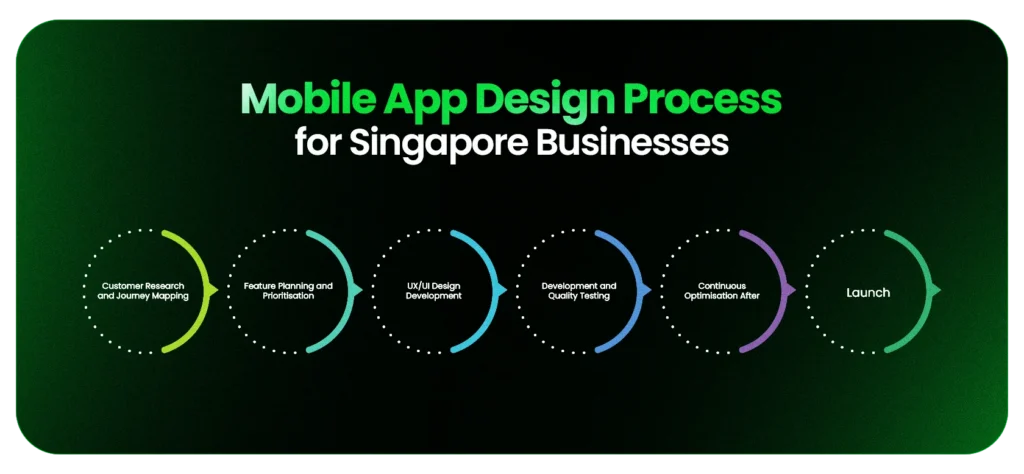
A successful app follows a structured build, not a rushed one. Businesses that skip research or testing tend to ship features nobody asked for.
Stage 1: Customer Research and Journey Mapping
Before development starts, a business needs to know who uses the app, which problems they face, and where delays happen. Journey mapping surfaces exactly where a mobile solution creates real improvement, and this stage is where discovery sprint work pays off most.
Stage 2: Feature Planning and Prioritisation
Businesses should separate essential features from optional ones and build a minimum viable product first. MVP development exists specifically to validate demand before a full feature set gets built out.
The practical steps behind MVP mobile app development apply just as much to a customer experience app as they do to a brand new product line.
| Development Phase | Recommended Features |
| MVP Stage | Core functions, account access, essential transactions |
| Growth Stage | Personalisation, loyalty features, automation |
| Advanced Stage | AI features, predictive tools, deeper integrations |
Stage 3: UX/UI Design Development
Design decisions should follow observed user behaviour, not assumptions. This stage includes wireframes, interactive prototypes, user testing, and accessibility review before a single line of production code is written.
Stage 4: Development and Quality Testing
Development teams focus on performance, security, device compatibility, and data protection, testing across real devices and operating systems rather than a single simulator.
Teams building with Flutter app development benefit from testing a single codebase across both platforms, which speeds up this stage considerably.
Running through device fragmentation, payment-flow edge cases, and other checks before launch is what solid mobile app testing strategies actually look like in practice.
Stage 5: Continuous Optimisation After Launch
Launch is a starting point, not a finish line. Businesses should track retention, feature adoption, feedback, and conversion after release, supported by ongoing post launch analytics and iteration rather than a one-time audit.
How Much Does Mobile App Development Cost in Singapore?
Cost depends on complexity, design depth, integrations, security requirements, and build approach. Businesses should size their investment against the outcomes they expect, not the other way around.
| App Type | Typical Development Range |
| Basic business app | SGD 25,000 – SGD 60,000 |
| Medium-complexity customer app | SGD 60,000 – SGD 150,000 |
| Advanced enterprise application | SGD 150,000+ |
A full mobile app development cost breakdown shows exactly how each factor above shifts the final number, which makes it easier to spot where a quote is padded and where it reflects real complexity.
Businesses working with a tight budget still have room to manoeuvre. Several practical ways to reduce mobile app development cost exist without cutting the features that actually matter to the customer.
| Factor | Cost Impact |
| Number of platforms | iOS and Android built separately increases effort |
| Custom design requirements | Premium UX needs more research and testing |
| Backend complexity | Advanced data systems need more development time |
| Third-party integrations | Payment, CRM, and analytics work adds scope |
| Security requirements | Compliance-focused apps need stronger protection |
The budget conversation should not stop at launch. Ongoing hosting, bug fixes, OS updates, and feature additions all add up, and businesses that plan for mobile app maintenance costs from the start avoid the common surprise of a shrinking budget six months after release.
A business should never choose a partner on the lowest quote alone. The right decision weighs technical capability, design quality, and long-term support together.
Measuring Mobile App Success Through User Experience Metrics
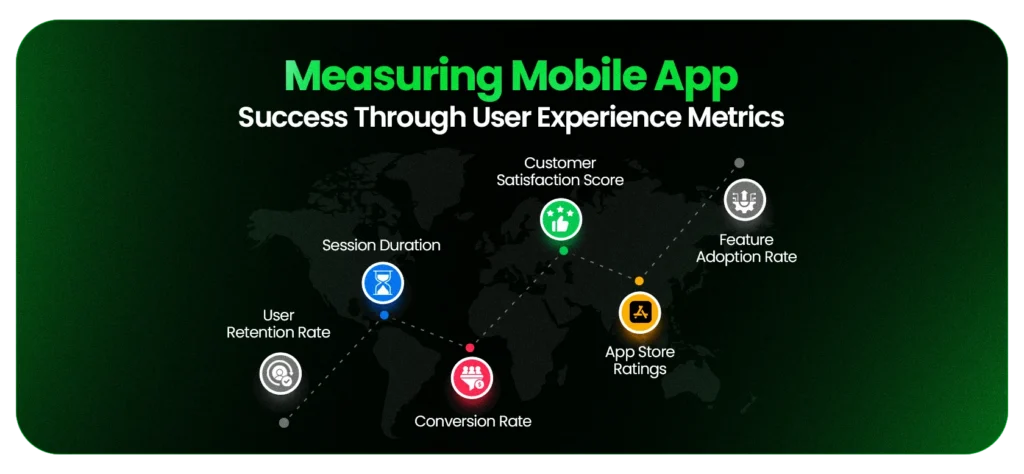
Downloads alone say very little about whether an app is working. Businesses need to track how customers actually use the product and whether it solves the problem it was built for.
| Metric | What It Measures |
| User retention rate | Whether customers keep using the app |
| Session duration | How effectively users engage with features |
| Conversion rate | How many users complete desired actions |
| Customer satisfaction score | User perception of service quality |
| App store ratings | Public customer feedback |
| Feature adoption rate | Success of newly introduced features |
Tracking these metrics consistently is also what feeds a stronger app store optimization strategy, since ratings and retention both influence how an app ranks in search results.
A high ranking on its own does not guarantee downloads, though. Real traction usually comes down to fundamentals like keyword placement and review volume, the same ground ASO strategies to increase your app store rankings walk through.
Metrics only matter once customers know the app exists. A retention-focused product still needs the right promotion behind it, and this is where effective marketing strategies for mobile apps turn a well-built product into one with real market traction.
Choosing the Right Mobile App Development Partner in Singapore
The partner a business chooses shapes the quality of the final product more than any single feature decision. Evaluation should go beyond price and portfolio screenshots.
A studio worth hiring builds more than code. That distinction- choosing a genuine partner over a vendor who just executes a spec- is really what how to choose the right mobile app development company comes down to.
| Selection Criteria | Question to Ask |
| Portfolio experience | Has the team built similar apps in this industry? |
| UX capability | Does the team run real user research and testing? |
| Technical expertise | Can they support future scale? |
| Security knowledge | Do they understand data protection requirements? |
| Post-launch support | Do they provide maintenance and optimisation? |
Once the build is ready to ship, the process is not quite finished. Getting the listing right the first time saves a team from a rejected submission or a rushed resubmission days before a launch date, one of the more avoidable headaches in publishing and updating an app on the App Store and Google Play.
Every operational decision on a build should trace back to one question: does this make the customer’s next step easier or harder?
— Areeb Rehman, COO, Inceptives Digital
From Friction to Loyalty: What This Guide Adds Up To
The businesses that get the most from mobile apps treat every stage in the first table, from discovery through loyalty, as a design requirement rather than a checklist item.
Onboarding that respects a customer’s time builds the trust that personalisation later depends on.
Self-service and commerce features remove the friction that used to send customers elsewhere, while notifications and accessibility choices decide whether that trust holds up over months of use.
None of this happens by accident. It comes from research, a structured build process, and continuous measurement after launch- the same five stages covered in the design process above.
Singapore’s mobile-first market rewards businesses that follow that discipline and quietly penalises the ones that skip it.
Build a Mobile App Experience Singapore Customers Trust
Work with a team that turns research, design, and engineering into an app customers actually keep using and recommending to others.
Start With a Product Launch StrategySingapore businesses invest in mobile apps because customers expect fast, convenient, and personalised digital interactions. Apps let companies offer self-service options, improve communication, and build stronger customer relationships than a website alone can support.
A mobile app improves customer experience by cutting unnecessary steps, speeding up access to services, personalising content, and letting customers complete tasks independently rather than waiting for support.
A basic app usually takes around three to six months. Advanced apps with custom systems, integrations, and complex features can take six to twelve months or longer.
The decision depends on target users and business goals. Many Singapore businesses build both platforms to reach a wider audience, while some start with one platform to validate demand first.
Essential features depend on the business model, but common ones include account management, secure payments, notifications, customer support, analytics, and personalised experiences.
Businesses improve app security through encryption, secure authentication, regular testing, access controls, and compliance with Singapore’s data protection requirements.


