


- Simple apps cost $40,000 to $80,000 and take 3 to 4 months.
- Mid-complexity apps cost $80,000 to $180,000 and take 4 to 7 months.
- Complex and AI-driven apps cost $180,000 to $500,000+ and take 7 to 15 months.
- Yearly maintenance adds 15% to 20% of the original build cost.
Planning mobile app development in San Francisco? Expect to budget $40,000 to $500,000+ in 2027, depending on what you build and who builds it.
Simple apps start near $40,000, while complex or AI-driven products climb past $500,000.
The cost for app development in San Francisco runs high because senior engineers command top salaries, agencies charge $150 to $250 per hour, and investors expect launch-ready products from day one.
Use this guide to set a budget before hiring a mobile app development company. It breaks down costs by app type, platform, and team model, plus hidden fees and savings tactics.
How Much Does Mobile App Development Cost in San Francisco in 2027?
Mobile app development services in San Francisco typically cost $40,000 to $500,000+ for a full build, and complexity, platform count, integrations, and compliance needs decide where your project falls.
| App Complexity | Typical Cost | Timeline | Example Features |
| Simple | $40K to $80K | 3 to 4 months | Login, profile, content feed, push notifications |
| Medium | $80K to $180K | 4 to 7 months | Payments, chat, third-party APIs, admin panel, analytics |
| Complex | $180K to $350K | 7 to 12 months | Real-time sync, multi-role access, advanced security |
| Enterprise or AI-driven | $350K to $500K+ | 9 to 15 months | Custom machine learning, large-scale infrastructure, compliance |
These ranges include design, development, QA, and project management from a US-based or US-led team. Offshore-only builds often cost 40% to 60% less, but then communication and quality risks rise.
Hourly rates explain most of that gap, since mid-sized San Francisco agencies bill $150 to $250 per hour and top studios can exceed $300.
For an early estimate, multiply total build hours by your blended hourly rate, then add a 10% to 15% buffer. Here is the math for a mid-complexity app:
- Build hours: 800, based on the estimated hours for each feature
- Base cost: 800 hours at $175 per hour equals $140,000
- Scope buffer: 15% adds $21,000
- Planning budget: $161,000
Why Does App Development Cost More in San Francisco Than Other US Cities?
San Francisco costs 30% to 60% more than most US markets because of talent competition, high living costs, and premium client expectations.
Local engineers also weigh agency roles against offers from large technology companies, so Bay Area rates sit above Austin and many other US cities, while New York comes closest.
Compare typical agency rates across regions:
| Region | Typical Hourly Rate | Cost for a Mid-Complexity App |
| San Francisco Bay Area | $150 to $250 | $120K to $220K |
| New York | $150 to $225 | $115K to $200K |
| Austin and Texas | $100 to $175 | $85K to $150K |
| US Midwest | $80 to $150 | $70K to $130K |
| Eastern Europe | $40 to $80 | $40K to $80K |
| South Asia | $25 to $60 | $30K to $65K |
Several local forces push prices up:
- Salaries: Senior mobile engineers in the Bay Area often earn $180,000 or more in total compensation.
- Competition: Apple, Google, Meta, and well-funded startups compete for the same talent pool.
- Overhead: Office space, payroll taxes, and benefits cost more than in nearly any other US metro.
- Standards: Venture-backed founders expect investor-ready design, security, and scalability from day one.
Higher rates do buy something real. Local teams overlap Pacific hours, join investor meetings, and understand the startup ecosystem around SoMa, Mission Bay, and the Peninsula.
Mobile App Development Cost by App Type
App type shapes budget more than any other choice. Fintech and AI apps cost the most, while content and SaaS companion apps cost the least.
| App Type | Typical Cost Range | Main Cost Driver |
| SaaS companion app | $60K to $180K | Sync with web platform |
| E-commerce or marketplace | $80K to $250K | Payments, catalog, two-sided logic |
| Social or community | $100K to $300K | Feeds, moderation, real-time chat |
| On-demand or delivery | $100K to $300K | Maps, dispatch, live tracking |
| Healthtech | $120K to $350K | HIPAA compliance, integrations |
| Fintech | $150K to $450K | Security, KYC, regulatory review |
| AI assistant or agent | $150K to $500K | Model integration, data pipelines |
San Francisco founders concentrate in fintech, healthtech, climate tech, and AI, where heavy compliance and infrastructure work pushes local budgets into the upper half of each range.
Match your idea to the closest row, then adjust for feature depth, since an e-commerce marketplace with escrow payments belongs near $250,000 while a simple listing app sits near $80,000.
Cost Breakdown by Development Phase
Development spending splits across seven phases, and mobile engineering takes the biggest share at roughly one-third. The table below shows a $150,000 mid-complexity build.
| Phase | Share of Budget | Cost on $150K |
| Discovery and strategy | 8% | $12,000 |
| UI/UX design | 12% | $18,000 |
| Mobile development | 32% | $48,000 |
| Backend and APIs | 23% | $34,500 |
| QA and testing | 12% | $18,000 |
| Launch and deployment | 4% | $6,000 |
| Project management | 9% | $13,500 |
Discovery looks optional, yet a structured discovery sprint saves the most money by preventing expensive rework in months four and five.
UI/UX design also pays for itself, because teams that test prototypes with five to eight real users before coding catch usability problems when fixes cost hours instead of weeks.
What Factors Affect Mobile App Development Cost?
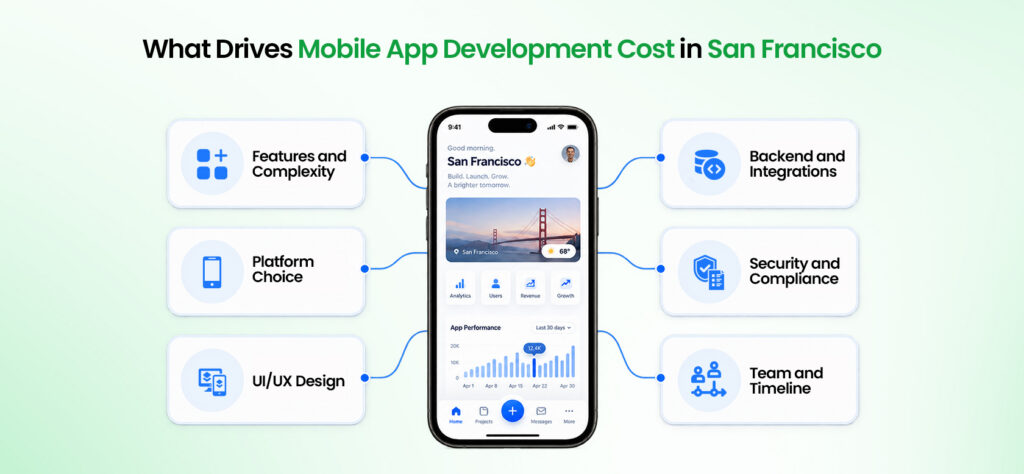
Eight factors set your final price: features, platforms, design, backend, integrations, compliance, team location, and timeline. Features and compliance usually move the number the most.
- Features and complexity: Every feature adds design, build, and test hours. Real-time chat alone can add $15,000 to $40,000.
- Platforms: iOS, Android, or both. Supporting two platforms raises cost by 40% to 80% without shared code.
- UI/UX design: Custom animations and brand systems cost more than standard component libraries.
- Backend and infrastructure: Cloud architecture, databases, and backend API development drive 20% to 30% of the build.
- Third-party integrations: Payments, maps, identity checks, and CRMs each add $3,000 to $20,000, depending on system and API integration complexity.
- Security and compliance: HIPAA, SOC 2, PCI DSS, and California privacy laws like CCPA and CPRA add audits and engineering time.
- Team location and seniority: Senior US engineers cost more per hour but often finish faster with fewer defects.
- Timeline pressure: Rush schedules require larger teams, and larger teams raise coordination costs.
Unplanned feature requests deserve close attention, since they can raise budgets by 20% to 30% without change control. Review the full factors affecting app development cost before you finalize scope.
Native vs Cross-Platform: Which Costs Less in San Francisco?
Cross-platform development usually costs 25% to 40% less than building two native apps, because Flutter and React Native share one codebase across iOS and Android, which cuts duplicate work.
| Approach | Mid-Complexity Cost | Best For |
| Native iOS only | $90K to $200K | Premium consumer apps, Apple-first launches |
| Native iOS and Android | $160K to $350K | Performance-heavy apps, hardware access |
| Cross-platform (Flutter, React Native) | $100K to $220K | Startups needing both stores fast |
| Progressive web app | $50K to $120K | Content and lightweight tools |
iPhone users hold a large share of the Bay Area market, so many San Francisco founders launch on iOS first, validate demand, and add Android once traction appears.
Native development performs better in specific cases. Apps that rely on advanced camera features, AR, heavy graphics, or deep Bluetooth control often need platform-specific code.
Choose cross-platform when speed and budget matter most. Choose native when performance and device features define the product, as our native vs hybrid vs cross-platform comparison explains.
How Much Does It Cost to Add AI Features to a Mobile App?
API-based AI features cost $15,000 to $60,000, while custom model development starts near $100,000, and most AI app development proposals in San Francisco now include this line item.
| AI Feature | Typical Build Cost |
| LLM chatbot or assistant (via API) | $15K to $50K |
| Recommendation engine | $25K to $80K |
| Voice interface | $30K to $100K |
| Computer vision | $40K to $120K |
| AI agent workflows | $60K to $200K |
| Custom model training | $100K to $300K+ |
Build cost covers only part of the total AI-native product development cost, since inference fees, vector databases, and monitoring tools add $500 to $10,000+ per month, depending on user volume and model choice.
Control AI spending with three practices:
- Start with hosted model APIs and validate demand with an AI MVP before training anything custom.
- Cache frequent responses and route simple tasks to smaller, cheaper models.
- Set usage limits and cost alerts from the first release.
Inceptives Digital applied this approach to WordSmith Pro, an AI writing assistant that pairs OpenAI APIs with LanguageTool grammar validation.
The team streamed suggestions in real time and shipped one React Native app for iOS and Android, supporting free, subscription, and enterprise plans in a single product.
Data quality matters as much as model choice, so budget 10% to 20% of AI work for data cleanup and avoid the common mistakes when building apps with AI.
Hidden Costs Founders Miss After Launch
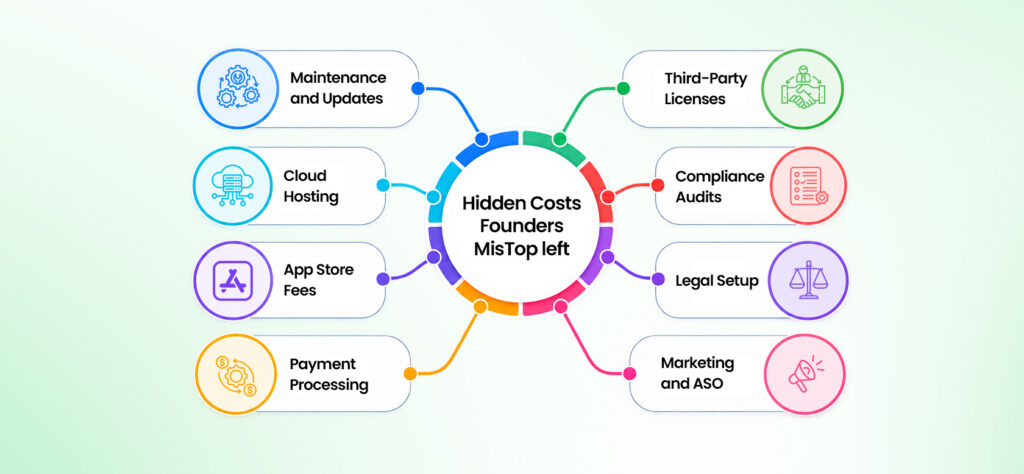
Post-launch expenses add 15% to 25% of your build cost every year. Founders who budget only for development are often surprised by the hidden costs in custom software development.
Plan for these recurring and one-time items:
- Maintenance and updates: Budget 15% to 20% of the build cost yearly for bug fixes, OS updates, and library upgrades. Our mobile app maintenance cost guide details each line.
- Cloud hosting: Costs range from $200 to $5,000+ monthly as users grow.
- App store fees: Apple charges $99 per year, and Google charges a $25 one-time fee.
- Payment processing: Stripe-style fees typically run 2.9% plus 30 cents per US card transaction.
- Third-party licenses: Maps, analytics, messaging, and identity tools often bill by usage.
- Compliance audits: SOC 2 or penetration testing can run $15,000 to $60,000.
- Legal setup: Privacy policies, terms of service, and CCPA readiness need attorney review.
- Marketing and ASO: User acquisition often outspends development within the first year, so budget early for app store optimization.
Apple’s Small Business Program cuts its commission to 15% for developers earning under $1 million yearly. Check eligibility early, since it directly improves margins.
In-House vs Freelancers vs Agency: Which Team Model Fits Your Budget?
Agencies suit most San Francisco startups because they deliver a full team without long-term payroll, while in-house development makes sense once the app becomes your core, long-term product.
| Team Model | Typical Cost | Speed | Main Risk |
| In-house SF team (5 people) | $700K to $1.2M per year | Slow to start | Hiring delays, high fixed cost |
| Freelancers | $30K to $120K | Variable | Coordination gaps, key-person risk |
| San Francisco agency | $80K to $500K | Fast | Higher hourly rates |
| Hybrid US-led and distributed team | $50K to $250K | Fast | Needs strong project management |
In-house hiring takes three to five months for senior roles in the Bay Area. Recruiter fees, equity, and benefits push the real cost well above base salary.
Freelancers work well for small, defined tasks. Complex products need design, engineering, QA, and product management working together, which freelancer networks rarely provide.
Hybrid models balance cost and control. A US-based product lead and architect guide a distributed engineering team, which often saves 30% to 45% against a fully local build.
Book a Free App Cost Consultation
Compare team models, refine scope, and finalize your budget with a strategist before development starts.
Book My Free Call!How to Reduce App Development Cost Without Cutting Quality
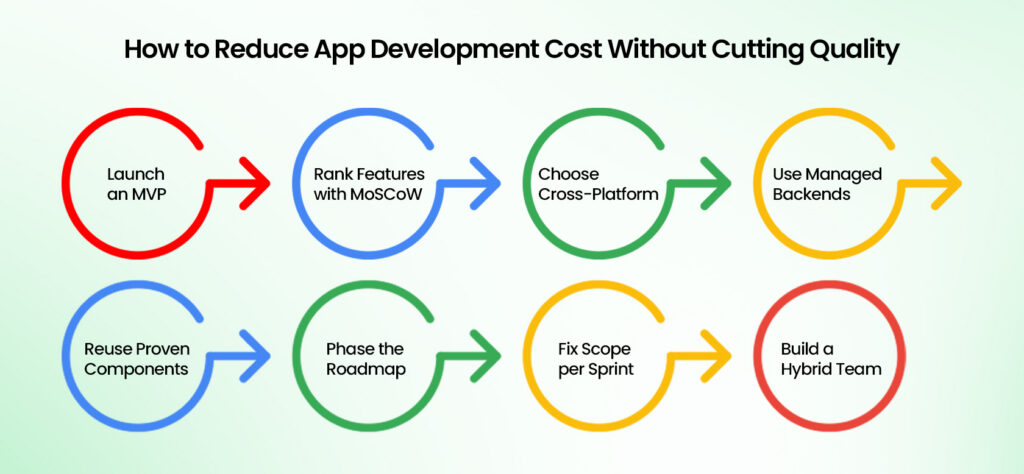
Building a minimum viable product cuts initial spend by 35% to 50%. Focused scoping, shared code, and managed services help reduce mobile app development cost while protecting quality.
Try these proven tactics:
- Launch an MVP. Release three to six core features through MVP development, test with real users, and expand using feedback.
- Rank features with MoSCoW. Label each item Must, Should, Could, or Won’t, then build only the Must list first.
- Choose cross-platform. One codebase serves both stores and halves duplicate engineering, and our Flutter vs React Native comparison helps you pick the framework.
- Use managed backends. Firebase, Supabase, and AWS Amplify replace weeks of custom server work.
- Reuse proven components. Authentication, payments, and analytics SDKs save hundreds of hours.
- Phase the roadmap. Release in quarterly stages so revenue and feedback fund the next round.
- Fix scope per sprint. Two-week sprints with clear acceptance criteria prevent budget overruns.
- Build a hybrid team. Pair a US-led strategy team with distributed engineers.
Avoid cutting QA or security to save money, because defects found after launch cost five to ten times more to fix than defects caught through solid mobile app testing strategies.
Sample App Budgets for San Francisco Startups
Three illustrative scenarios show how scope translates into dollars. Treat them as planning anchors, not quotes.
| Scenario | Scope | Budget | Timeline |
| Seed-stage marketplace MVP | iOS and Android via Flutter, listings, payments, chat, admin panel | $90K to $140K | 4 to 5 months |
| HIPAA telehealth app | Video visits, scheduling, EHR integration, encrypted storage | $180K to $300K | 7 to 9 months |
| AI fintech companion | Bank linking, KYC, AI insights, fraud alerts, SOC 2 prep | $250K to $450K | 9 to 12 months |
Each scenario excludes post-launch costs, so plan for these add-ons:
- Maintenance: 15% to 20% of the build cost every year
- Infrastructure: Cloud hosting that grows with your user base
- Growth: Mobile app marketing costs for user acquisition
Regulated builds such as the telehealth and fintech examples carry compliance work, which our guides to healthcare app development cost and the cost to build a fintech app break down.
Investors in San Francisco also ask for a 12-month cost model, so include build, maintenance, infrastructure, and acquisition costs to help your runway projections hold up in due diligence.
How to Choose a Mobile App Development Company in San Francisco
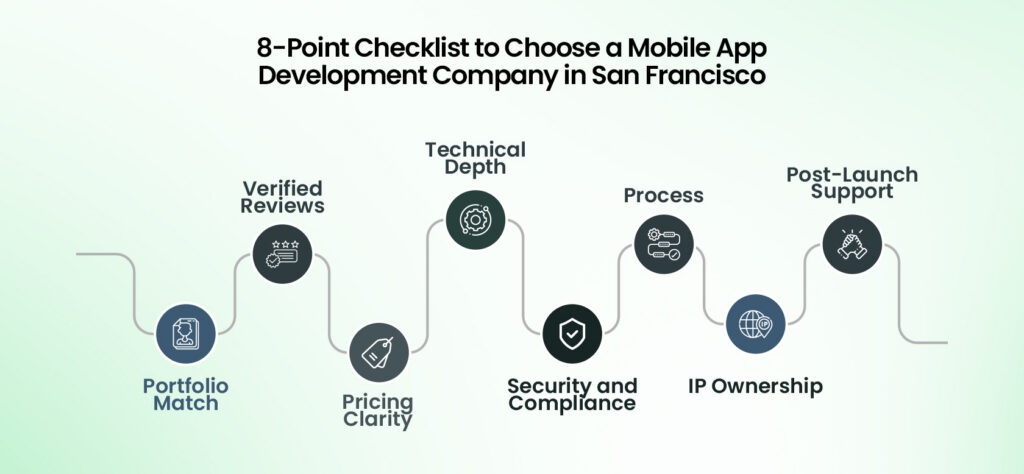
Choosing the right mobile app development company starts with relevant portfolio work, transparent pricing, and proven security practices, and strong partners explain trade-offs before you sign.
Use this checklist during vendor calls:
- Portfolio match: Look for shipped apps in your industry and at your scale.
- Verified reviews: Check Clutch, Google Business, and direct client references.
- Pricing clarity: Ask for itemized estimates, not a single lump sum.
- Technical depth: Confirm experience with Swift, Kotlin, Flutter, React Native, and your required cloud stack.
- Security and compliance: Ask about HIPAA, SOC 2, and CCPA experience, and compare answers with mobile app security best practices if your product handles sensitive data.
- Process: Look for discovery workshops, sprint demos, and weekly reporting.
- IP ownership: Your contract should assign all code and design rights to you.
- Post-launch support: Confirm maintenance plans and response times in writing.
Watch for these red flags:
- Quotes that arrive before any discovery conversation
- Prices far below market rates with no scope detail
- No references or case studies
- Vague answers about who writes the code
Request quotes from three to five vendors, then compare scope line by line. The cheapest proposal often omits testing, design, or support.
Conclusion
Mobile app development in San Francisco costs more than most markets, but the premium delivers speed, talent, and investor-ready quality.
Budgets run from $40,000 for simple apps to $500,000+ for complex products, which reflects the San Francisco premium over the typical mobile app development cost in other markets.
Disciplined planning keeps costs manageable, and four habits make the biggest difference:
- Define a tight MVP before you write code.
- Pick the platform strategy that fits your users.
- Budget for maintenance from day one.
- Choose a partner who itemizes every line.
Founders who validate their mobile app idea early spend less and learn faster, so start with discovery, finalize scope, and let real user data guide every funding decision.
Start Your San Francisco App Project Today
Request a detailed quote and turn your app idea into a launch-ready product this year.
Request My Quote!Frequently Asked Questions About Mobile App Development Cost in San Francisco
Most projects cost $40,000 to $500,000+ in 2027. Simple apps start near $40,000, mid-complexity apps average $80,000 to $180,000, and complex or AI-driven products exceed $180,000.
Expect 3 to 4 months for simple apps and 7 to 15 months for complex builds, and a realistic app development timeline also includes two to six weeks of discovery.
Yes. A hybrid team can build an MVP with three to five core features for $35,000 to $50,000, which keeps MVP development cost within a seed-stage budget.
Freelancers cost less upfront, often $30,000 to $120,000. Agencies charge more but supply design, QA, and project management, which lowers rework and delivery risk on larger projects.
Budget 15% to 20% of the original build cost. A $150,000 app typically needs $22,500 to $30,000 yearly for updates, fixes, and OS compatibility.
API-based AI features cost $15,000 to $60,000. Custom model training starts near $100,000, and monthly inference costs range from $500 to $10,000+.
Flutter app development typically costs 25% to 40% less than separate iOS and Android builds, although savings shrink when the app needs heavy platform-specific features.














CEO Insight:
“Development makes unclear decisions more expensive to reverse, that is why we challenge the product before we estimate the build.”
— Hannan Shahnoor, CEO at Inceptives Digital